

Number Match: Train your brain review
 Analysis by Appsdrops
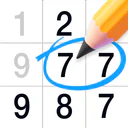
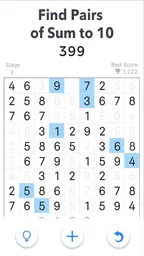
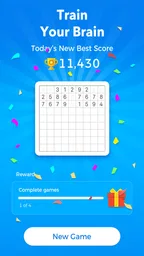
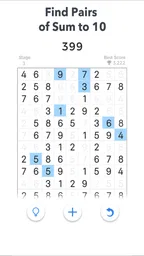
I like number puzzles best when I can understand the rules quickly, then decide for myself how much concentration to give them. Number Match: Train your brain has that pick-up-and-play appeal: its central challenge is to find pairs and combinations that make ten, while working through logic and math puzzles. It is a free trivia game from Greyfun Games, and its appeal is less about a story or a sprawling collection of modes than about giving your attention a small, concrete job.
That simplicity makes it easy to try during a quiet break, but the more useful question is whether a matching puzzle can keep earning a place on your phone once the initial novelty wears off. My view is that this game suits people who enjoy scanning a number grid and weighing a few possible moves. It is less compelling if you need a steady stream of different activities, a social competition, or a detailed progression system to keep you returning.
Why the first sessions are easy to start
The basic idea is straightforward enough to grasp without treating the game like a lesson. You look for numbers that can be paired to make ten and use logic to decide which matches are worth taking. That quick entry matters: on a short break, I would rather begin solving than spend several minutes learning a complicated control scheme.
The first stretch is naturally helped by the pleasure of spotting a match. A board full of numbers invites a quick scan, and a promising pair gives you a reason to pause and check the surrounding choices. This is not the same kind of instant reward as a reflex game. The satisfaction comes from noticing a useful move and seeing whether it improves the puzzle rather than from speed or spectacle.
One practical habit makes the game more enjoyable: scan the whole visible arrangement before committing to the first pair that catches your eye. It is tempting to take an obvious match immediately, but a different move may leave a more useful pattern behind. Treating each choice as a small planning decision helps the puzzle feel thoughtful rather than like a repetitive tapping exercise.
That approach also suits different energy levels. When I have only a minute, I can focus on a simple match. When I want a more deliberate challenge, I can slow down and think about how a move affects the remaining numbers. The game’s number-focused premise makes that shift in pace feel natural, even though it does not turn the experience into a broad collection of unrelated puzzle types.
There is a useful distinction between arithmetic confidence and puzzle skill here. Knowing that two numbers make ten is only the entry point; choosing which pair to remove is where attention and planning come in. If you enjoy spotting patterns, the logic element can provide more satisfaction than the sums themselves. If you are looking for advanced mathematics, though, this is not the same as a course or a deep calculation challenge.
The game is available to players rated Everyone, which makes its basic number-puzzle concept approachable for a wide audience. I would still think about the intended player rather than assuming that a general age rating makes every puzzle equally suitable or engaging for every child. A younger player who enjoys number patterns may find it inviting; someone who dislikes quiet, repetitive reasoning may not.
What keeps it useful after the novelty
A simple puzzle can be a dependable habit if it fits into moments that already exist in the day. I can imagine opening this one while waiting for a friend, sitting through a short journey, or taking a pause between tasks. Those situations favour a game that asks for attention without demanding that I learn a long sequence of controls before I can play.
The strongest recurring value is the mental routine: look, compare, choose, and reassess. That loop can be satisfying when I want a small focus reset, especially after time spent switching between messages or other distractions. It is not a replacement for a substantial strategy game, but it can serve a different purpose: a contained puzzle that gives a brief break some shape.
For a more thoughtful session, I would avoid playing on autopilot. Before each move, ask whether the pair is merely available or actually helpful. This tiny pause makes the board feel more like a logic problem and less like a checklist. It is a practical way to get more from the core mechanic without inventing extra rules or treating every round as a race.
There is also a useful stopping point built into the nature of the activity. Once I have solved enough puzzles for the moment, I can put it down without feeling that I have abandoned a story at a cliffhanger. That makes it a reasonable choice for people who want a game they can visit briefly. The trade-off is that players who depend on narrative hooks, character development, or a strong sense of unlocking new content may find less reason to return.
Among familiar alternatives, Number Match occupies the quieter end of the puzzle spectrum. Compared with word trivia, it asks for number recognition and spatial scanning rather than recall of facts or vocabulary. Compared with fast arcade games, it gives more room to think and less emphasis on reaction. Those are meaningful differences, but they also define its limits: if you want varied question topics or energetic action, a different genre will likely be a better fit.
Greyfun Games is the developer behind the game, and the available version is 1.13. Those details matter most as basic context when deciding whether to try it; the lasting appeal depends more on whether this particular matching rhythm suits you. The game is free, which lowers the barrier to sampling it, but a free download alone cannot make a repetitive puzzle enjoyable if its core loop is not your kind of pastime.
Keeping the game in rotation without turning it into a chore
The maintenance burden appears modest in the everyday sense: this is a focused number puzzle, not an app that asks me to manage a complicated virtual world. Its small scope is a strength when I want something uncomplicated. It also means that the game’s value rests heavily on the quality of the repeated puzzle activity, rather than on a separate system that might keep each visit feeling different.
To make it last, I would use it intentionally rather than opening it every time I have a spare second. A short session during a predictable pause is more likely to feel refreshing than repeatedly checking in out of habit. If I notice that I am tapping matches without considering them, that is a good sign to take a break; the point of this kind of game is the attention it asks for, not merely keeping the screen busy.
A second useful adjustment is to match the session to your mood. Choose a quick round when you want a light distraction, and save more careful play for a moment when you can concentrate. Trying to force a demanding logic session into a noisy commute or while multitasking can make a simple puzzle feel irritating. Conversely, if you are looking for a deep challenge to occupy a long evening, the compact premise may leave you wanting more variety.
The main source of fatigue is easy to identify: the central action does not change its basic character. Pairing numbers and planning around the board can be absorbing, but repeated sessions may begin to feel alike if you want new mechanics, changing themes, or a sense of progression. That is not a flaw for everyone. Some players actively prefer a reliable puzzle they can return to without relearning it; others need novelty to stay interested.
Another possible friction point is the difference between a relaxing break and a mentally engaging one. The game is approachable, but it still asks you to pay attention to the numbers and think about choices. If you want something you can leave running while your focus is elsewhere, this is not the strongest match. A passive audio app or a simple idle game would suit that moment better. If you want an active but low-pressure task, the puzzle format makes more sense.
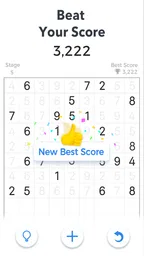
Its audience response gives some context without deciding whether it will fit an individual player: the game has a 5.0 average from around 2.6 thousand ratings, and more than 100 thousand installs. I take that as evidence that people have found the basic concept worth trying, not as a promise that every session will stay fresh. Ratings cannot tell me whether a particular player enjoys repeated number matching, so I would use the free entry point to judge that for myself.
The release date was November 28, 2023, and the game requires Android 6.0 or later. That makes device compatibility worth checking before installing, especially on an older phone. Its content rating is Everyone, which reinforces its broad accessibility, while the game’s actual appeal still depends on a more personal question: do you enjoy working through number patterns at your own pace?
Who should keep it, and who should move on
I would recommend Number Match: Train your brain to someone who likes compact logic puzzles, wants a free game for short breaks, and finds satisfaction in planning a small sequence of number matches. It is particularly well suited to people who enjoy a calm alternative to trivia quizzes that test general knowledge or action games that demand quick reactions. The most rewarding way to play is to think about the board before each move and stop when the exercise no longer feels engaging.
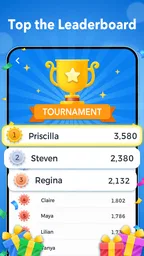
I would skip it if I were seeking a steady rotation of very different challenges, a competitive reason to return, or a game whose appeal grows through a substantial narrative. Those preferences are not problems the number-matching premise can solve. A broader puzzle collection would be a better choice for variety; a conventional trivia game would fit someone who wants questions about many subjects rather than a focused arithmetic-and-logic loop.
Overall, I see it as a useful occasional companion rather than an automatic daily fixture. The first sessions are easy to enter, and the game can continue to earn space when a short, attentive puzzle is exactly what I want. Its long-term value depends on accepting repetition as part of the design. If that steady rhythm feels comforting, it may stay in your rotation; if you need frequent novelty, the initial appeal is likely to fade. My advice is simple: try it during a genuine spare moment, play thoughtfully, and keep it only if the matching itself remains satisfying.
What we like
- Simple rules make it easy to start playing.
- Short rounds fit well into brief breaks.
- Multiple ways to find matching number pairs add variety.
- The undo option helps recover from a mistaken move.
- Offline play makes it usable without an internet connection.
What could be better
- Some boards can require repeated attempts to solve.
- Hints may make challenging puzzles feel less rewarding.
- Large numbers of levels can make progression feel repetitive.
- Small number tiles may be difficult to tap on compact screens.
- Ads can interrupt play between puzzles.







