
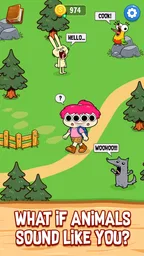




My Talking Animal 2 review
 Analysis by Appsdrops
I would judge a game like My Talking Animal 2 not only by whether it is cute, but by how comfortably different people can actually spend time with it. Its premise brings together animal collecting, zoo building, and idle-tycoon progression, which sounds welcoming at first glance. In practice, the important question is whether those activities feel easy to follow, manageable to control, and enjoyable in the situations where someone might want a light game rather than a demanding challenge.
This is a free music-category game from Finger Rhythm, with an Everyone age rating. It has an average rating of 3.3 from around 125 ratings, and more than 100,000 installs. Those figures suggest some interest, but not a strong consensus. I would treat them as a reason to approach it with modest expectations, not as a verdict on whether its animal-focused style will suit you.
How readable and easy to navigate is the zoo?
The central loop is easy to understand in broad terms: build a zoo, gather animals, and let the management side grow over time. That gives the game a clear identity for younger players and for anyone who prefers visible, gradual progress over complicated objectives. The animal-collection theme also gives a natural reason to return: you can think about what to add next rather than needing to remember a long story or a demanding sequence of tasks.
Still, a simple premise does not automatically mean every screen will be equally clear. In an idle tycoon, the useful information is usually the information that helps you decide what to do next: which action advances the zoo, what a collected animal contributes, and whether waiting or actively managing is more worthwhile. I recommend taking a moment at the beginning to inspect the available controls and labels instead of tapping through quickly. That small pause can make a collection-and-building game less confusing, especially for a child playing without an adult beside them.
Because the game is built around accumulating animals and expanding a zoo, it may appeal to players who enjoy organizing a growing collection. A practical way to keep the experience legible is to set one goal per short visit: focus on a particular addition or on the next visible step in development, rather than trying to optimize the whole zoo at once. This is a useful habit in idle games because it turns an open-ended progression loop into a series of manageable decisions.
The current version is 1.0.4, and the game is listed for devices running version 7.1 or later. That makes checking a device’s operating system a sensible first step before downloading. The version number alone does not tell me how the interface behaves on every screen size, so I would also recommend testing whether the text and interactive elements are comfortable to read and reach on the device you plan to use.
What the idle format asks of your attention
Idle progression is often attractive because it can suit players who do not want to stay focused for a long session. Here, the zoo-building theme gives that format a concrete payoff: returning to a growing collection can feel more satisfying than watching an abstract counter rise. The trade-off is that idle games can make progress feel slow when you want a direct, immediate challenge. If you prefer rhythm play, precise timing, or a level-based game with a clear finish, this may not scratch the same itch despite being categorized as a music game.
I would approach the game as a casual collection and management experience rather than assume that its category means it plays like a conventional music or rhythm title. Its own summary centers on animals and an idle zoo, so that is the safer expectation to bring. For someone choosing between it and a familiar rhythm game, the deciding factor is whether they want gradual collection and growth or music-led timing challenges.
Motor and sensory comfort in everyday play
A zoo-building game can be easier to approach than a game that depends on rapid reactions, because the basic appeal is growth and collection rather than competition. That does not prove that every interaction is slow or effortless, however. I would pay attention to how often the game asks for repeated taps, how comfortably buttons can be reached, and whether a player can pause between decisions. Those are practical checks for anyone with limited dexterity, hand fatigue, or a preference for a calmer pace.
One helpful approach is to play in brief sessions at first. That lets you notice whether repeated interactions feel comfortable before the game becomes part of a longer routine. If a child is playing, an adult can sit with them for the first visit and see whether the main actions are understandable without constant correction. This is not a special accessibility mode; it is simply a low-effort way to identify whether the game’s actual controls match the player’s needs.
Sensory comfort deserves the same attention. Cute animals and a lively presentation can be appealing, but players vary in how they respond to motion, sound, bright effects, and busy screens. I would begin with the device volume at a comfortable level and observe whether the presentation feels relaxing or distracting. If the player is sensitive to movement or visual clutter, a short trial is more useful than assuming that a friendly theme will automatically feel calm.
There is also a meaningful difference between a game that is easy to understand and one that is easy to use for everyone. A child may grasp the idea of collecting animals yet still need help locating the next action. Someone with low vision may find small interface text tiring even if the overall concept is straightforward. I would not recommend judging suitability by the animal theme alone: the player should be able to see the relevant choices and make them without strain on their own device.
Using it around other parts of the day
The idle-tycoon framing makes this a plausible game for a short break: a player can check in, make a small bit of progress, and put the device away rather than commit to a long match. A realistic example is a family waiting for an appointment. A child who likes animals could spend a few minutes tending to the idea of a growing zoo, while an adult nearby can help interpret any confusing screen. That is a better fit than expecting the game to keep someone occupied for an entire wait without support.
It may also work as a low-pressure option at home when a player wants to return to the same collection over several brief sessions. The useful trade-off is that gradual progress can make stopping easier than a game built around competitive rounds, but it can also make the experience less satisfying for someone who wants a complete task in every sitting. If a player becomes frustrated by waiting or by repeating actions, a puzzle game with self-contained stages may be a better choice.
For shared play, I would avoid assuming that two people can easily manage the same zoo together. The theme may invite conversation about favorite animals, but the game’s basic premise is not enough to establish a cooperative mode. A more reliable way to enjoy it as a family is to take turns looking at the collection and discussing what to aim for next, while treating that as social play around the game rather than a feature the game necessarily provides.
Where the experience may still be a poor fit
The clearest limitation is expectation. The title and category might lead some players to expect a talking-pet experience or a music game, while the game’s stated focus is a zoo that grows through animal collection and idle management. If you want a musical challenge, a pet that responds through conversation, or a tightly structured story, I would choose an option designed around that specific activity instead.
Another potential barrier is the open-ended nature of tycoon progression. Players who enjoy setting their own priorities may appreciate having a zoo to develop, but people who rely on explicit, step-by-step goals can find an open management loop less reassuring. If the next useful action is not obvious, the game may require patience and experimentation. For a younger player, it is worth checking whether they can make sense of the choices without feeling that every session turns into an adult-led lesson.
Attention and energy matter too. A player who wants a quiet game may still find a lively animal presentation distracting, while someone seeking strong stimulation may find incremental growth too gentle. I would test the game in the environment where it is actually meant to be used: on the intended device, at the intended volume, and for a few minutes at a time. That is more informative than judging it from its premise alone.
Its average rating of 3.3 is a middling signal rather than a promise of either quality or disappointment. With only a modest pool of ratings, I would focus more on whether the particular mix of collecting and idle growth suits the intended player. Since it is free, trying it may be a reasonable way to answer that question, provided you are comfortable evaluating the experience directly and not expecting every detail to match a different animal or music game.
My inclusive verdict
I see My Talking Animal 2 as a potentially approachable choice for players who enjoy cute animals, gradual collection, and the idea of growing a zoo at their own pace. Its theme is easy to explain, and the idle-management angle gives it a reason to revisit without demanding that every session become a major event. I would especially consider it for a child or casual player who likes collecting and can comfortably navigate the game on their device.
I would be more cautious if the player needs highly legible text, minimal sensory activity, very simple one-tap controls, or clearly bounded tasks. Those needs cannot be judged from the premise, so a short, supervised first session is the most practical test. If the screen feels tiring or the controls cause frustration, switching to a simpler collection game or a structured puzzle is a better decision than trying to push through.
Overall, the game’s strongest inclusive quality is the low-pressure idea of developing an animal collection rather than competing against other players. Its biggest question is whether the actual interface and pace feel comfortable for the person holding the device. Finger Rhythm’s version 1.0.4 is free to try and has an Everyone rating, but neither fact guarantees a perfect fit. I would recommend it selectively: give it a chance if zoo-building sounds appealing, and move on if you need a more direct music challenge, a clearer sequence of goals, or a calmer and more accessible presentation.
What we like
- Simple touch controls make it easy for younger players to explore.
- Animal reactions add a playful touch to everyday interactions.
- Short activities suit quick play sessions.
- Character customization gives players room to personalize their pet.
- The familiar virtual-pet format is easy to understand.
What could be better
- Frequent ads may interrupt play.
- Some features may require in-app purchases.
- Gameplay can feel repetitive after extended sessions.
- The app may need an internet connection for certain features.
- Younger children may need help with purchase settings.







