

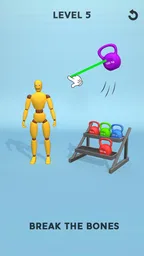

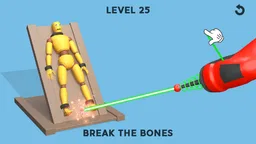
Kick & Break The Ragdoll Games review
 Analysis by Appsdrops
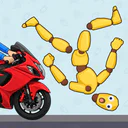
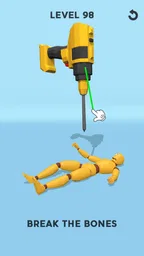
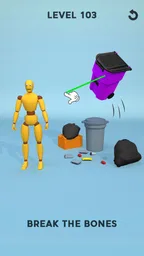
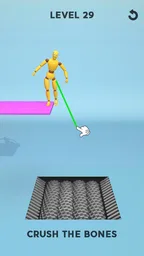
I see Kick & Break The Ragdoll Games as a quick, deliberately silly simulation rather than a deep physics sandbox. Its appeal is easy to understand: you interact with a ragdoll and turn clumsy impacts into a moment of comic release. That makes it a natural choice for a short break when I want something tactile and undemanding, not a game that asks me to learn a long set of rules before I can enjoy it.
That narrow focus is also the key to deciding whether it suits you. If you like playful slapstick and the simple satisfaction of making a character tumble, it has an immediate premise. If you want careful construction, realistic physics experiments, a story, or steadily demanding challenges, I would look elsewhere. The game’s best use is a few casual minutes at a time, with expectations set accordingly.
Choosing how to play with the chaos
The central decision is less about mastering a complicated system and more about how you approach each interaction. You can treat the ragdoll as a target for comic impact, or slow down and see what different actions and timing do to the resulting movement. That small choice changes the feel: quick play is a stress toy, while deliberate play is a lightweight experiment in cause and effect.
I find it helpful to resist tapping randomly from the start. Try one action, watch how the character reacts, then vary your next attempt rather than changing everything at once. This gives each result a little more meaning and makes the physics feel less like visual noise. It is a simple habit, but it can turn a few repetitive moments into a more satisfying sequence of tests.
The game belongs to the simulation category, though it is not the sort of simulation I would pick for realistic management or detailed world-building. Its focus is immediate physical comedy. Compared with a conventional physics sandbox, where players may build elaborate setups or shape a scene, this is a more direct, compact form of interaction. Compared with a puzzle game, it puts less emphasis on finding one correct solution and more on enjoying the reaction.
That distinction matters if you are deciding what to install. Someone who wants a thoughtful puzzle to solve on a commute may prefer a game with defined stages and clear goals. Someone who wants to open a game, make a few ridiculous things happen, and close it again may be better served here. I would not judge it by how much long-term structure it offers; I would judge it by whether its moment-to-moment feedback stays amusing for you.
Small experiments make each session feel less random
One practical way to get more out of it is to give yourself a tiny challenge before you start: see whether you can produce a different-looking reaction from the last attempt, or pay attention to how an action’s timing affects the ragdoll’s movement. These are personal goals, not formal objectives, but they make the session feel more intentional without asking the game to be something it is not.
There is a trade-off. Repeating an interaction can be funny at first, but the novelty may fade if you expect every attempt to open up a new layer of play. I recommend treating variation as the entertainment rather than assuming there is a hidden progression to uncover. When the results stop surprising you, taking a break is likely more satisfying than trying to force a deeper game out of a deliberately simple premise.
When the payoff is worth the repetition
The reward is immediate amusement, and the risk is that the same basic joke can wear thin. That balance makes the game especially suited to brief sessions. I can imagine opening it after a frustrating stretch of work, spending a few minutes watching the ragdoll flop around, and then returning to what I was doing. It is a low-commitment way to change gears, not a substitute for a longer game night.
For that everyday use, I would keep expectations modest and sessions short. A quick visit lets the exaggerated movement do its job before repetition becomes noticeable. If I were already tired of slapstick or wanted a calming activity with minimal visual commotion, I would skip it that day; a quiet puzzle or a straightforward idle game would be a better fit. “Stress relief” is personal, and comic impacts that make one player laugh may feel noisy or monotonous to another.
Another useful trade-off is control versus spontaneity. The fun comes partly from watching an outcome unfold, so not every result will feel finely directed. If you enjoy unpredictable physical comedy, that looseness is the point. If you prefer precise inputs and a consistent response every time, the same looseness may feel frustrating. I would approach each attempt as a playful test rather than expecting it to behave like a competitive action game.
It is also worth considering where you plan to play. The premise suits short idle moments, but it is not an especially strong choice when you need a game that rewards sustained concentration or can occupy a long session with varied tasks. I would pick it while waiting or taking a small mental break, then switch to something with more layers when I have a longer stretch of free time.
How to adapt when the joke starts to repeat
If the first few interactions feel entertaining but the next ones blur together, change your approach before deciding the whole game has run its course. Slow down, watch one reaction closely, and make a single adjustment in the next attempt. That simple comparison can restore a sense of discovery. If it still feels repetitive, that is useful information: this is probably a brief diversion for you, not a game that will hold your attention every day.
I would also avoid turning the experience into a test of endurance. There is little value in continuing after the core interaction stops being funny. The game works best when you let its physical comedy provide a quick burst of novelty. A short session that ends while you are still amused is a better outcome than a long one that leaves you bored with the same gag.
For younger players or anyone choosing a casual game for a shared device, its Everyone age rating is relevant. The game is free, which makes trying that simple premise easy, but free access does not automatically make it a good match for every player. I would still base the decision on whether slapstick ragdoll play sounds enjoyable, especially if the person playing prefers gentler or more structured activities.
What the numbers suggest—and what they cannot decide for you
Game District LLC developed the game, which has an average rating of 4.6 from around 353,000 ratings. It has also passed 100 million installs, a sign that its straightforward idea has reached a large audience. Those figures are encouraging if you want a familiar, widely tried casual game, but they cannot predict whether you personally will enjoy repeated ragdoll antics. The style is specific enough that your taste matters more than popularity.
The listed release date is January 14, 2024, and the current version is 11.2.0. It is free and requires Android 7.0 or later. Those details make the basic compatibility and cost decision simple for Android users: check that your device meets the requirement, then decide whether the game’s particular kind of humor appeals to you. The figures are useful context, not a reason to expect a complex simulation or a lasting progression system.
Does it have enough depth to return to?
For me, the depth is in how I choose to play, not in a long strategic horizon. You can experiment with timing and compare reactions, but I would not approach it expecting a broad campaign or a layered management challenge. That makes it easy to pick up without preparation, while also placing a natural limit on how long it may stay fresh.
There is a small planning choice even in a casual game like this: decide whether you want an instant laugh or a few minutes of experimentation. If you want the first, keep moving and enjoy the absurd motion. If you want the second, change one thing at a time and pay attention to the outcome. The latter gives you more to notice, but it will not transform the game into a detailed physics workshop. Knowing that boundary helps avoid disappointment.
Compared with other simulation games, this one is firmly on the quick-play side. A management simulation usually rewards planning across multiple decisions; a sandbox often gives you room to build and shape elaborate situations. Here, the pleasure is more immediate and less demanding. I would choose it over those alternatives when I want low-effort comic play, and choose them instead when I want a project, a persistent goal, or a system that keeps unfolding over time.
The main limitation is therefore not a flaw that can be solved by playing differently; it is a question of fit. Anyone who needs a strong sense of advancement may find the central interaction too narrow. Anyone who enjoys slapstick, likes watching physical reactions, and is happy with short bursts may find that narrowness refreshing. I would not recommend it as a universal pick, but I can see why a simple premise like this attracts a broad casual audience.
My verdict: a good break, not a long-term plan
I would recommend Kick & Break The Ragdoll Games to a friend who wants a free, light simulation built around physical comedy and quick experiments. It is at its best when you approach it with a small amount of curiosity, enjoy the ragdoll’s unpredictable movement, and stop before repetition takes over. The experience does not need a complicated goal to work; it needs the right mood and a player who likes this kind of silly interaction.
I would point a friend toward another game if they wanted precise control, substantial progression, careful puzzles, or a calmer way to unwind. For those players, the simplicity that makes this one easy to start may also make it easy to leave. My honest recommendation is to treat it as a short comic diversion rather than a game to build a routine around. If that is what you are looking for, it does its job; if you want more strategic depth, choose a simulation with a broader set of decisions.
What we like
- Simple controls make it easy to start playing.
- Short rounds suit quick breaks.
- Ragdoll reactions add slapstick appeal.
- Different attacks can keep encounters varied.
- The game works well as a casual time-killer.
What could be better
- Gameplay may feel repetitive after a while.
- The ragdoll physics can be unpredictable.
- Progress may depend on repeated play.
- Ads may interrupt the experience.
- The game offers limited depth for long sessions.







