


Teacher Simulator: Exam Time review
 Analysis by Appsdrops
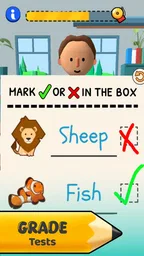
Teacher Simulator: Exam Time turns the classroom into a string of small, comic tests of attention and judgment. I found its appeal less in pretending to teach a full lesson and more in the quick fantasy of keeping a lively room under control: notice what is going on, decide what deserves action, and try to get through the day without missing the obvious. If you like light simulation games with a clear setting and short bursts of activity, it has an immediately understandable hook.
From classroom chaos to a clear first goal
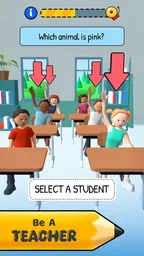
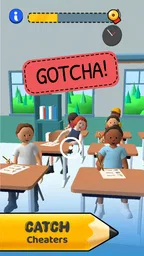
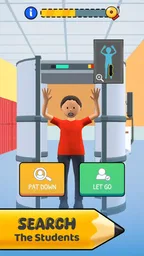
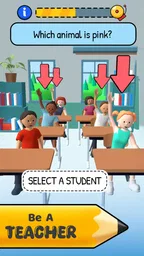
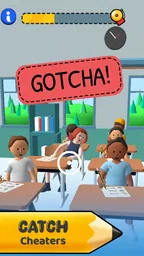
The game’s premise is easy to grasp even if you have never played a teacher-themed game before. You are placed in a school environment where students may be misbehaving or trying to cheat, and your job is to respond. That gives each moment a readable purpose: look around, spot the problem, and act. I appreciate that the fantasy is specific rather than abstract. The classroom itself makes the stakes legible, so you do not need a long explanation to understand why you are paying attention.
The early appeal comes from learning to observe before acting. A student’s behavior is the clue, while your response is the decision. That rhythm gives the opening stretch a simple goal to chase: become quicker at noticing what is happening and keep the class moving. It suits casual sessions because I can pick it up without first studying a complicated set of rules or remembering a long campaign.
There is a useful distinction between the game’s comic premise and a serious classroom simulator. This is a playful take on school authority, not a detailed model of lesson planning, grading, or the everyday work of an educator. I would recommend it to someone who wants a silly role-play setup and easy-to-read challenges, not to a teacher looking for a realistic professional tool or a thoughtful simulation of classroom management.
Progress that feels like recognition, not a report card
In a game built around catching problems, progress is most satisfying when I can feel myself reading the room better. The strongest feedback is the immediate connection between noticing something and responding to it. Rather than asking me to master a large collection of menus, the core fantasy keeps the focus on attention and judgment. That is a good fit for mobile play, where a small, comprehensible task often works better than a long sequence of setup screens.
Unlocks and advancement can help a casual game feel like it is going somewhere, but they are not automatically a reason to keep playing. Here, I would treat new progress as a bonus around the central classroom loop, not as a substitute for it. The key question for a new player is whether the act of watching students and making quick decisions stays amusing after the novelty of the premise fades. If that basic loop clicks for you, seeing the next bit of progress can be a pleasant nudge; if it does not, an unlock alone is unlikely to change your mind.
One practical way to get more out of a session is to treat each situation as a small observation exercise instead of rushing through it. Take a beat to scan the classroom, then decide what actually needs attention. That habit makes the teacher role feel more coherent and reduces the sense that you are simply tapping at whatever appears first. It also helps you judge whether the game’s pace suits you: some players enjoy rapid reactions, while others prefer a slower, more deliberate puzzle.
Challenge and pacing: quick decisions, limited depth
The central challenge is accessible, but it depends on paying attention. A game about cheaters and unruly students naturally invites you to look for telltale behavior, and the satisfaction comes from connecting what you see with what you should do. I find that more engaging than a simulation in which progress is only a matter of waiting or repeatedly pressing the same button. The classroom context gives even a simple action a bit of character.
At the same time, this is not the place I would go for a deep strategy system or a demanding management challenge. Its premise points toward short, immediate encounters rather than the long-term planning found in more elaborate simulation games. If you want to build a school, manage staff, balance budgets, or shape a detailed story over many hours, a broader management sim will serve you better. Teacher Simulator: Exam Time is more appealing when you want a playful task you can understand at a glance.
The pacing is best approached in short sessions. The quick classroom premise makes it easy to play during a break, while the repeated act of spotting misconduct may feel familiar if you stay for a long stretch. I would not expect the same kind of escalating complexity that a layered strategy game uses to keep every hour distinct. Instead, the attraction is the compact loop: observe, react, and see how the moment turns out. That makes it convenient, but also means that players who need constant mechanical change may tire of it sooner.
Who will enjoy the school setting—and who should pass
I can see this working well for someone who likes lighthearted mobile simulations, enjoys a playful authority role, or wants a game that does not demand a large time commitment before its premise makes sense. It may also appeal to younger players who enjoy school humor, though the content rating is Teen, so families should check that rating against the player’s age and preferences rather than assuming the classroom theme makes it suitable for everyone.
A realistic everyday use case is a short wait between errands or a few minutes before switching to another task. You can settle into the teacher role, focus on the room, and stop when you have had enough without needing to keep track of a complicated story. The game is free to download, which lowers the barrier to trying it, but it also includes in-app purchases priced from $1.99 to $14.49 per item. I would decide whether the core play is enjoyable before spending anything; a purchase makes little sense if the basic classroom loop is not already holding your attention.
For alternatives, it helps to be clear about what you want from the simulation label. If you enjoy the immediate, character-based premise, this game is more direct than a school-management title focused on buildings and resources. If you prefer careful planning, richer systems, or a long progression arc, choose that sort of management game instead. And if your main goal is a quiet game with no pressure to react, this classroom’s emphasis on noticing and responding may feel more demanding than you want.
Retention without mistaking repetition for depth
As with many mobile games, there is a difference between having a reason to return and having a reason to stay for a long session. Goals and unlocks can provide a next step, but the underlying activity has to remain enjoyable. My advice is to judge the game by its moment-to-moment decisions first. If spotting a student’s behavior and choosing how to respond is fun in itself, progression can give that enjoyment a little direction. If you are playing only to reach the next reward, the repeated classroom routine may begin to feel like a chore.
I also would not approach it expecting the same kind of narrative pull as a story game. Its central pleasure is the role and the situations that come with it, rather than a promise of a sprawling plot. That is a sensible design choice for a casual simulation, but it sets a boundary: the game works best when you want a small dose of comic classroom drama, not when you are searching for a major new world to explore.
There is a useful trade-off in that simplicity. New players can understand the basic appeal quickly, and a brief session can feel complete without a substantial time investment. On the other hand, players who like to experiment with many strategies or carefully tune a complex system may find less room to express themselves. I would keep expectations modest and let the game’s light tone be the point, rather than expecting it to grow into a full-scale school-management experience.
A quick way to decide whether it belongs on your phone
Kwalee Ltd developed this simulation game, which has an average rating of 4.5 from around 858,000 ratings and over 100 million installs. It was released on November 6, 2020, and version 2.4.4 supports Android 8.0 and later. Those figures suggest that the classroom concept has reached a broad audience, but popularity cannot tell you whether its particular rhythm will suit you. The useful test is whether you enjoy paying attention to small visual cues and making quick decisions.
For me, Teacher Simulator: Exam Time is most recommendable as a low-commitment, humorous diversion. Its theme gives the familiar casual-simulation format a clear identity, and its central activity is easy to explain without a tutorial-length introduction. Its limits are equally important: it is not a realistic teaching simulator, a deep school-management game, or an ideal pick for someone who dislikes repeated reaction-based tasks.
If you are curious, try the free version with a short session and notice how you feel after the novelty wears off. Do you still enjoy scanning the classroom and choosing what to do, or are you waiting mainly for the next unlock? That answer is a better guide than the game’s premise alone. Teacher Simulator: Exam Time is worth a look when you want comic classroom mischief in an approachable mobile package; if you want richer systems or a calmer, more varied simulation, I would choose a different game.
What we like
- Quick rounds make it easy to play during short breaks.
- Simple controls are approachable for younger players.
- Exam scenarios provide a light classroom role-play theme.
- Humorous student responses add variety to the quizzes.
- The game can be enjoyed without advanced gaming skills.
What could be better
- Repeated question formats may feel predictable over time.
- Some answers can depend on interpreting playful wording.
- Progress may feel slow for players seeking deeper challenges.
- Ads can interrupt the flow of play.
- The classroom theme may not appeal to every player.







