



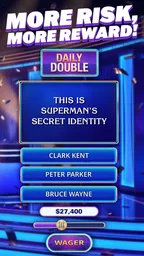


Jeopardy!® Trivia TV Game Show review
 Analysis by Appsdrops
My favorite way to use Jeopardy!® Trivia TV Game Show is as a small shared challenge: one person reads a clue, another thinks aloud, and everyone gets a chance to test what they know. It brings the familiar quiz-show format to a phone, which makes it easy to pull out during a quiet stretch at home or while waiting for dinner. I enjoy it most when nobody treats it like a serious contest. The fun is in the odd fact someone remembers, the confident wrong guess, and the quick debate that follows.
A quiz that works best when the room joins in
This is a trivia game from Uken Games, built around Jeopardy!’s recognizable question-and-answer style. Rather than feeling like a general collection of disconnected questions, it invites you to think in categories and clues. That structure gives a session a little more shape than simply tapping through a stream of facts, and it can make a familiar topic feel unexpectedly challenging.
In a shared-device situation, the simplest approach is to make the phone the board and let people take turns. One person can hold it while others call out possible answers, or players can pass it around between turns. That can turn a short lull into a lively household activity without needing to set up a full game night. I would agree on whose turn it is before starting, especially with younger players, because a phone game is still a personal device even when everyone is gathered around it.
The format also suits people who like to learn through conversation. A clue that stumps one person may spark a useful explanation from another, and the game can reveal which subjects your household knows well and which ones tend to produce guesses. My practical tip is to let people explain their reasoning after a tricky clue instead of rushing straight to the next one. That keeps the shared experience social rather than making it feel like a private score chase.
What the Jeopardy format adds
Compared with a typical trivia app that presents one question after another, this game has the advantage of a recognizable quiz-show identity and a clue-led style. That makes it easier to introduce to someone who already knows the television format. It also gives trivia fans a different rhythm from quick-fire quizzes, where speed and rapid tapping can matter more than considering a clue.
That difference is a matter of taste. If you want a quiet solo puzzle, the familiar structure can be satisfying. If your group prefers a fast party game with everyone answering at once, the mobile version may not naturally create that experience on its own. You can make it more communal by reading clues aloud and taking turns, but that is a household choice rather than something I would assume the game handles for you.
For a realistic everyday use, imagine a family waiting for a meal to finish cooking. Someone opens the game, and the group agrees to take turns choosing and answering. A short session gives everyone something to do, while the person holding the phone can keep it in hand between turns. The same setup can work for roommates or friends sharing a living room, provided the group is happy to play cooperatively or take turns instead of expecting a dedicated multiplayer arrangement.
Shared device, separate expectations
One useful boundary is to decide whether the phone is being used as a communal quiz board or whether each person wants an individual experience. Those are not necessarily the same thing. If several people take turns on one device, keep track verbally of who has played and avoid assuming that a shared session means everyone’s progress or preferences are shared in a particular way. I would treat the device as belonging to its usual owner and let that person handle any account-related choices.
This is especially sensible when a household includes children. A parent or caregiver can decide when the phone is available, supervise any purchase decisions, and make clear that other players should not change settings or make choices on the owner’s behalf. I would not hand over a personal device without first considering the usual family rules for app use. That simple agreement can prevent the game from becoming a source of arguments about turns, spending, or whose activity is being recorded.
The game is free to download, but it includes in-app purchases priced from $0.99 to $99.99 per item. That range makes it worth setting expectations before a shared session, particularly if a child is using an adult’s phone. I recommend checking the device’s purchase safeguards and keeping payment decisions with the account owner. The game can still be enjoyed as a casual quiz without making a purchase the center of the activity, but families should be deliberate about how purchases are handled.
Coordination matters more than it might seem. If one person is eager to keep playing while another only has a few minutes, agree on a stopping point before the phone changes hands. If people have different knowledge strengths, rotate who leads rather than letting one confident player dominate every clue. Those small choices make the game more welcoming and help avoid turning a relaxed trivia session into a test that only one person enjoys.
Age fit and household trust
The game is rated Everyone, which makes it broadly suitable for general audiences, but an age label does not replace a parent’s judgment about a particular child or household. Trivia can expose gaps in someone’s knowledge, and younger players may need a little context when a clue touches on subjects they have not encountered. I would treat wrong answers as conversation starters, not as a reason to tease someone or keep score against them outside the game.
For children sharing an adult’s phone, the key issue is less about the quiz format and more about maintaining clear boundaries around the device and purchases. I would show them how the phone is to be handled, explain that payment choices belong to the adult, and keep the device nearby during a shared session if that fits the family’s routine. Those are sensible precautions for any app used on a shared phone, rather than claims about special family controls in this game.
There is also a practical difference between letting a child play independently and playing together. A child who already enjoys trivia may be happy to explore clues alone, while a mixed-age group can benefit from adults explaining unfamiliar references. If your household wants a game designed specifically around cooperation, child-focused learning, or group party rules, another option may fit better. This one is most appealing when the Jeopardy! format itself is part of the draw.
Who will enjoy it, and who may not
I would recommend it to fans of the television quiz format, people who enjoy broad trivia, and households that like taking turns with a phone rather than needing a separate board game. It can also suit someone who wants a familiar, structured alternative to open-ended trivia feeds. The game has reached over five million installs, and its average rating is 4.4 from around 169,000 ratings, which suggests a substantial audience has found the format worth trying. Those figures are useful context, but the right fit still depends on whether you like this style of clue-based play.
It may be less suitable if you want a completely hands-off shared experience, a game built around a room full of simultaneous players, or trivia focused on one narrow subject. It is also not my first recommendation for someone who dislikes quiz-show presentation or feels uncomfortable answering under even light competitive pressure. In those cases, a cooperative board game or a more relaxed question-and-discussion activity may be a better match.
Another trade-off is that familiarity can cut both ways. Fans may appreciate the recognizable premise, but someone looking for a radically new trivia mechanic may find the core appeal too close to the quiz-show format they already know. I see that as a clear choice rather than a flaw: this is for people who want that particular flavor of trivia, not for every player who happens to enjoy questions.
What to know before installing
The game was released on May 17, 2017, and its current version is 60.0.0. It requires Android 7.0 or later, so checking the operating system on an older device is a sensible first step. Its content rating is Everyone. Those details help answer basic household questions, while the free starting price makes it easy to try before deciding whether the format suits your routine.
When choosing between this and another trivia game, I would ask what the group actually wants to do. If you want clue-based quiz-show play that can be shared informally around one phone, this is the more natural fit. If your priority is a built-in group activity, a specialized multiplayer trivia game may require less improvisation. If your priority is learning a particular subject, a focused educational app could be more useful than a general quiz experience.
My household verdict is that Jeopardy! Trivia TV Game Show is a good casual choice when people already enjoy trivia and are willing to coordinate turns themselves. I like that it can turn a few spare minutes into a conversation, and the recognizable format gives the activity an easy starting point. I would keep purchase boundaries clear, avoid assuming a shared phone means shared accounts, and choose something else if your group needs built-in cooperative play. For the right household, it is an approachable way to bring a little quiz-show energy into an ordinary day.
What we like
- Familiar quiz-show format makes rounds easy to understand.
- Clues cover a wide range of general knowledge topics.
- Daily challenges offer a reason to return regularly.
- Solo play lets you practice at your own pace.
- Short rounds work well for quick play sessions.
What could be better
- Some clues may feel difficult without specialist knowledge.
- Progress can depend on maintaining a regular play streak.
- The experience may include ads between activities.
- A stable internet connection may be needed for some features.
- Players seeking a story or action may find the format repetitive.







