

Guitar Band: Rock Battle review
 Analysis by Appsdrops
Guitar Band: Rock Battle is a music game built around a simple, appealing fantasy: pick up a virtual guitar, find the rhythm, and play along with famous songs. I like how quickly that idea communicates the mood. Rather than asking you to study a complicated simulation, it puts the focus on timing, musical energy, and the feeling of stepping into a rock performance. It is free to play, and its broad appeal is reflected in an average rating of 4.5 from around 314,000 ratings.
A rock-stage first impression
My first impression is that Guitar Band: Rock Battle knows exactly what sort of experience it wants to offer. This is a rhythm game with a guitar-shaped identity, not a general music player or a realistic instrument tutor. The appeal is immediate: famous songs provide the musical backdrop, while the player’s job is to keep pace and make the performance feel satisfying. That clear premise gives the game an easy entry point, even if you have never picked up a real guitar.
The rock framing matters because it gives the action a personality beyond tapping in time. A guitar performance suggests confidence, movement, and a little bit of showmanship, and the game’s overall concept leans into that feeling. I found it easy to picture the experience as a compact dose of stage energy: start a song, focus on its pulse, and try to stay connected to the music as it moves along. That makes it a natural choice for short sessions when I want something lively rather than a long, story-heavy game.
The basic attraction is also easy to understand for people browsing for a guitar rhythm game. You do not need to know music theory to enjoy following a beat, and the game’s famous-song premise gives each performance a familiar musical anchor. At the same time, the rhythm-game format still asks for attention. It is not just background listening; the fun comes from responding to what the song is doing and feeling that your actions belong to the performance.
A focused musical fantasy
One thing I appreciate about the setup is its focus. The game does not need an elaborate fictional universe to make the central fantasy work. The instrument, the songs, and the idea of playing rock are enough to establish a recognizable mood. That helps the experience feel approachable: you can understand the basic promise at a glance, then decide whether the combination of music and timing is your kind of fun.
That focused identity also helps set expectations. If you are looking for a full guitar simulator, a music-making studio, or a detailed lesson app, this is not the same sort of product. Its appeal is that it turns playing along into a game. I see that distinction as a strength rather than a limitation: the experience has a clear purpose, and it can concentrate on the immediate pleasure of rhythm instead of trying to cover every possible musical activity.
Visual language and the rock setting
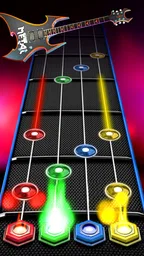
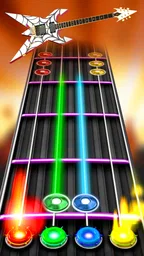
The art direction has an important job in a music game: it needs to support the sound without distracting from the timing. The rock setting gives the experience a coherent frame, making the guitar feel like more than a decorative label. That framing helps turn a sequence of musical actions into a performance fantasy, which is a good fit for a game built around songs and the excitement of playing them.
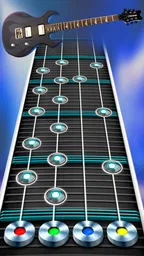
I think the most effective visual approach for this kind of game is one that makes the musical task easy to read while preserving a sense of occasion. The player should feel connected to the performance, but the visuals should not compete with the rhythm. That balance is what makes the game’s premise work on a phone: a quick glance needs to keep the player oriented, while the larger rock mood gives the session some flair. The concept naturally supports that contrast between practical clarity and stage-inspired energy.
The setting also helps the game avoid feeling like an abstract timing exercise. Music games can become emotionally flat if all the player notices is a stream of inputs. Here, the guitar-and-rock identity gives the activity a stronger context. Even when the mechanics are the main focus, the idea of playing a song helps each session feel like a small performance rather than a detached test of reflexes.
Keeping the mood readable
For me, the best art direction in a rhythm game is not necessarily the busiest or most elaborate. It is the direction that reinforces what I am doing and lets the music remain the star. A rock mood works well because it supplies a clear emotional tone—energetic, expressive, and suited to a song-led challenge—without needing a complicated narrative explanation. That consistency makes the game easier to settle into.
This also affects how the experience may appeal to different players. Someone arriving for the songs can enjoy the musical identity, while someone more interested in the challenge can focus on timing. The two parts do not have to compete. When the visuals and setting support the same idea as the soundtrack, the result feels more unified, and that unity is a major part of why the game’s concept is easy to remember.
Sound, songs, and rhythm
Sound is the heart of Guitar Band: Rock Battle. The store description presents it as a music rhythm game where you can become an amazing guitarist and play famous songs, so the soundtrack is not incidental decoration; it is the reason the format exists. Familiar songs can make a rhythm challenge feel more inviting because the player already has a sense of the music’s character. Even when concentration shifts to timing, the song provides a recognizable pulse and emotional direction.
I like the way this premise makes listening and playing feel connected. A strong rhythm game asks you to pay attention to the beat, but it also rewards you with the sensation that you are participating in the song rather than merely hearing it. That is the special appeal of a guitar-themed music game. The player can focus on keeping time while still enjoying the idea of contributing to a performance, which gives repetition a musical purpose.
The pacing of a song-based challenge is important too. Music naturally creates its own movement, building anticipation and carrying the player from one moment to the next. That can make a session feel more fluid than a generic sequence of tasks. I find that this kind of pacing is especially suitable for mobile play: a song offers a clear beginning and ongoing momentum, so it is easy to understand what I am doing and why the next moment matters.
When a song becomes a challenge
There is a satisfying tension in trying to stay in step with music. The song pulls you forward, while the game asks you to remain attentive. That combination gives a simple rhythm mechanic room to feel engaging without requiring a complicated premise. It also means the soundtrack has to do more than sound good: it needs to give the player a sense of pace. The rock framing helps that relationship feel natural, since guitar performance and rhythmic precision belong together.
Of course, rhythm games are most enjoyable when players want to return to the music, not only chase a result. The promise of famous songs gives this game a straightforward point of attraction for music fans. It also makes the experience approachable to casual players who may not normally seek out a competitive or highly technical game. For me, that combination of recognizable music and active timing is the most compelling part of the design.
Mechanics that serve the music
The mechanics need to support the performance fantasy, and the game’s central idea gives them a clear job: make playing along feel responsive and engaging. The rhythm format is familiar enough to understand without a lengthy explanation, but timing still gives each song a challenge. That balance is useful. A game can be accessible without being entirely passive, and a musical theme can make the effort feel enjoyable rather than demanding for its own sake.
I also think the guitar theme does useful work here. It gives the player an imagined role, which can make repeated rhythmic actions feel more expressive. Instead of thinking only about inputs, I can think about keeping a performance together. That mental shift is small, but it helps the mechanics fit the mood. When a game’s actions reinforce its setting, the experience feels more coherent even if the core interaction is straightforward.
As with any rhythm game, enjoyment depends on how well the player connects with the songs and the timing challenge. If you enjoy following a beat and responding as music unfolds, the basic idea should make sense quickly. If you prefer games where progress comes mainly from exploration, dialogue, or solving complex systems, this may feel more focused than you want. I see that narrowness as part of the design: it keeps the musical activity front and center.
Accessible, with room to concentrate
The game’s broad audience is reflected in its Everyone content rating, which makes its music-game concept suitable for a wide range of players. That does not mean every session is automatically effortless; rhythm still asks you to pay attention. But the overall premise is easy to grasp, and that matters on mobile, where players often want to begin without a steep learning curve.
There is also a practical distinction between casual enjoyment and long-term motivation. A player might open the game for a quick burst of music, while another might enjoy returning to the timing challenge and trying to feel more in control. The song-based format can serve both moods because the music provides immediate enjoyment and the gameplay gives the player something active to do. For a music game on mobile, that combination is a sensible foundation.
The game is free to download, with in-app purchases ranging from $0.99 to $299.99 per item. That range is worth keeping in mind if you prefer to avoid optional spending in games. I would treat the purchase options as a reason to check the app store carefully before buying anything, while remembering that the headline appeal remains the music-and-rhythm experience. The game has reached over 50 million installs, suggesting that its straightforward guitar performance fantasy has found a substantial audience.
Who will enjoy the atmosphere?
I would recommend this game most readily to players who like music games, enjoy rock’s energetic image, or want a quick activity that feels more lively than a standard puzzle. Its identity is easy to grasp, and the emphasis on famous songs gives the experience a clear musical hook. If your ideal mobile session involves listening closely and responding to a beat, the format has a natural appeal.
It may be less compelling if you want a deep musical sandbox or a realistic instrument-learning experience. The game is built around rhythm and performance as entertainment, not around teaching guitar technique. That distinction helps avoid the wrong expectations. I would approach it as a playful, song-led game first, then judge it by how much I enjoy its timing and rock atmosphere.
Its history also shows that it is not a brand-new experiment: it was released on September 27, 2017, and the current version is 4.20.3. It is developed by Supercharge Mobile and requires Android 7.1 or later. Those details make it easy to identify for players checking compatibility and deciding whether the game fits their device, while the game itself remains centered on music rather than technical complexity.
Final atmosphere verdict
Guitar Band: Rock Battle works best when its parts are considered together. The guitar theme gives the game a clear identity, the rock setting supplies a lively mood, and the songs provide the pulse that makes the mechanics meaningful. I like that its central fantasy is so easy to understand: play along, stay with the rhythm, and enjoy the feeling of taking part in a performance.
The experience is most convincing as an accessible rock rhythm game for players who want music to be the main event. Its structure appears designed around immediate musical engagement rather than a sprawling world or elaborate simulation, and that focus gives it a coherent feel. The art direction and setting help establish the mood, while the rhythm challenge keeps the player involved instead of leaving the music as passive background.
With an average rating of 4.5 and around 11,000 written reviews, the game has built a strong presence among mobile players. Those figures do not decide whether it will suit your taste, of course. My overall view is that it is worth considering if you enjoy rhythm games and like the idea of playing famous songs through a guitar-themed performance. It offers a clear, energetic premise and a mood that feels well matched to its music-first gameplay.
What we like
- Online battles make performances feel competitive.
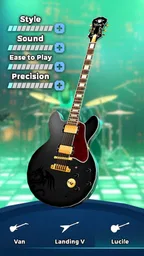
- Multiple guitar styles add variety to the setlist.
- Short sessions suit quick play breaks.
- Unlockable gear gives players goals to work toward.
- The rock theme creates a lively concert atmosphere.
What could be better
- Progress can slow without frequent play.
- Online matches depend on a stable connection.
- Some upgrades may require substantial in-game currency.
- Repeated songs can make sessions feel less varied.
- Competitive play may frustrate newcomers.







