

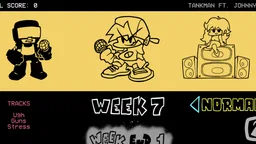


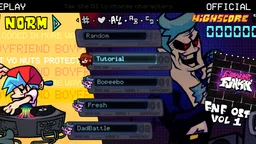


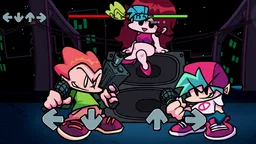
Friday Night Funkin' review
 Analysis by Appsdrops
I like rhythm games that make me pay attention to the music rather than stare at a score, and Friday Night Funkin’ has a particularly direct way of doing that. You follow the notes as they reach their cues and tap in time, with each successful sequence turning a track into a small test of focus and timing. It is playful on the surface, but the tougher moments ask for real practice. My main advice is to treat it as a game to learn in short, repeatable sessions—not one to rush through while distracted.
Getting a reliable feel for each track
Friday Night Funkin’ is a free music game from The Funkin’ Crew Inc., available on Android for devices running OS 9 or later. It is rated Teen, so it is not aimed at very young children. The game has a 4.8 average from around 514,000 ratings and has passed 10 million installs, a strong sign that its distinctive rhythm-action style has found a large audience.
The basic loop is easy to understand: read the incoming prompts, hit the matching inputs in rhythm, and keep your performance steady through the song. That simplicity makes it approachable, but it also means that small mistakes are easy to notice. I find it more satisfying to focus on the beat and the pattern together than to chase every note with frantic tapping. When I slow down mentally, my timing tends to become more consistent.
A useful first-session habit is to play a track once for orientation rather than expecting a clean run immediately. Notice where the rhythm feels natural, where the notes cluster, and which transitions catch you off guard. On a second attempt, you have a clearer idea of what deserves attention. This is more effective than repeating the same song on autopilot and hoping your hands will eventually sort it out.
The game suits brief breaks because a song gives you a defined challenge with a clear endpoint. It also works for someone who wants to practise a particular rhythm game skill without committing to a long role-playing campaign or a sprawling collection of modes. If you have a few quiet minutes, you can make a genuine attempt, identify one trouble spot, and return later with a specific goal.
Set up for comfort before chasing a high score
Before settling into a longer session, I recommend checking the available settings and controls on your device. Touchscreen play can feel different depending on screen size, hand position, and how comfortably you can reach the inputs. A setup that is fine for one song may become awkward when a sequence asks for faster responses. Take a moment to see what options the game actually presents, then choose the arrangement that lets you react without covering too much of the action.
Sound matters here for more than atmosphere. The track gives you a musical reference, so playing at a volume where the beat is clear can help you stay oriented. If you are in a shared space, headphones may make it easier to concentrate without turning the game up for everyone else. I would avoid playing with audio so low that you are relying entirely on visual timing unless that is the only practical option.
There is also a useful distinction between changing a setting and changing your technique. If a run feels uncomfortable, first check whether your grip or posture is making the controls harder to reach. Then consider whether the timing itself is the issue. Adjusting settings repeatedly can become a distraction; a stable setup gives you a fairer way to judge whether practice is helping.
For a realistic everyday routine, I would play one song during a short break, pause long enough to think about the section that went wrong, and then try it again only if I still have time to focus. That small reset matters. Replaying while annoyed can turn a rhythm game into a reflexive tapping contest, while a deliberate second attempt gives you a chance to correct a specific mistake.
Build speed by recognizing patterns, not mashing
As the notes become more demanding, it is tempting to tense up and press as quickly as possible. I find that approach unreliable. A better habit is to watch a little ahead of the immediate cue so the next part of the pattern does not arrive as a surprise. You are still responding in the moment, but your attention is prepared rather than startled.
When a passage trips you up, break it into a question you can answer: did I lose the beat, misread the sequence, or simply react late? Those are different problems. If the rhythm is the issue, listen more closely to how the phrase moves. If the visual sequence is confusing, keep your eyes on the approaching prompts instead of flicking around the screen. If your hands are lagging, relax your grip and avoid adding unnecessary movement.
Another practical technique is to separate a clean run from a learning run. In a learning run, accept that you may miss notes while you work out the troublesome section. In a clean run, use what you learned and focus on consistency. Expecting every attempt to be your best attempt creates needless pressure, especially in a game where one difficult stretch can disrupt an otherwise solid performance.
Experienced players often benefit from repeatable habits more than dramatic tricks: use the same comfortable grip, keep the audio and device position consistent, and give a difficult track a clear purpose each time you revisit it. This does not unlock a hidden advantage; it simply makes your attempts easier to compare. If your setup changes every run, it is harder to tell whether you are improving at the song or merely adapting to a new way of holding the phone.
Short practice is also a sensible way to manage fatigue. Rhythm games reward attention, and tired hands or a wandering mind can make familiar patterns feel harder than they are. I would rather stop after a focused attempt than keep replaying until every input feels late. Coming back fresh is often more useful than trying to force one more run.
Where it differs from other rhythm games
Compared with rhythm games built around long song libraries, elaborate collection systems, or frequent customization, Friday Night Funkin’ puts more of its appeal in the immediate performance: follow the cues, feel the music, and improve through repetition. That makes it a good choice if you want a direct challenge without needing to manage a separate roster or spend time tuning a complicated strategy before playing.
The trade-off is that players looking for a broad music-discovery service or a large catalogue organized around their personal tastes may prefer a different kind of rhythm game. Friday Night Funkin’ is best approached as a specific game with its own personality, not as a replacement for every music app or a guaranteed fit for every musical preference. Its charm depends on enjoying the act of matching inputs to its tracks and learning their patterns.
The game can also be less comfortable when you want a passive experience. It asks you to watch, listen, and respond, so it is not ideal as background entertainment while you are doing something else. If you want music that can simply play while you work, a streaming app is the better tool. If you want a game that rewards concentration and gives you a concrete skill to practise, this is where Friday Night Funkin’ makes more sense.
Because it is rated Teen, I would also make the age suitability part of the decision rather than assuming that a colourful style makes it automatically suitable for every child. Parents should check the game in context and decide whether that rating fits the person who will be playing. For older players, the rating is a helpful boundary, not a reason to expect a particularly serious or realistic presentation.
What to expect as you improve
The current Android version is 0.8.8. I would keep the game updated through the app store so I am playing the current release, but I would not make version numbers the main reason to try it. The more useful question is whether its particular rhythm challenge feels enjoyable to you. A high average rating and a substantial player base can help establish that it has broad appeal, but they cannot guarantee that the music, controls, or difficulty will suit your hands and habits.
It is also worth distinguishing a difficult song from a broken routine. If you repeatedly miss the same stretch, do not immediately conclude that you need faster fingers. Check whether you are looking too close to the current cue, whether you are losing the pulse, and whether fatigue is setting in. These small checks often reveal a practical fix, even when the track itself remains challenging.
One limitation is that a phone screen and touch input may not feel equally comfortable for everyone. Players with larger hands, a smaller display, or a preference for physical controls may need time to find a workable posture. If the controls remain awkward after a sensible adjustment, a rhythm game designed around a different input style may simply be a better fit. I would not keep blaming my timing for a setup that feels uncomfortable from the start.
Another trade-off is the learning curve hidden inside the simple premise. Beginners can understand what to do quickly, but understanding is not the same as executing cleanly. The game can ask for quick visual recognition and steady timing at once. If you prefer games that let you progress mainly through exploration, story choices, or gradual equipment upgrades, this may feel demanding in a way you do not enjoy.
A good pick for focused, repeatable play
I would recommend Friday Night Funkin’ to anyone who likes music games where improvement comes from learning a track rather than collecting upgrades. It is especially appealing if you enjoy short challenges, can tolerate a few imperfect attempts, and find satisfaction in noticing that a once-tricky pattern now feels manageable. The free price makes it easy to try, while its Teen rating gives families an important suitability cue.
I would skip it if you want a hands-off music experience, dislike retrying difficult sections, or find touchscreen timing frustrating. I would also choose another option if your priority is a much broader music library or a more relaxed pace. Those are not flaws that can be fixed by practising harder; they are differences in what a player wants from the category.
For me, the best way to enjoy Friday Night Funkin’ is to make each attempt deliberate: keep a comfortable setup, listen for the pulse, identify one specific weak spot, and stop when concentration fades. That routine turns a simple premise into a satisfying test of timing without making every session feel like a grind. If that kind of focused practice sounds fun, Friday Night Funkin’ is an easy game to give a try and a rewarding one to return to.
What we like
- Simple controls make it easy to start playing.
- Distinctive music gives each level a strong identity.
- The rhythm gameplay rewards timing and concentration.
- Colorful character designs help the game stand out.
- A wide range of community-made mods can add variety.
What could be better
- Some songs become difficult quickly for new players.
- The original game offers limited content compared with larger rhythm games.
- Community mods may require extra setup to install.
- Frequent rapid inputs can feel uncomfortable during long sessions.
- Performance and controls may vary across unofficial mobile versions.







