

Don't Forget the Lyrics review
 Analysis by Appsdrops
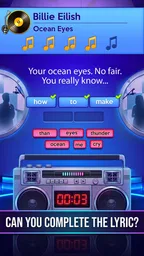
I like music games best when they turn familiar songs into a reason to talk, laugh, and challenge the people around me. Don't Forget the Lyrics is built around that simple appeal: it asks you to remember what comes next in a song, making it a casual fit for friends and family rather than a demanding musical test. I’d reach for it during a relaxed get-together or a quiet break when a little friendly competition sounds more fun than another round of scrolling.
Getting a good round started
The most enjoyable way to approach this music trivia game is to treat it as a shared activity. Someone can read or play a prompt, everyone can take a moment to recall the missing lyric, and the group can compare guesses. That small pause before the answer is part of the fun: one person may know the tune instantly, while another remembers only the chorus and tries to work backward from it.
It works especially well with people who have overlapping musical memories. Family members can bring different eras to the same round, and friends can discover that the person who sings along loudly in the car does not always remember the words. I’d keep the mood light rather than turning every miss into a serious scorekeeping dispute. The game’s appeal is the shared recognition and the good-natured debate that follows.
For a practical first session, I’d explain the basic idea before passing the device around, then let the group settle into a rhythm. If everyone tries to answer at once, the fastest speaker can dominate even when someone else knows the lyric. Taking turns to guess, or agreeing that the group gets a brief moment to confer, gives quieter players a fairer chance. These simple house rules make more difference than adding complicated competition to a casual game.
The central challenge is remembering lyrics, not identifying a song solely from an instrumental clip or demonstrating music theory. That distinction matters if you’re choosing something for a group. People who enjoy singing along, quoting lines, or testing their pop-culture memory are likely to find the premise immediately inviting. Someone who prefers rhythm-game timing, instrument practice, or a deep catalogue browser may be happier with a different kind of music app.
Small habits that make play smoother
I would decide in advance whether guesses should be spoken freely or taken one at a time. Free-for-all answers are lively, but they reward quick reactions; turns make the game easier for mixed-age groups and for anyone who needs a little longer to recall a line. A useful compromise is to allow a short group discussion, then ask one person to give the final answer. That keeps the social energy without letting the loudest voice decide everything.
It also helps to keep the phone easy for the next player to use. In a group setting, I’d pass it to the person whose turn it is rather than letting several people tap around between prompts. That avoids accidental interruptions and keeps attention on the lyric. If the game is being played around a table, placing the device where everyone can hear or see what is happening is a straightforward improvement; no special setup is needed to make the basic activity feel more inclusive.
Another worthwhile habit is to treat a missed lyric as a conversation starter, not merely a wrong answer. Ask who remembers the song, what part they know, or whether someone can hum the melody. That gives people who are less confident about exact words a way to join in. It also makes the session feel less like a narrow quiz and more like a shared music-memory game.
What to check before settling in
The game is free to download, though it includes in-app purchases ranging from $0.99 to $99.99 per item. I’d check the purchase options before handing a phone to a child or leaving it unattended during a family session. The content rating is Everyone, which makes the general audience broad, but that does not remove the need to manage spending on a device used by younger players.
The app is developed by Music Games & Trivia Games & Trombone - LB ART. It has a 4.3 average from around 77,000 ratings, alongside roughly 17,000 written reviews, and has passed five million installs. Those figures suggest that many people have tried it, but popularity cannot tell you whether its style suits your group. I’d judge it by whether your players enjoy lyric recall and casual turns rather than treating a high download count as a guarantee of a perfect fit.
It first appeared on September 28, 2012, and the current version is 2.0.2. Its listed minimum operating system is 7.0, so it is aimed at devices that meet that requirement. Since operating-system compatibility can depend on the device and its software, I’d check the app store on the phone you plan to use before organizing a group around it. That quick check is more useful than assuming an older handset will behave exactly like a newer one.
For a family gathering, I’d also agree on whether people can sing or hum while guessing. Singing makes the game more welcoming for players who recognize a melody more readily than a line of text, while keeping answers spoken can make the competition feel tidier. Neither approach needs to be treated as the official way to play; the point is to choose a rule that gives everyone a comfortable route into the round.
Using repetition without turning it into homework
Experienced players can improve the pace through repeatable habits rather than imagined shortcuts. I’d listen closely to the wording of each prompt, pause long enough to let the lyric surface, and avoid blurting out the first line that merely sounds plausible. Familiar songs can trick you into supplying a related phrase instead of the exact continuation. A brief mental check—does this fit the song’s wording, or just its theme?—can prevent confident but careless guesses.
When playing with a group, rotating who answers first is another simple way to keep things balanced. If the same person always gets the opening guess, they can set the tone and crowd out other memories. A changing order makes the session more social, and it gives players time to learn how others approach a clue. Some people recall lyrics by melody; others remember a rhyme or a repeated chorus. Noticing those different approaches can make later rounds more engaging.
I’d also avoid making the session too long. Lyric recall is fun while people are alert and sharing memories, but a marathon can make even familiar songs feel like an exam. A few rounds between conversation or other activities work better for a casual gathering than insisting everyone play until they are tired of it. This is especially useful with children or a mixed-age group, where attention spans and musical familiarity can vary widely.
One trade-off of the format is that musical knowledge is uneven. A player who knows the featured songs may enjoy a clear advantage, while someone whose listening habits differ can feel left out. The best fix is not to pretend that every prompt is equally familiar; instead, keep the mood friendly, let the group help after a guess, and switch roles so that less confident players can contribute in other ways. If your group strongly prefers equalized competition, a broader trivia game with varied subjects may be a better choice.
Where this game fits among music apps
Compared with rhythm games, Don't Forget the Lyrics asks for memory and recognition rather than precise taps timed to a beat. That makes it easier to play while chatting, and it does not require the same focus as a performance-style challenge. Compared with music-streaming apps, it is not primarily about choosing an album or building a listening queue; its purpose is to turn song knowledge into a quiz. Those differences make it a useful change of pace, but also mean it will not replace either type of app.
It is also distinct from general trivia games. A broad quiz can give everyone a chance through science, geography, or history questions, whereas this one keeps the spotlight on lyrics and songs. That focus is a strength when a group already enjoys music, but a limitation when participants have very different tastes. If your gathering includes people who rarely listen to the same styles, a mixed-topic quiz or a playlist-based guessing game may create more common ground.
For solo use, I’d think of it as a light way to test recall rather than as a structured training tool. It can make a spare moment more playful, but the social dimension is where the idea feels most distinctive. If you want to practise an instrument, learn music theory, or explore new artists through recommendations, a dedicated learning or discovery app would serve that goal better.
When it may not be the right pick
The game is not ideal for a group that expects every answer to be equally accessible or wants a highly tactical multiplayer contest. Lyrics can be deeply tied to what someone grew up hearing, and a player who knows a song’s melody may still struggle to recall its exact words. I would skip it for a gathering where people dislike singing, guessing aloud, or being put on the spot. A cooperative playlist activity may be more comfortable in that situation.
It may also disappoint someone looking for a large set of adjustable rules or a music-making experience. The core idea is narrow by design: remember the lyrics and enjoy the quiz. That focus keeps the game easy to explain, but it can become repetitive if you want complex progression or a different challenge every time. I’d approach it as a casual social game, not a substitute for a full rhythm title or a comprehensive music-learning app.
Because purchases are available, it is sensible to review the purchase controls on the device if children will play. The game is free, but “free” does not mean every optional item has no cost. I’d make that clear before a family session, particularly if the phone is shared or a child is allowed to make in-app purchases elsewhere.
My verdict after weighing the fit
Don't Forget the Lyrics is an easy recommendation for friends and families who already enjoy singing along and testing one another’s memories. Its best use is a relaxed round where people can guess, laugh at near-misses, and help each other remember a line. The free entry point makes it simple to try, while the broad Everyone rating supports its casual, mixed-age appeal.
I would not pick it for people who want rhythm mechanics, music lessons, or a quiz that balances every player’s knowledge across many subjects. Nor would I expect the lyric format alone to overcome a major gap in musical taste. But if your group shares enough songs to spark recognition, a few turns can make a quiet evening or family visit feel more lively without requiring elaborate preparation.
For the smoothest experience, check the device compatibility and purchase settings first, agree on a fair way to take turns, and keep the session short enough that the guessing stays fun. Those small choices play to the game’s real strength: it turns familiar music into a social prompt. If that is what you want from a music game, this is a personable, low-pressure option; if you want deeper mechanics or broader subject matter, another app will suit you better.
What we like
- Recognizable songs make rounds easy to join.
- Short turns keep casual sessions moving.
- Multiple difficulty levels suit different skill levels.
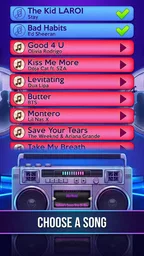
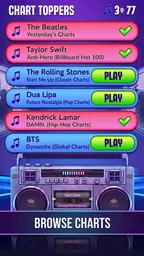
- A broad song selection helps keep repeat play fresh.
- The format works well for friendly group challenges.
What could be better
- Some song catalogs may feel dated to younger players.
- Recognizing a tune can depend on regional music knowledge.
- Players who dislike singing may feel left out.
- Repeated rounds can become predictable over time.
- Song availability may vary by version or region.







