







Beat Cats review
 Analysis by Appsdrops
Some music games ask you to learn a complicated pattern; Beat Cats is built around a simpler pleasure: following a beat as a cat bounces across piano-style tiles. I’d recommend it to someone who wants a quick rhythm game they can pick up without a long tutorial, especially if a playful theme sounds more appealing than a serious instrument simulator. The key question is whether you enjoy reacting to music in short bursts, because that is the experience this game is designed to offer.
What to consider before you play
Before choosing a rhythm game, I think about what I want from the session. If I’m looking for a light, visual challenge that keeps my fingers moving, this cat-themed approach makes sense. If I want to practise piano, study music theory, or build a detailed playlist, I’d choose a different kind of app. Beat Cats is a game first, not a substitute for music lessons or a conventional music player.
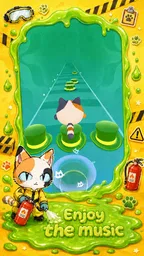
The basic appeal is easy to understand: watch the action, keep pace, and try to stay in step with the tiles. That simple premise makes it approachable when I have only a few minutes. It also means the main attraction is the rhythm challenge itself, rather than a broad set of tools or a deep musical workspace. The store summary highlights bouncing and dancing cats on piano tiles, and that gives a fair sense of the game’s playful direction without making it sound like a keyboard trainer.
As a music game from SAMFEN LIMITED, Beat Cats has found a sizable audience: it has over ten million installs and an average rating of 4.5 from around eighteen thousand ratings. I treat those figures as useful context, not proof that it will suit everyone. Rhythm games are personal: the feel of timing, the music, and the visual presentation matter more than popularity if you know you prefer a different style.
Why the cat-and-tile idea works
The cat theme gives the familiar piano-tile concept a lighter personality. That matters most in a casual setting: I can open a round for a brief distraction without feeling that I need to commit to a training plan or master a complicated interface. The visual hook also makes the game easier to recommend to someone who might be curious about rhythm games but put off by intense, score-focused presentation.
There is a practical trade-off, though. A simple premise can make timing the whole test. If your enjoyment depends on story, exploration, or a long progression system, a tile-based rhythm game may feel narrow. I would approach this as a compact challenge to revisit when I want a quick change of pace, not as a game that necessarily needs to occupy a long evening.
Making short sessions feel better
One useful way to judge a rhythm game is to play when you can give it your attention, rather than treating it as something to tap through while doing another task. In a game built around matching movement to music, splitting your attention can make a fair challenge feel frustrating. I’d set aside a quiet moment, keep the screen comfortably visible, and focus on the beat. That is a small adjustment, but it helps separate a genuine timing mistake from simple distraction.
Another practical tip is to think of a run as a focused attempt rather than a test of musical ability. If a section feels difficult, pausing between tries can help more than repeatedly rushing through while annoyed. This is especially useful for younger players or anyone new to rhythm games: the aim is to enjoy the interaction, not to prove that you already have perfect timing.
A realistic everyday use is a short break between errands or during a quiet moment at home. I would choose it when I want something more active than scrolling but less involved than starting a long game. Because the concept is immediately readable, it is also a reasonable option to show a friend or family member who has not played many music games. The broad Everyone age rating supports its family-friendly positioning, although younger players may still benefit from an adult checking how in-app purchases are handled on the device.
Where it stands against other music games
Compared with music apps that teach notes or let you practise an instrument, Beat Cats is the more game-like choice. Its tile-and-rhythm focus asks for quick reactions, not musical knowledge. Compared with rhythm games that emphasize elaborate charts or a more serious performance feel, its cats and bouncy presentation make it an easiergoing pick. Those are differences in purpose rather than claims that one category is objectively better.
If you prefer singing along, managing a personal music library, or learning a real instrument, a game centered on piano-style tiles is unlikely to meet that need. Likewise, someone who wants a deep competitive scene should compare options specifically designed around that kind of play. Beat Cats makes the most sense when the brief, playful rhythm challenge is the point, not a stepping stone to a different musical hobby.
What the purchase details mean in practice
The game is free to download, which makes it easy to try before deciding whether it deserves space on your device. It also offers in-app purchases priced from $5.99 to $39.99 per item. I would treat those as optional spending and start by seeing whether the free experience is enjoyable enough on its own. If you are setting it up for a child, checking purchase controls first is a sensible habit; it avoids turning a casual game into an unexpected expense.
The cost of switching is low if you discover that the format is not for you: you can simply move on to another kind of music game or use a music-learning app instead. The more important cost is attention. Rhythm challenges reward focus, so this is not the best pick if you want a game you can comfortably play while watching something else or handling a conversation. I’d also avoid judging it after a distracted first attempt; give the timing a fair chance before deciding.
Beat Cats is at version 0.0.32 and was released on May 23, 2024. It requires Android 7.1 or later. Those details are helpful when checking device compatibility, particularly if you are installing it on an older phone or tablet. The app’s broad age rating and free entry point make trying it straightforward, while the optional purchases are worth keeping in mind before handing the device to a younger player.
Who should choose it—and who should skip it
I’d point casual players toward this game if they like music-led tapping, enjoy cute visual themes, and want a challenge that is easy to understand at a glance. It may also suit a household looking for a simple game to try together, provided everyone is comfortable with reaction-based play and an adult manages purchase settings where appropriate. Its appeal is clearest when a short burst of rhythm play sounds fun in its own right.
I’d suggest looking elsewhere if you need a structured piano course, prefer slower activities, or want a game whose main attraction is an elaborate story. People who find repeated timing challenges stressful may also be happier with a music app that lets them listen or learn at their own pace. That is not a flaw unique to this title; it is a consequence of choosing a rhythm-game format.
There are around two hundred and forty reviews alongside its ratings, and that wider public response suggests plenty of people have taken the time to share an opinion. I still wouldn’t use a review count as a substitute for trying the game yourself. The best test is whether the tile-and-cat presentation makes you want to keep following the beat after the novelty wears off.
My recommendation
For me, Beat Cats is a sensible choice when I want a cheerful, low-commitment music game rather than a learning tool or a complex rhythm experience. Its strongest point is how clearly its central idea comes across: a cat-themed take on piano-tile timing that is approachable for casual play. Its main limitation is the same simplicity that makes it easy to pick up; anyone looking for musical depth or a broader kind of gameplay should choose another category.
I’d try it for a short session before spending anything, and I’d keep optional purchases in mind if a child will be using the device. If the bouncing-cat presentation makes the rhythm challenge feel inviting, it is a good fit for a quick break. If what you really want is to play piano, learn music, or listen without tapping, skip it and choose an app built for that purpose. For the right player, Beat Cats offers an uncomplicated way to turn a spare moment into a small rhythm challenge.
What we like
- Easy controls make it accessible to newcomers.
- Bright cat characters give the game a playful look.
- Short levels suit quick gaming sessions.
- Rhythm gameplay rewards timing and concentration.
- Unlockable content gives players goals to work toward.
What could be better
- Some tracks may feel repetitive after extended play.
- Difficult sections can frustrate players with slower reactions.
- Progress may require replaying earlier levels.
- The visual effects can distract from timing cues.
- A stable internet connection may be needed for some features.







