


Surveys On The Go: Earn Cash review
 Analysis by Appsdrops
I see Surveys On The Go: Earn Cash as a small side activity, not a dependable way to cover bills. Its appeal is straightforward: it is a free lifestyle app from MFour Data Research, Inc. that offers cash for completing surveys rather than asking users to build up a points balance. That distinction makes the reward feel easier to understand, but it does not turn survey work into predictable income. In my view, it suits people who are happy to check in occasionally and take a survey when one fits their time and interests.
Where survey users can get stuck
The main friction with survey apps is usually not the act of answering questions; it is matching with opportunities and making the time worthwhile. A survey invitation can look promising, yet its questions may reveal that the participant is not a fit. That is a familiar trade-off in this category, and I would approach this app with flexible expectations rather than assuming a survey will always be available or completable when I open it.
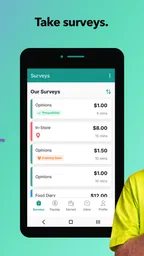
The app’s advertised cash rewards are in the range of one to five dollars per survey. That is more tangible than points, but the headline amount should not be treated as an hourly rate. The time involved can vary, and the useful question is whether a particular survey’s reward feels fair for the time and attention it asks from you. I would skip an opportunity if I were rushing or unable to read carefully; careless answers can make the experience less useful for both sides.
Another possible sticking point is the personal information involved in survey participation. Surveys naturally ask about preferences, habits, and experiences, and some people are comfortable sharing that kind of information while others are not. I recommend reading each question before answering and leaving a survey if its subject feels too personal. A cash reward is not a reason to ignore your own privacy boundaries.
It also helps to separate the app’s promise from the way survey availability works in practice. “Paid” describes the reward format, not a guarantee that every visit will produce a suitable task. I would treat it like checking for a useful opportunity during spare time, rather than opening it with a specific amount of money in mind. That mindset prevents a quiet day from feeling like a broken app.
Start with a low-pressure routine
For a realistic everyday use, imagine waiting for an appointment with a few minutes free. I might open the app, see whether a survey is worth attempting, and continue only if I can give it proper attention. If nothing fits, I would close it and get on with my day. This is a better match for the app than setting aside a long block of time and expecting a steady stream of paid work.
For that reason, I would not recommend relying on it for a fixed savings target or urgent expense. Survey opportunities are not the same as scheduled shifts, and a good result on one occasion does not establish a regular pattern. People looking for reliable earnings should compare it with work that has clearer hours and compensation. People who simply enjoy earning a little cash during otherwise idle moments may find the arrangement more satisfying.
Setup checks and a smoother first session
Before beginning, I would make sure the app is installed from the app store and that the device meets its minimum operating-system requirement of version 8.0. The current release is 3.11.0, and keeping an app updated is a sensible first check if something behaves unexpectedly. The age rating is Everyone, though that does not mean every survey topic will feel suitable for every individual; personal comfort still matters.
When creating an account or filling in profile details, I would take the time to answer consistently and accurately. Survey matching depends on the information a participant provides, so rushed or contradictory answers can make later screening feel confusing. I would also avoid guessing just to get through setup faster. A truthful profile is more useful than one shaped around what I imagine a survey might want to hear.
Use a stable connection before starting a survey, especially if you are somewhere with weak reception or moving between networks. This is ordinary preparation, not a special trick: interruptions can make any online form harder to complete. If you are on the move, it may be wiser to wait until you are settled rather than begin a survey that requires concentration and then lose your connection halfway through.
I would also set a simple personal rule for notifications and checking in. If alerts are useful, leave them enabled in the way that suits your phone; if they become distracting, check the app only when you have spare time. The goal is to keep the app in its proper place as an occasional activity. Repeatedly checking for new work can consume more attention than the rewards justify.
Recovering from a stalled or interrupted survey
If a survey freezes, closes, or stops loading, I would first check whether the phone still has a working internet connection. Then I would close and reopen the app, and make sure it is up to date. These are basic recovery steps, but they help distinguish a temporary connection problem from an issue that persists across sessions. I would avoid repeatedly submitting the same answers if the app appears uncertain about whether a response went through.
If an interruption happens in the middle of a survey, I would reopen the app once and see whether the task is still available. If it is not, I would not assume that tapping around or restarting the phone will restore it; a survey may simply no longer be active. The practical lesson is to begin when you have enough uninterrupted time, and not while juggling a conversation, commute, or other task.
For anything involving an account or a reward that appears inconsistent, I would keep the description precise: note what screen you were on, what you completed, and what happened next. Clear details make it easier to explain an issue if you contact the app’s support through the available in-app or store channels. I would not share passwords or sensitive account details in a public comment, and I would not install unofficial copies as a workaround.
It is also worth checking whether the problem happens only on one connection or one device. If other apps are also failing to load, the survey app may not be the source. If the problem appears only in this app and persists after ordinary checks, it is more reasonable to report it rather than repeatedly retrying the same task. This avoids wasting time and reduces the chance of making an unclear situation harder to explain.
When the app may not be the cause
Not every disappointing session signals a technical fault. A lack of suitable surveys can be a matching issue rather than a loading problem, while an interrupted session can result from spotty connectivity. I would first ask whether the app actually failed to open or submit anything, or whether it simply had no opportunity that suited me. Those are different problems and call for different expectations.
Likewise, a survey that ends after screening questions may be frustrating, but screening is part of how survey participation works. I would not interpret every early ending as evidence that my phone or account is broken. If it happens often enough to make the experience feel unrewarding, that is still a valid reason to spend less time in the app; the user’s time matters even when the app is functioning as intended.
For privacy-conscious users, the more important question may not be troubleshooting but whether the exchange feels worthwhile. I would review what I am being asked to share on a case-by-case basis and decline anything that crosses my comfort line. Someone who wants entertainment without personal questions may be better off with a casual game or reading app. Someone who prefers surveys should choose an option whose subjects and reward approach feel acceptable to them.
How it compares with other ways to earn casually
Compared with survey services that use points, the cash-based framing here is easier to evaluate at a glance: there is less mental arithmetic about what a balance might eventually be worth. That is a meaningful convenience, though it does not eliminate the uncertainty of finding a survey that fits. Compared with microtask platforms, which may offer a broader range of small jobs, a survey-focused app is narrower by nature and will appeal most to people who are comfortable answering questions.
Compared with cashback apps, this is also a different kind of exchange. Cashback generally depends on shopping activity, while survey participation asks for time and opinions. I would not buy something I do not need just to chase a reward elsewhere, and I would not spend a long stretch answering surveys unless the return seems reasonable to me. The best alternative depends on what someone already does: frequent shoppers may prefer cashback, while people with brief idle intervals may prefer surveys.
The app has a 4.4 average from around 135,000 ratings, and it has been installed more than five million times. Those figures suggest that it has reached a large audience, but they cannot predict whether a particular person will receive enough suitable surveys to enjoy it. I would use popularity as context, not as a promise of personal earnings or a substitute for deciding whether the format suits me.
Who I would recommend it to
I would suggest trying it if you like answering questionnaires, are comfortable sharing relevant opinions, and can treat rewards as occasional extra cash. It is particularly easy to fit into a routine that already includes short waiting periods, provided you can focus long enough to finish a survey. The free price makes a cautious trial straightforward, but the app is still asking for your attention and answers, so I would judge it on whether that exchange feels worthwhile.
I would skip it if you need dependable income, dislike screening questions, or find personal surveys uncomfortable. It may also be a poor fit if you prefer activities with immediate entertainment value or tasks whose completion time and payoff are more predictable. In those situations, another kind of side activity—or simply doing nothing with that spare moment—may be a better choice.
My practical verdict is that Surveys On The Go is most appealing when used casually and selectively. Its clear cash-reward approach is a real advantage over point-heavy alternatives, but survey availability, screening, and the time required can limit how rewarding it feels. I would keep expectations modest, answer honestly, protect my own boundaries, and only start when I have a little uninterrupted time. Used that way, it can be a reasonable small extra; treated as a reliable income source, it is likely to disappoint.
What we like
- Cash rewards can be redeemed through several payout options.
- Surveys are easy to complete during spare moments.
- The app clearly shows the reward before you start a survey.
- Some surveys offer higher payouts than typical survey apps.
- A profile questionnaire can help match you with relevant surveys.
What could be better
- Survey availability may be limited by your location.
- You may be screened out after answering several questions.
- Some rewards require reaching a minimum balance before withdrawal.
- Survey invitations can fill up quickly and become unavailable.
- Earnings are modest and are not a reliable source of income.





