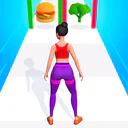

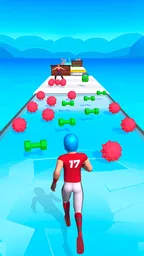
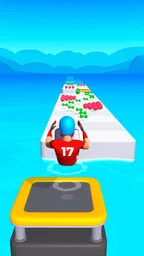
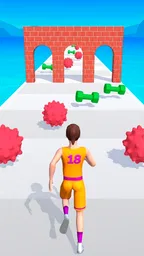

Twerk Race 3d — Fun run game! review
 Analysis by Appsdrops
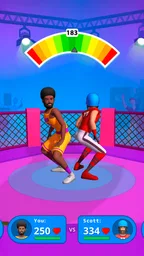
I like arcade games that explain themselves quickly, and Twerk Race 3d gets to its central idea without much ceremony: steer through a running course, collect items that affect your character, and reach a dance-off at the end. The premise is deliberately silly, which is part of the appeal. It is less about mastering a deep simulation than about making quick choices and seeing how those choices shape the finish.
In my experience, the game works best as a small, casual distraction. A round is easy to fit into a spare moment, and the combination of running and a final twerk battle gives each course a clear payoff. That structure also sets expectations: if you want a long story, intricate controls, or a demanding arcade challenge, this is probably not the game to choose. If you enjoy playful, uncomplicated races, it has a more distinctive hook than a standard endless runner.
Quick goals make the first runs easy to understand
The first goal is straightforward: move along the course and make choices that leave your character ready for the dance contest. That gives a new player something to focus on immediately, instead of asking them to learn a complicated control scheme or decode a long list of objectives. I found the race-to-battle format useful because the finish line feels like a conclusion, not just the point where a run stops.
The running sections ask you to pay attention to what lies ahead and react as you go. The challenge is therefore less about memorizing a route and more about making quick decisions while the course is moving past. That makes the game approachable on a phone, where a short burst of attention is often more realistic than a lengthy session.
The dance battle adds a playful reason to care about the race. It turns the result into a small performance, so the goal is not simply to reach the end but to arrive in a state that makes the payoff feel satisfying. I would not mistake this for a detailed rhythm game; the dance-off is part of the arcade premise, rather than a promise of deep music gameplay.
For a useful first-session approach, I would focus on learning how the course presents its choices before worrying about chasing an ideal result. Watch how the items and obstacles are arranged, and notice whether a route choice seems to support the outcome you want. That simple habit makes the runs feel more deliberate and helps avoid the common mistake of treating every visible pickup as automatically worth pursuing.
What progress feels like between the start and the finish
A good arcade loop needs clear feedback, and here the main progress signal is immediate: the runner changes during the course, then the dance contest gives the run a visible ending. That link between a choice and a result is more satisfying than collecting things with no apparent effect. It also helps younger or less experienced players understand why they are making decisions without needing a lengthy tutorial.
There is a trade-off, though. A progress signal can be easy to read without offering much strategic depth. If you prefer games where each unlock changes the way you play, or where an intricate upgrade tree rewards careful planning, this is a lighter experience. Its appeal lies in quick, legible feedback rather than long-term build crafting.
I also like that the race and battle give a session a natural stopping point. If I only have a few minutes, I can finish a run and put the phone away without feeling that I have abandoned a complicated mission halfway through. This makes it better suited to a short break than to a player looking for a substantial, continuous campaign.
That same compact structure means the game’s novelty depends on how much you enjoy its central joke and repeated format. The dance-off is a memorable finish, but a player who quickly tires of the running-and-performance pattern may find that the basic appeal wears thin. I would treat it as a pick-up-and-play arcade option, not as a game whose premise alone guarantees months of fresh play.
The challenge is about attention more than mastery
The difficulty is most comfortable for players who want a modest test of timing and route awareness. You need to notice what is coming and make a decision before the opportunity passes, but the basic idea is easy to grasp. That makes Twerk Race 3d a reasonable choice for someone who finds traditional precision platformers frustrating and still wants a little interaction beyond tapping through a passive animation.
Its challenge may feel less convincing to players who want tight, demanding controls. A runner built around quick choices is not the same as a platform game that asks for exact jumps, or a rhythm game that rewards keeping time. If your favorite arcade games make improvement depend on mastering a narrow skill, you may find this one too light. I would choose it for its comic tone and simple race structure, not for a high-skill test.
One practical tip is to play with enough attention to see the upcoming course rather than rushing through while distracted. A casual game can still punish careless decisions if its main interaction is choosing what to collect or avoid. When I am only half-looking at the screen, the race becomes less of a playful challenge and more of a sequence of missed opportunities.
The course format also makes it easy to compare a run with the previous one in your own mind: did I react sooner, choose more carefully, or reach the dance battle feeling better prepared? That kind of personal comparison can sustain a few extra attempts without needing a formal leaderboard or elaborate competitive system. It is a small but useful source of motivation for players who enjoy improving their own consistency.
Unlocks, spending, and the point where repetition sets in
Progression matters most when it gives a player a reason to return, but it should not be confused with a deep account-building system. The game’s core attraction is still the short race and its dance finish. I would go in expecting a series of arcade runs with a light sense of advancement, rather than a complex collection game where every session opens a new branch of strategy.
There is a sensible way to judge whether the progression is working for you: after a few rounds, ask whether you are still curious about the next finish or whether you are repeating the same pattern out of habit. If the races remain funny and the choices keep your attention, the loop is doing its job. If the joke has already landed and the repeated structure feels familiar, more time may not make the game deeper.
The game is free to download, with in-app purchases listed at $1.99 to $5.99 per item. I would treat those purchases as optional rather than as a reason to start spending. First see whether the basic running-and-battle loop holds your interest; if it does not, paying for an item is unlikely to solve that more fundamental mismatch. This is especially worth remembering in a quick-play game, where a purchase should feel like a personal choice, not a requirement for enjoying the premise.
For everyday use, I can see it fitting a short wait, a commute break, or a casual hand-off to someone who wants a simple game to try. The Teen content rating is useful context for families deciding whether the deliberately cheeky dance theme suits their household. I would not choose it as a quiet, story-driven game for a long flight, but its short-run format makes more sense when you want a quick distraction and can stop after a finish.
How it compares with other arcade runners
Compared with a conventional endless runner, this game gives each run a more defined endpoint and a comic payoff. Endless runners often ask you to survive for as long as possible and chase a longer distance; here, the race leads into a dance battle, so the tone and finish are part of the attraction. If you want an open-ended score chase, a familiar endless runner may suit you better. If you want a race with a deliberately absurd finale, this has a clearer personality.
It also differs from rhythm games. The dance theme may suggest that timing music is central, but I would not pick it expecting the demanding beat-matching found in a dedicated rhythm title. Likewise, it is not a replacement for a serious racing game, where vehicle handling, track knowledge, and competition are the main draw. Its category is arcade, and its strongest use is a light, humorous session rather than technical mastery.
That comparison clarifies who should skip it. Players who dislike repeated short runs, who want a substantial narrative, or who prefer finely tuned controls will likely get more from a different genre. On the other hand, someone who enjoys simple decisions, cartoonish silliness, and an end-of-run payoff may find this more entertaining than a generic runner with no distinctive finale.
Who I would recommend it to
I would recommend Twerk Race 3d to friends looking for an easy-to-understand mobile arcade game that does not demand a long commitment. It is especially suited to players who enjoy goofy premises and can appreciate a game for a few minutes at a time. The straightforward objective also makes it approachable for someone who does not regularly play games, provided the dance theme is a good fit for them.
I would be more cautious recommending it to someone who wants carefully balanced competitive play, a lot of tactical variety, or a progression system that keeps revealing new mechanics. Those are reasonable expectations for other games, but they are not the best reasons to choose this one. Its strength is immediacy: you understand the basic aim, make choices on the move, and see the result at the finish.
Freeplay Inc developed the game, which has an average rating of 4.2 from around 192,000 ratings and over 100 million installs. Those figures suggest that its simple, offbeat pitch has found a broad audience, but they do not mean every player will enjoy the repeated loop. For my recommendation, the more useful question is whether you like the particular combination of running choices and a dance-battle ending.
The game was released on September 15, 2021, and its current version is 1.100.7. It is listed for devices running Android 7.0 or later. That helps Android users check basic compatibility before downloading, while the free entry point lets them decide for themselves whether the main loop is worth keeping on their phone.
A playful loop with a clear limit
My overall view is that Twerk Race 3d knows what kind of arcade game it wants to be. It takes a simple race, gives the choices a comic context, and makes the dance battle the punctuation mark at the end. The best part is how quickly the idea becomes understandable; the main limitation is that a clear loop can also become repetitive once its central gag has worn off.
I would try it when I wanted a low-commitment distraction, especially if I was in the mood for something sillier than a standard runner. I would skip it if I were looking for deep progression, a serious racing challenge, or a rhythm game built around precise timing. Its appeal is the quick, ridiculous payoff—not a promise of endless strategic depth.
What we like
- Quick races make it easy to play in short sessions.
- Simple swipe controls are easy for new players to learn.
- Changing body sizes adds a distinctive twist to running races.
- Colorful visuals keep the tracks lively.
- The casual premise suits players seeking light entertainment.
What could be better
- Ads may interrupt the flow between races.
- Gameplay can feel repetitive after several runs.
- Progress depends on collecting enough food along the track.
- The body-size mechanic may feel awkward to some players.
- Limited depth may not satisfy players seeking a challenge.







