




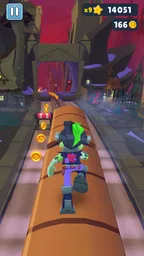



Subway Surfers review
 Analysis by Appsdrops
I like Subway Surfers best as a game I can pick up for a few minutes without having to remember a long quest or learn a complicated control scheme. Its basic appeal is immediate: run, react, collect what you can, and try to last longer than you did last time. That simplicity is also its main limitation. If you want a story-driven arcade game or a run that feels carefully planned, this may not hold your attention for long. But when I want a brisk mobile challenge that works in short bursts, it is an easy one to reach for.
Quick runs, readable action, and a familiar chase
Made by SYBO Games, Subway Surfers is a free arcade game built around an endless run through busy railway surroundings. You guide Jake, Tricky, and Fresh as they flee an Inspector and his dog, dodging obstacles and trying to keep the run going. The premise is deliberately light; the interest comes from responding to what appears in front of you rather than following a complex plot.
The controls are easy to understand, which makes the game approachable for people who do not regularly play mobile games. You swipe to steer through lanes and react to barriers, trains, and other hazards. That straightforward setup does not make every run effortless. As the pace rises, a move that feels obvious at the start can become a split-second decision, especially when obstacles narrow the available path.
That balance is a good fit for brief sessions. I can start a run while waiting for a bus or taking a short break, then stop when I have had enough. There is no need to set aside a long stretch of time to make progress in the basic experience. On the other hand, someone who wants a relaxing game with little chance of failure may find the constant demand for attention tiring rather than soothing.
Why the simple loop keeps working
The chase gives each run a clear purpose, while the changing sequence of obstacles keeps the immediate task from feeling entirely solved. I find it helpful to look a little ahead rather than fixating on the character: the next safe lane matters more than the reward directly in front of me. That small change in focus can prevent greedy detours from turning a promising run into an avoidable collision.
A useful habit is to treat coins and other pickups as optional when the route becomes crowded. The game invites you to collect things along the way, but survival is the first priority. If an item pulls you toward a risky lane, skipping it can be the smarter choice. This is a practical distinction between a run aimed at collecting and one aimed at lasting longer: trying to achieve both on every attempt can make your decisions worse.
There is also a rhythm to learning the controls. Early runs are a good time to build the habit of making deliberate lane changes, while later attempts reward looking ahead and avoiding last-second swipes. I would not expect every failure to feel fair in the moment; fast reactions can be difficult on a small touchscreen, and a distracted player can miss a hazard. Still, the simple controls make it relatively easy to understand what went wrong and try a different approach.
Progress without turning every run into a task
Endless-run games naturally make improvement visible: you can compare a new attempt with your own previous efforts and try to go farther. That personal challenge is the part I find most dependable here. It suits someone who likes short sessions and incremental goals, rather than a player who needs a fixed ending or a detailed campaign to feel that their time mattered.
For a more focused session, I would choose one goal before starting: stay alive, collect a particular amount of what appears on the route, or simply practice cleaner lane changes. Keeping one priority in mind makes the action easier to read. It also stops a run from becoming an unfocused scramble in which every pickup seems equally important.
One trade-off is that an endless structure can blur together. If you are not interested in beating your own performance or repeating a familiar loop, the basic chase may begin to feel samey. This is not the best pick for someone looking for a series of distinct levels with a clear final stage. Its appeal depends on whether the act of reacting, restarting, and gradually improving is satisfying on its own.
Purchases, fairness, and what a free game means
The game is free to download, with optional in-app purchases priced from $0.99 to $99.99 per item. That range is worth noticing before you hand a device to a child or decide how you want to spend. I would approach any purchase as optional entertainment rather than something required simply because the game is free. The listed age rating is Everyone 10+, which is another useful point for families considering whether it is suitable.
Those purchase facts alone do not establish exactly what each item does, how often prompts appear, or whether a purchase changes competitive outcomes. I would not assume that paying guarantees a better run or that every purchase is necessary for progress. If spending is a concern, the sensible approach is to check the purchase details in the app store and use the device’s purchase controls where appropriate. That keeps the decision grounded in what is actually shown at the point of purchase instead of guessing about the game’s economy.
For fairness, I would separate the personal challenge from comparisons with other players. The reliable test available to any player is whether they can improve their own runs through better timing and route choices. I cannot responsibly claim that purchases do or do not affect every form of competition without knowing the exact mechanics involved. If you mainly want a contest where everyone’s tools and conditions are explicitly identical, a game with clearly defined competitive rules may be a better fit.
There are other unknowns that matter to some players, including the precise purchase flow and how any particular item affects play. Those details should be checked in the app itself before spending; I would not infer them from the existence of optional purchases. This is a small but important distinction: a free download and a listed price range tell you that paid items exist, not whether you personally need them or whether they suit your preferences.
How it compares with other arcade choices
Compared with arcade games built around a single-screen score chase, this one puts more emphasis on movement through a forward-running course. You are choosing lanes and reacting to a sequence of obstacles rather than staying in one arena. That gives each attempt a stronger sense of motion, but it also means the game can demand more visual attention than a slower puzzle-style arcade title.
Compared with story-led action games, it is much lighter on narrative and structured progression. I would choose it for a spare moment, not as a substitute for a game with a substantial campaign. It is also less suited to players who prefer thoughtful, turn-based decisions: here, hesitation can be as costly as a mistaken move. Those differences make the choice fairly clear. If quick reflexes and repeat attempts sound enjoyable, the format has a lot to offer; if you want calm planning or a sense of completion, another style will likely serve you better.
Its scale is striking for a mobile arcade game: it has more than a billion installs and an average rating of 4.6 from around 41 million ratings. Those figures suggest broad reach, but they do not tell me whether you will enjoy repeating runs. I would use them as context rather than proof of quality. The more useful question is whether a fast, familiar chase fits the way you like to play.
Practical fit, device basics, and my verdict
The game was released on September 20, 2012, and its current version is 3.71.11. It runs on Android 7.0 or later, so checking the operating system before installing is worthwhile if you have an older device. It is also a good candidate for a short commute or a quick break, provided you can give the screen your attention; it is not something I would recommend playing while walking through a busy area or doing another task that needs focus.
Subway Surfers remains a strong choice when I want an uncomplicated arcade run with quick restarts and a clear reflex challenge. Its best qualities are accessibility, short-session convenience, and a loop that rewards paying attention to the route instead of chasing every pickup. Its weaker side is the same repetition that makes it easy to return to: players who need varied objectives, deep strategy, or a definitive ending may lose interest. I would recommend trying it if you enjoy testing your reactions and improving one run at a time, while keeping purchases optional and checking their details before spending.
What we like
- Quick sessions make it easy to play during short breaks.
- Swipe controls are simple to learn and responsive.
- Daily challenges give players goals beyond chasing a high score.
- Hoverboards provide a useful way to recover from mistakes.
- Regular themed updates keep locations and rewards feeling fresh.
What could be better
- Frequent ads can interrupt play unless you make an in-app purchase.
- Progress can feel slow without collecting coins and completing missions.
- Some character and board items require substantial grinding.
- The core endless-runner gameplay can become repetitive over time.
- An internet connection may be needed for certain events and features.







