




Temple Run review
 Analysis by Appsdrops
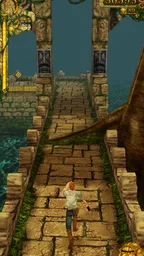
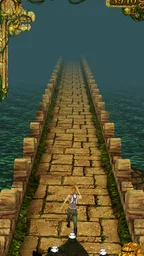
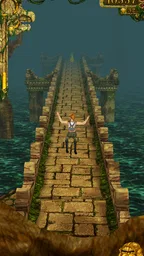
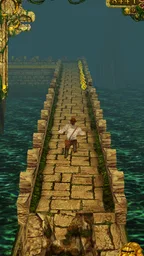
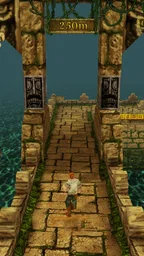
I think Temple Run is at its best when I have a spare minute and want a game that gets moving without asking me to learn a complicated setup. It puts the focus on reacting: keep running, read the path ahead, and make quick choices before the ruins catch up with you. That simple premise is easy to understand, but it still takes practice to handle the turns, gaps, and obstacles smoothly when the pace rises.
Quick runs built around sharp reactions
As an arcade game from Imangi Studios, it suits short, self-contained sessions more than long stretches of planned play. I can open it for a quick attempt, make a few decisions under pressure, and stop when I am ready. The design is especially convenient for a commute, a brief break, or a moment when I do not want to keep track of a story or a complicated set of objectives.
The basic appeal is the way an apparently simple run becomes harder to control the longer it goes. Early on, I can concentrate on learning what the path is asking me to do. Later, familiar actions arrive in quicker succession, so a moment of hesitation matters. That gives each attempt a clear rhythm: settle in, react, and see how long I can keep my attention steady.
The game is free to download, and its in-app purchases range from $0.99 to $19.99 per item. I would treat that as useful context rather than a reason to assume that spending is required. A player can decide whether the free experience is satisfying before considering any purchase. If you prefer to avoid optional spending altogether, it is sensible to check the purchase controls on your device and involve a parent or guardian for a younger player.
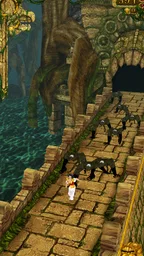
The audience rating is Everyone, which makes the game broadly accessible as an arcade choice. That does not mean every player will enjoy its pressure. The pursuit and repeated runs create tension, and the central challenge is reacting quickly rather than relaxing through a calm or story-led experience. If you are choosing a game for someone who dislikes urgency, the age label alone will not settle whether the style is a good fit.
Why progress feels earned, and why it can be frustrating
Temple Run’s strongest hook is that improvement is easy to notice in your own play. A run that ends quickly can reveal a particular mistake: I turned late, failed to prepare for a gap, or let my attention drift. That makes restarting feel purposeful rather than random. I am not simply waiting for a new scene; I am trying to carry one lesson into the next attempt.
A useful habit is to focus on the next decision instead of thinking about a personal best while the run is still going. When I start chasing distance in my head, I become less attentive to the path directly in front of me. Treating each obstacle as its own small problem keeps the game readable for longer. This is a practical difference between a satisfying attempt and one that ends because I was mentally congratulating myself too early.
Another small but helpful approach is to notice which kinds of moments repeatedly trip you up. If a run tends to end after a late turn or a missed jump, give that action your full attention when it comes around rather than trying to correct every weakness at once. The game works well for this kind of self-coaching because a failed attempt is short enough to remember clearly. I find that more useful than blaming a bad run on luck without identifying what happened.
The same structure can also become repetitive. Since the main pleasure is the run itself, players who want a changing narrative, a large social layer, or a deep character-building system may find the loop too narrow. I would not recommend it as a substitute for a longer adventure when the goal is exploration or plot. It is a better match when the goal is a quick test of attention and timing.
Fairness, purchases, and what a player can judge
When I think about fairness here, I separate the skill challenge from the spending question. The confirmed purchase information gives a price range for in-app items, but it does not describe what each item does or how purchases affect play. So I would not claim that buying anything is necessary, nor promise that spending has no effect on a player’s experience. A cautious approach is to try the game without paying and make a decision only if an in-game purchase is clearly relevant to what you want.
That distinction matters for families and for anyone trying to keep mobile spending predictable. A free download can still present paid options, so I would check the device’s purchase settings before handing the game to a child. The game is rated Everyone, but that rating does not replace a household rule about purchases. If a player is uncomfortable with optional transactions appearing in games, they may prefer an arcade title with a purchase model they already understand.
In competitive terms, the challenge is personal and immediate: can I respond well enough to keep the run alive? I would choose this over a puzzle game when I want reflexes to matter more than deliberation. Compared with other endless-runner-style arcade games, its appeal is the directness of the chase and the need to react to the route in front of me. A slower score-chasing game may be a better alternative if you want more time to plan each move.
There is a trade-off in that directness. The quick decisions make the game easy to pick up, but they also mean that a mistake can end a promising run before I have much time to recover. If you dislike restarting after failure, that pressure may feel unfair even when the challenge is simply part of the format. I find it more enjoyable when I treat each run as practice, not as a long investment that must pay off.
Practical fit for everyday play
A realistic use case is a short wait when I have one hand free and only a little time to fill. I can play an attempt, put the phone away, and return later without needing to remember a mission or a long sequence of story events. That makes it more convenient than games that expect a continuous session. It is less suitable when I need to keep my attention on something else, because the game’s rising pressure rewards focus rather than casual glances.
For a newcomer, I would begin by learning the basic rhythm before worrying about performance. Keep your attention on the next section of the route, and do not let a long run make you assume that the rest will be easy. If you are introducing it to a child, it can help to explain that the point is improving reactions, not winning every attempt. That framing makes short failures easier to accept and keeps the experience from turning into a demand for repeated retries.
Temple Run can also be a useful choice for someone who wants an arcade game with little setup. Its premise is immediately clear, and its challenge comes from execution rather than from reading instructions or managing a complex plan. On the other hand, players who need a strong sense of progression beyond improving their runs should compare it with games built around campaigns, puzzles, or longer-term goals. Choosing based on the kind of attention you want to give is more useful than choosing by popularity alone.
The game has an average rating of 4.2 from around 5.1 million ratings, and it has received about 321,000 written reviews. It has been installed over 500 million times, which helps explain why it is such a familiar example of mobile arcade play, but those figures do not tell me whether its fast, repeatable loop suits a particular person. I would use them as context, then decide based on whether a short, reflex-driven challenge sounds enjoyable.
Compatibility and a measured recommendation
The current version is 1.43.0, and the game requires Android 7.0 or later. It first appeared on March 26, 2012, so it has been around long enough to be a recognizable mobile game rather than a new experiment. Before downloading, I would still check that the device meets the operating-system requirement and that the player is comfortable with the purchase options. The game is free to start, while individual in-app items cost between $0.99 and $19.99.
My recommendation is straightforward: try it if you enjoy fast reactions, brief sessions, and the satisfaction of learning from a mistake. Skip it if you want a calm game, a story to follow, or a clear guarantee about how optional purchases affect progression. Imangi Studios’ arcade runner earns its place as an easy game to understand and a challenging one to master, but its pressure and repetition are central to the experience, not minor details to overlook.
For me, the most trustworthy way to approach it is to keep expectations modest: download it for the running challenge, play without assuming that purchases are needed, and stop when the loop stops being fun. That leaves room to enjoy the quick bursts of focus it does well, while recognizing that another kind of arcade game may be a better fit for players who want more variety or less urgency.
What we like
- Simple swipe controls make it easy to learn.
- Runs smoothly on many older phones.
- Short sessions suit quick breaks.
- Coins unlock useful upgrades and new characters.
- Endless runs encourage replay and score chasing.
What could be better
- The gameplay can feel repetitive over time.
- Later runs demand quick reactions and precise swipes.
- Ads may interrupt play between runs.
- Some upgrades take a long time to earn.
- Accidental swipes can end a promising run.







