
Tower War - Tactical Conquest review
 Analysis by Appsdrops
I like arcade strategy games that make me think quickly without asking me to learn a long rulebook. Tower War - Tactical Conquest has that appealing premise: send groups across a compact battlefield, claim territory, and try to outmaneuver the other side. In practice, its strongest moments come from choosing where to commit and when to wait. It is easy to understand at a glance, but a careless move can leave your map exposed.
That mix makes it a better fit for short bursts than for a slow, deeply customizable strategy campaign. I would recommend it to someone who enjoys watching a simple plan unfold and adjusting it on the fly. If you want a game built around long sessions, elaborate army management, or a detailed competitive ruleset, this is probably not the one to install first.
How the map-control battles feel
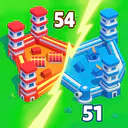
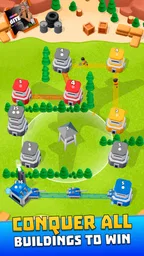
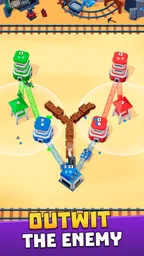
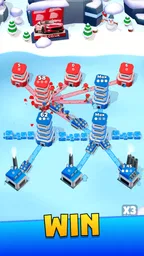
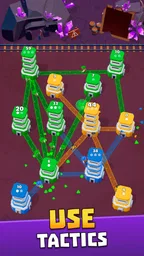
This is an arcade game from SayGames Ltd, centered on taking and holding ground rather than on the usual reflex test of dodging hazards or chasing a high score. The map gives each move a visible consequence: a route toward an opponent may create pressure, while sending units elsewhere can leave a useful position poorly defended. That spatial tug-of-war is what gives the game its identity.
The basic appeal is immediate. You look at the field, decide where your attention matters most, and try to turn a small advantage into control of more of the map. I found that clarity helpful on a phone screen: there is a clear objective, and the action does not depend on memorizing a large set of menus before a match becomes understandable.
But “simple” does not mean that every choice is automatic. A move that looks aggressive can be wasteful if it draws too much force away from another part of the board. A more cautious approach can buy time, but waiting too long may let an opponent gain ground. The game works best when I treat each decision as a trade-off instead of tapping toward the nearest open space.
Small decisions matter more than frantic tapping
One useful habit is to scan the whole map before committing. It is tempting to focus on the most obvious target, especially when the action is moving quickly, but a glance at the rest of the field can reveal that a seemingly minor position is more important to protect. This is a practical difference from many arcade games, where the main challenge is simply reacting fast enough.
I also recommend making moves with a purpose. Before sending a group, decide whether the goal is to expand, defend, or pressure an opponent. That tiny pause makes the match feel more deliberate and helps prevent the common mistake of spreading effort across several directions without securing any of them. It is not a complicated strategy system; it is simply a better way to read the map.
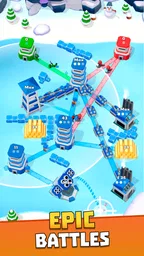
Another trade-off is that a visually busy moment can make it harder to keep track of your overall plan. When several areas need attention, I find it more useful to prioritize the position that could change the balance of the match than to respond to every movement equally. Players who enjoy constant, precise control may find that abstraction frustrating, while players who like quick tactical choices may find it liberating.
Where it sits among arcade and strategy games
Compared with a conventional arcade game, Tower War asks for more planning and less pure reflex. Compared with a full strategy title, it pares the experience down: the attraction is the immediate map contest, not a sprawling campaign of systems to manage. That middle ground is its main strength. It gives casual players a taste of tactical thinking without demanding a long setup or a specialist’s knowledge.
The compromise is depth. If you usually choose games for layered progression, a broad range of build options, or highly detailed control over an army, the streamlined approach may feel restrictive. I would pick a larger strategy game when I want a session that rewards studying systems over time. I would pick this one when I want a quick contest where the map is the puzzle and the next decision is easy to grasp.
For a realistic everyday use, imagine having a few spare minutes while waiting for an appointment. This is the kind of game I would open when I want something more engaging than a reflex-only distraction but do not want to settle into a long campaign. The map gives me something to think about, and the compact premise makes it easier to step in without preparing beforehand.
What the current release tells players
The game was released on June 24, 2021, and its current version is 1.30.1. Those facts give useful context: this is not a brand-new concept being introduced for the first time, but an established mobile game that has continued to receive version updates. I would not treat the version number alone as proof of any particular new feature, though. It tells you which release is current, not what changed in every update.
For someone already playing, the practical advice is straightforward: check that the installed app is up to date before judging how it currently runs. Updates can matter to day-to-day use, but I would separate that sensible habit from expectations about new mechanics or a changed balance. The available version and release details do not, on their own, establish a feature-by-feature history.
That distinction matters because players often see a later version and assume the game has transformed. Here, I would judge the experience by its core appeal: quick map decisions and tactical pressure. If that loop is what you enjoy, the current release is the relevant one to try. If you are waiting for a particular mode or system, do not assume it is present simply because the version has advanced.
Who is likely to enjoy it
I think it suits players who like compact territory battles, clear objectives, and decisions that can be understood without a lengthy tutorial. It is also a reasonable choice for someone curious about strategy but wary of games that bury the main action under menus and resource management. The map itself supplies the problem: where to apply pressure, what to secure, and when not to overextend.
It may be less satisfying for players who want a relaxing, hands-off experience. Even a simple tactical game asks you to pay attention, and the push to take ground can make a match feel tense rather than soothing. It is also not my first recommendation for anyone who expects deep control over every unit or wants a richly explained competitive environment. Those players may be happier with a more involved strategy game.
The title is free to download, with in-app purchases ranging from $0.99 to $99.99 per item. That wide spread makes it sensible to look carefully at purchase prompts rather than assuming every optional item is a small add-on. I would start by playing without spending and decide whether the core loop is enjoyable first. If you prefer a game with no in-app purchase options at all, this may not meet that preference.
Its audience rating is Everyone 10+, so I would take that age guidance into account when choosing it for a younger player. The game has an average rating of 4.2 from around 700,000 ratings, with about 18,000 written reviews and over 100 million installs. That scale suggests it has reached a broad audience, but popularity is not a substitute for personal fit: the tactical, map-focused loop is still the key question.
Friction worth knowing before you install
The most important limitation is also tied to the game’s simplicity: a compact tactical loop can become repetitive if you need each session to introduce a new kind of challenge. I would not approach it expecting the breadth of a large strategy campaign. Its appeal is concentrated in the contest for territory, so whether that remains enjoyable depends on how much you like revisiting the same kind of decision under changing pressure.
There is also a difference between “easy to start” and “effortless to play.” The rules may be approachable, but good decisions still require attention to more than one area. If you are opening a game while distracted, you may make moves that feel arbitrary rather than satisfying. My tip is to give each match a little focus: look across the map, choose one priority, and reassess after the situation shifts.
Players who dislike purchase prompts should also keep the in-app purchase range in mind. Free entry is useful for testing whether the game suits you, but it does not mean every optional transaction has the same cost. I would avoid buying anything impulsively and first decide whether the base experience provides enough enjoyment for your habits.
What to watch as you keep playing
For new players, the best test is not whether the game looks simple in the first minute, but whether its map decisions remain interesting after the initial novelty. Notice whether you enjoy weighing expansion against defense, and whether you like adjusting a plan when the board changes. If those choices feel rewarding, the focused design is doing its job. If you want more systems to master, that same focus may feel narrow.
For returning players, I would watch for the current version in the app store and evaluate updates on what they actually change, rather than assuming that a higher version number promises a particular addition. The release information establishes the present version, while future content remains a matter of expectation. That is a sensible distinction for any ongoing mobile game, especially one whose attraction rests on a clear, familiar core loop.
Overall, I see Tower War as a good pick for short, tactical sessions when you want an arcade game with more thought than a simple reflex challenge. Its map-based decisions give it a recognizable personality, and its accessible premise makes it easy to recommend to curious casual strategists. I would skip it if you need deep campaign systems, dislike in-app purchases, or want a completely passive distraction. For me, its best use is a focused spare-moment match: scan the field, commit with a reason, and enjoy the small satisfaction of turning a tactical choice into control of the map.
What we like
- Quick matches make it easy to play in short bursts.
- Simple controls are approachable for new strategy players.
- Capturing towers creates satisfying tactical decisions.
- A range of levels keeps the campaign varied.
- The minimalist visuals make the battlefield easy to read.
What could be better
- Later levels can feel difficult without careful planning.
- The core tower-capture loop may become repetitive.
- Winning often depends on timing and rapid decisions.
- The small units can be hard to distinguish at a glance.
- Progress may feel slow when a level takes several attempts.







