




Stickman Hook review
 Analysis by Appsdrops
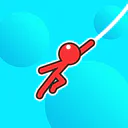
I can see why Stickman Hook catches on quickly: the whole game is built around a simple, satisfying action—swinging a stick figure through a course by hooking onto points and letting momentum do the work. That makes it easy to understand in a spare moment, but the real question is whether its short bursts of play stay enjoyable after the novelty wears off. My answer is yes, with a caveat: it’s best as a lightweight arcade game you return to when you want a quick challenge, not as a deep game to make your main hobby.
Why the first sessions click
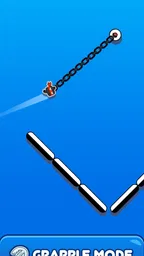
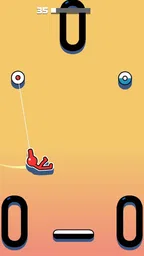
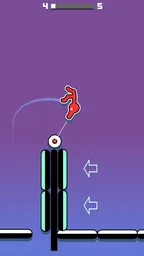
Developed by Madbox, this free arcade game strips its central idea down to an inviting loop. You tap to catch a hook, release to launch forward, and try to carry your motion through the level. The controls are uncomplicated, but the timing is not automatic. A small change in when I let go can turn a clean arc into a missed landing, so even a basic-looking course asks me to pay attention.
That gap between simple controls and careful timing is the game’s strongest early hook. I don’t need to learn a complicated move set before I can enjoy a run, and failure is easy to understand: I released too soon, held on too long, or misjudged the swing. When a level goes wrong, restarting and trying a slightly different rhythm feels natural rather than like a chore.
The stickman’s movement gives each successful swing a pleasing sense of flow. It’s not a physics sandbox where I can improvise endlessly; the courses guide the action. Still, the feeling of building momentum and clearing a stretch in one smooth sequence gives the game a little more texture than a basic tap-to-jump arcade title. For a commute, a short wait, or a break between tasks, that focused loop is a good fit.
The game’s broad reach is understandable: it has an average rating of 4.2 from around 558,000 ratings, with more than 100 million installs. Those figures suggest a familiar pick-up-and-play appeal, not a guarantee that every player will love it. I’d recommend it first to someone who enjoys reflex challenges, quick retries, and learning a course through practice.
What makes the swinging feel rewarding
The main skill is not simply tapping quickly. I get better results by watching where the next useful hook sits and thinking about the direction I’ll be moving when I release. If I focus only on the stickman’s current position, I tend to react late. Looking ahead turns the course into a sequence of small decisions: attach, build a useful arc, then let go with enough room to continue.
One practical tip is to avoid treating every hook as something I must hold for as long as possible. More time attached can mean more swing, but it can also send the character past a helpful angle. Releasing earlier can produce a cleaner line, especially when I’m trying to set up the next part of the course. This is the kind of small adjustment that makes retries feel like learning rather than random luck.
Another useful habit is to change only one thing after a failed attempt. If I alter the timing and my attention at the same time, it’s hard to tell what helped. A slightly earlier release is a clearer experiment. That approach makes the game more satisfying for players who enjoy refining a movement pattern, though anyone looking for a relaxed, consequence-free toy may find the repeated precision work less appealing.
Who should make room for it
I’d point casual players toward it when they want an arcade game that can be understood without a long tutorial or a big time commitment. It also suits people who like repeating a compact challenge until the movement feels right. Because the basic interaction is so direct, it can work as a small palate cleanser between more demanding games.
It is less suitable if you want a story to follow, a large strategic layer, or a sense of progress built around long play sessions. The pleasure here is in controlling the swing and clearing the course, not in managing a cast of characters or building a world. If you usually prefer puzzle games that reward planning over reflexes, or action games with more varied tools, the usual alternatives in those categories may hold your attention longer.
The age rating is Everyone, which makes the presentation approachable for a wide audience. I’d still keep expectations centered on its arcade challenge: younger players may enjoy the motion and quick attempts, while those who dislike repeating a section to get the timing right may lose patience. The game is free to download, with in-app purchases ranging from $0.99 to $20.99 per item, so it’s sensible to keep purchase settings in mind if a child will be playing.
Does it stay worthwhile after the first week?
The first-week appeal comes from how quickly I can move from curiosity to competence. I don’t have to memorize a long list of controls. Instead, I learn through short attempts, noticing how a release affects the next swing. That creates an easy reason to open the game again: I can make another run without setting aside an evening or reconstructing where I left off.
For month-to-month value, the key question is whether improving at that loop remains enjoyable. If I like chasing smoother runs and correcting small mistakes, there’s a good chance I’ll keep returning. If I need each session to introduce a substantially different activity, the core mechanic may start to feel familiar. The same consistency that makes it easy to pick up can also limit its variety for players who tire of mastering one central skill.
Compared with many arcade alternatives, Stickman Hook puts more emphasis on momentum and release timing than on rapid sequences of different actions. A conventional endless runner may ask me to dodge and switch lanes repeatedly; a platform game may focus on jumps and enemy patterns. Here, the challenge is reading the swing and deciding when to let go. That gives it a distinct feel, but it also means a player who wants frequent changes in mechanics may prefer those other formats.
Keeping the game in a healthy routine
The maintenance burden is low in the everyday sense: it’s easy to return for a quick round because the basic controls stay memorable. The current version is 9.9.51, and the minimum operating-system requirement is 8.0. Those details make it easier to check whether a device can run it, while the game’s short-session structure helps it fit into an existing routine rather than demanding a new one.
I wouldn’t turn it into a daily obligation just to preserve its appeal. Its best use is opportunistic: a few attempts while waiting for food, sitting on transit, or taking a brief break from work. In that everyday scenario, the clear objective and immediate feedback are strengths. I can stop after a run without feeling that I have abandoned a complicated task halfway through.
For a longer session, I’d set a personal stopping point. Repeating a course can be enjoyable while each attempt teaches me something, but after several identical mistakes I may be reacting rather than learning. Taking a break and returning later can be more useful than tapping through another frustrated retry. That’s a practical way to keep the game’s satisfying movement from turning into a test of patience.
There’s no need to approach it as a game that must occupy a permanent spot in a daily rotation. Its value is that it can be ready for a spare moment, and that it offers a compact skill challenge when I want one. Someone who plays in bursts may get more from it than a person who expects a steady stream of new systems to explore.
Where fatigue can set in
The biggest source of fatigue is repetition. Because swinging is the central activity, missed timing can lead to retries that feel similar, particularly when I’m not changing my approach. The cleanest way to keep that from becoming dull is to pay attention to the reason a run failed and make a deliberate adjustment. If I’m no longer interested in that small process of trial and correction, there may not be enough else to pull me back.
Another trade-off is that the controls are easy to grasp but still demand restraint. A player may assume that holding longer always produces a better swing; in practice, overcommitting can spoil the next move. The game rewards watching the course rather than tapping on instinct alone. That’s a satisfying lesson for someone who likes fine timing, but it can feel fussy to anyone hoping for a completely casual, hands-off experience.
Its free entry point makes trying it straightforward, but the presence of in-app purchases is worth considering before handing a device to a child or playing without purchase controls in place. I also wouldn’t choose it as my go-to option when I want a substantial narrative, a collaborative experience, or a deep progression system. Those aren’t shortcomings in the narrow arcade loop so much as reasons to choose a different kind of game for a different mood.
My long-term verdict
For me, Stickman Hook earns a place as a small, reusable arcade diversion rather than a game that needs to dominate my screen time. It has a clear identity, responsive-feeling timing challenges, and a loop that makes sense in brief sessions. Its release date was November 2, 2018, and its continued audience is substantial, but longevity still depends on whether I enjoy refining the same kind of movement rather than waiting for a radically different activity.
I’d suggest trying it if you want a free game for short breaks and like learning through quick retries. Go in expecting momentum, timing, and course-by-course improvement—not a broad adventure. If a missed swing makes you curious about what to change, it can remain enjoyable beyond the first burst of novelty. If repeated attempts feel like busywork to you, a puzzle game, a story-led title, or an arcade game with more varied mechanics will probably be a better fit.
My recommendation is measured but positive: keep it installed if you value an easy-to-resume challenge and don’t mind repetition. It doesn’t need elaborate maintenance or a strict play schedule to be useful; a few thoughtful attempts are enough to enjoy what it does well. That’s a modest promise, but one this arcade game can deliver for the right player.
What we like
- One-touch controls make swinging easy to learn.
- Short levels suit quick play sessions.
- Timing swings well gives each run a satisfying rhythm.
- Bright visuals keep the action easy to follow.
- Unlockable characters add a simple collection goal.
What could be better
- Missed hooks can end a run abruptly.
- Physics can feel unpredictable during tricky swings.
- The core swinging mechanic can become repetitive.
- Ads may interrupt the flow between levels.
- Some character unlocks require substantial play time.







