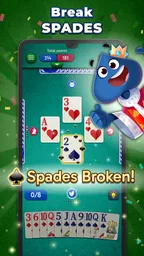
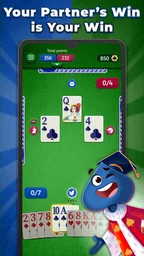
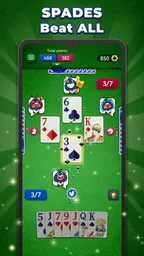

Spades Stars - Card Game review
 Analysis by Appsdrops
I like a card game best when it lets me focus on the hand in front of me instead of making every session feel like a chore. Spades Stars is aimed at that kind of player: it brings the familiar trick-taking game to a phone and is designed to be playable offline. My overall impression is that it works best as a convenient way to enjoy a few rounds of Spades, whether I have a quiet break to fill or want a simple game to share with friends. It is less suited to someone looking for a broad collection of card games or a deep competitive platform.
A familiar game that fits short breaks
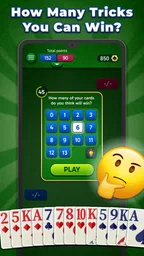
Spades is easy to recognize but rewarding to play well. You estimate how many tricks your hand can take, make a bid, and then try to meet that estimate while reading the choices around the table. That mix of planning and uncertainty gives each hand a little tension. In this game, the appeal is the chance to get straight to that familiar decision-making without needing a physical deck or a place to sit down together.
The offline focus is especially useful in ordinary situations. I can imagine opening it while waiting for an appointment, riding somewhere without reliable service, or passing a phone between friends during a relaxed evening. That flexibility is more meaningful than it sounds: a card game that depends on a steady connection is a poor companion when the network drops. Here, offline play is part of the central appeal rather than an afterthought in the pitch.
Bluetile develops the game, and its identity stays focused on Spades rather than trying to turn the experience into an all-purpose gaming hub. That focus is a strength if you already enjoy the rules and simply want a digital table. It also sets expectations: players who want poker, hearts, solitaire, and other familiar options in one place should look for a broader card collection instead.
Why the classic format still works on a phone
The strongest part of Spades is the small amount of information that can change a hand. A bid is not just a guess about the cards you hold; it is a commitment that shapes how cautiously or boldly you play the tricks that follow. A strong-looking hand can still become awkward if the timing is wrong, while a modest hand may be useful when your bid leaves room to support a partner. That gives the game more texture than a simple sequence of card comparisons.
For a newcomer, I recommend treating early rounds as practice in estimating rather than trying to win every trick. Notice which suits are likely to run out, remember what has already been played, and use that information to judge whether a high card is still powerful. Experienced players can use the same moments to refine their bidding discipline. The practical lesson is to make a bid you can explain, not one based only on the excitement of seeing a few high cards.
A useful way to enjoy short sessions is to decide in advance what you want from them. If I have only a few minutes, I can play for the pleasure of making sensible bids and accept that a single hand may turn on luck. If I have more time with friends, I can focus on the conversation and treat the score as a backdrop. This makes the game adaptable without requiring a different mode of play for every occasion.
Where it sits among card-game alternatives
Compared with solitaire, Spades asks more of me because the challenge comes from anticipating a changing table rather than solving a fixed arrangement alone. Compared with a general card-game app, its narrower scope is the trade-off: it offers a clear reason to open it if Spades is what I want, but less variety when I tire of that one game. A physical deck still has the advantage for a group gathered around a table, since everyone can see the cards and talk naturally; a phone is more convenient when the deck is not available or the group wants a quick start.
The offline emphasis also distinguishes the experience from online card play. If the main attraction for you is finding opponents, watching rankings, or building a social circle around competitive matches, an online-first game is likely a better fit. If you simply want Spades available when you are away from a connection, this is the more practical kind of choice. I would decide based on whether convenience or a large, active online community matters more to me.
What the numbers suggest—and what they do not
The game has an average rating of 4.8 from around 170,000 ratings, and it has passed one million installs. Those figures suggest that it has found a substantial audience among people seeking this style of card game. They are useful context, but I would not treat popularity as proof that every player will enjoy the same pace or presentation. The real question is whether a focused Spades experience matches the way you like to play.
It is free to download, with optional in-app purchases priced from $0.99 to $99.99 per item. That range is broad, so I would take a moment to check purchase prompts and the item details before spending. A free starting point makes it easy to try the game, but anyone who prefers to avoid optional spending altogether should be attentive to the in-app purchase setup rather than assuming every part of the experience is paid for once and done.
The practical trade-offs to keep in mind
The biggest limitation is also the clearest part of its identity: this is a dedicated Spades game, not a varied card library. If I have the urge to switch from trick-taking to a different card format, I need another app. That narrowness will feel refreshing to a Spades regular and restrictive to someone who wants one download to cover several moods.
Another consideration is that the game’s offline appeal does not automatically make it a substitute for playing with people in person. If what you enjoy most is reading a friend’s expressions, negotiating bids aloud, or sharing the table, the phone version cannot reproduce that social atmosphere. It is better understood as a convenient way to play Spades when a physical game is impractical, or as a way to pass time on your own.
The game is rated for Everyone, which makes it approachable as a family-friendly card choice. Still, the best match depends on whether the people playing already know Spades or are willing to learn its bidding and trick-taking rhythm. For a first-timer, I would start slowly and focus on understanding how bids affect later choices; for a regular player, the enjoyment comes from making sharper estimates and adapting as cards are revealed.
Who I would recommend it to
I would point a casual Spades fan toward this game if they want a ready-to-hand option for travel, waiting rooms, or quiet moments at home. It also makes sense for someone who likes card games but does not always have another person nearby or a deck in reach. The straightforward premise makes it easy to understand why to open it, and the offline angle is particularly helpful when connectivity is unreliable or simply not part of the plan.
I would be more hesitant to recommend it to a player whose main goal is a deep online ladder, a broad assortment of card games, or the richer table talk of a face-to-face match. Those are not small preferences; they change what makes a card game satisfying. In those cases, a multiplayer-focused option, a general card collection, or a real deck may serve better than a single-game mobile experience.
It is also worth checking device compatibility before installing: the current version is 2.7.3 and requires Android 7.0 or later. The game was released on January 23, 2024, and its age rating is Everyone. I see those details as useful for deciding whether it will run on an older device and whether it fits the household, rather than as reasons on their own to choose it.
My verdict
For me, Spades Stars succeeds by keeping its promise modest and useful: it gives Spades fans a convenient way to play without requiring a physical deck or a dependable connection. Its best qualities are its focused card-game identity and its suitability for casual sessions; its main compromise is that it does not aim to replace a broader card collection or the social feel of a real table.
I would try it if I already enjoy bidding and trick-taking, especially if I want a game I can keep available for downtime. I would skip it if I rarely choose Spades or if online competition and variety are essential to my idea of a good card app. For the right player, it is a sensible, approachable way to get a few hands in; for everyone else, its narrow focus is a reason to choose something different.
What we like
- Quick matchmaking makes it easy to start a game.
- Clear card visuals are easy to read on small screens.
- Short rounds suit casual play sessions.
- The rules are approachable for new Spades players.
- Online play adds variety beyond computer opponents.
What could be better
- A stable internet connection is needed for online matches.
- Match quality can depend on finding active players.
- Ads may interrupt the free-to-play experience.
- Random teammates can make coordinated play difficult.
- Some features or rewards may require in-app purchases.







