






Solitaire Grand Harvest review
 Analysis by Appsdrops
I like solitaire best when I can settle into a steady rhythm: scan the cards, make a choice, and see how the board changes. Solitaire Grand Harvest builds that familiar Tripeaks routine into a light, farm-themed card game, with Kevin Bacon as part of its playful presentation. It is easy to understand after a round or two, but the changing layouts give each deal enough variety to keep me thinking rather than simply tapping whatever card is available.
How a typical session plays
The basic loop is straightforward. You remove cards from the layout by choosing ones that follow the game’s sequence, using the stock when the board does not offer a useful move. That makes each turn a small decision: take an available card now, or consider whether another choice could preserve a better route through the remaining cards. The appeal is less about complicated rules and more about managing a limited run of opportunities.
In practice, I find it works well in short breaks. A round gives me a clear task and a natural stopping point, so I can play while waiting for an appointment or during a quiet stretch of a commute. It is also easy to pick up without needing to remember a long campaign or a complicated hand of rules. If you already know classic solitaire, the transition feels quick; if you do not, the game’s central pattern is simple enough to learn by playing.
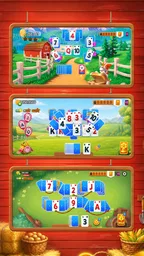
The farm setting gives the game a warmer identity than a plain card table, while the Tripeaks format keeps the cards in the foreground. That balance matters: the presentation makes progress feel cheerful, but the actual decisions still come from reading the layout. I would describe it as a casual card game with a progression wrapper, rather than a deep strategy game dressed up with scenery.
One useful habit is to pause briefly before using the stock. I try to compare the currently playable cards and ask which move could uncover more of the layout, rather than automatically choosing the first card that fits. This will not make every deal winnable, but it helps me avoid spending a useful option on a move that clears little. When the board is nearly open, I also look at the exposed sequence before committing, since a card that seems convenient now may leave fewer sensible choices next.
That small planning step is the difference between playing on autopilot and feeling involved. Still, I would not expect every round to reward careful thought equally. The game is designed for relaxed repetition, and luck in the order of available cards can limit how much a player can control. I enjoy it most when I treat a difficult deal as a quick puzzle, not as a test I must solve perfectly.
Settings and spending choices worth checking
Before settling in, I recommend checking the available in-game settings and the controls on your own device. A card game depends on clear visual reading and comfortable taps, so display brightness, text size options if available, and sound preferences are worth adjusting to your habits. I avoid assuming that every device or version presents the same controls, but taking a moment to make the interface comfortable can make repeated rounds less tiring.
It is also worth being deliberate about purchases. The game is free to download, while in-app purchases range from $0.49 to $349.99 per item. That is a broad spread, so I would not tap through a purchase prompt without checking the amount and what is being offered. If you prefer to keep mobile games strictly free, you can approach it with that boundary in mind and decline optional spending rather than treating a purchase as part of the basic rules.
For parents, the age rating is Everyone, but I would still review purchase controls on a shared device. A child-friendly rating and optional in-app purchases are separate considerations. If a device is used by several people, I find it sensible to use the platform’s purchase safeguards and to make clear that the game can be played without casually approving paid items.
The game is made by Supertreat - A Playtika Studio. Its current version is 2.429.1, and it requires Android 7.0 or later on Android devices. Those details are useful when deciding whether an older phone or tablet is likely to be suitable, though the practical experience will still depend on the device. On iOS, I would check the app store compatibility details for the device in question before installing.
Repeatable habits that make rounds smoother
Experienced play here is less about a secret trick and more about keeping a consistent process. I scan the exposed cards, identify the moves that reveal new cards, and only then choose among the available options. If two choices appear equally useful, I tend to prefer the one that opens more of the layout or keeps a broader sequence possible. This is a general decision rule, not a guarantee: the stock and the arrangement can still narrow the path.
Another practical habit is to avoid rushing through a run simply because the game is casual. Fast tapping feels satisfying for a moment, but it can make me miss an exposed card that changes the order of useful moves. I play more smoothly when I take a second to read the board after each reveal. That is especially helpful late in a round, when fewer cards remain and each choice has a more visible effect on what can be played next.
I also separate my goals. Some sessions are for relaxing and making progress through the game; others are for seeing whether I can clear a tricky layout with fewer careless choices. Keeping those goals distinct prevents frustration. If I am tired or distracted, I use the game as a low-pressure break rather than trying to optimize every turn. When I want a more thoughtful session, I slow down and treat the open cards like a small planning problem.
A realistic everyday example is a short wait before a meeting. I can start a round, make a few careful moves, and stop when I need to put the phone away. That works better for me than a game that depends on a long uninterrupted session. The trade-off is that frequent short visits can encourage habitual checking, so I would set my own limit if I am trying to keep screen time contained.
Compared with a traditional solitaire app, this one gives more weight to themed progression and a lively setting, rather than presenting only a clean deck and a score. Compared with broader card collections, it stays focused on Tripeaks rather than asking me to switch between several rule sets. That focus is a strength if this is the solitaire style you enjoy; it is a limitation if you want a quiet, minimal interface or several different card games in one place.
Where the strategy stops
There is a ceiling to how much planning can accomplish. You can improve your choices by reading the layout and saving useful options, but you cannot turn every deal into a win through skill alone. If you want a pure logic challenge in which careful calculation reliably determines the outcome, this may feel too dependent on the cards you are dealt. I find the best mindset is to make sensible decisions and accept that some rounds will be less cooperative.
The other friction is the progression-and-purchase model. The game is free, but optional purchases create a reason to be attentive to prompts and spending boundaries. Players who dislike in-app offers altogether may prefer a paid, minimalist solitaire alternative, even if it has less personality. Likewise, anyone looking for competitive multiplayer, elaborate card rules, or a completely distraction-free interface should compare options before committing to this particular style.
Its scale suggests a well-established audience: it has passed 50 million installs, with a 4.7 average from around 2.2 million ratings and roughly 247,000 written reviews. I see those figures as a sign that the format has broad appeal, not proof that it will suit every player. The presentation, progression, and purchase prompts that one person finds motivating may be exactly what another person wants to avoid.
Who I would recommend it to
I would recommend Solitaire Grand Harvest to someone who likes Tripeaks, wants a friendly theme around familiar card decisions, and prefers rounds that can fit into small pockets of free time. It is also a reasonable choice for a returning solitaire player who wants more atmosphere than a barebones deck, without having to learn a complicated set of rules. The Everyone rating makes its broad audience clear, though supervision around purchases is still sensible for younger players.
I would skip it if I wanted a strictly traditional solitaire experience, a broad selection of card games, or a game with no optional spending. I would also look elsewhere if I find progression mechanics distracting or if I need every outcome to be determined primarily by skill. Those are not flaws for everyone; they are simply important differences between this game and a stripped-down card app.
Overall, I find it an easy game to return to because its core decision is clear and its rounds have a comfortable pace. My best advice is to check the controls and purchase settings once, then play with a small routine: scan, choose the move that opens the most useful possibilities, and slow down when the board gets tight. For relaxed Tripeaks with a distinctive farm-themed wrapper, it is a solid pick; for pure, no-frills solitaire, a simpler alternative will suit you better.
What we like
- The tutorial makes the basic card rules easy to learn.
- Short levels work well for quick play sessions.
- Daily rewards encourage regular play.
- The farm theme gives the game a distinct look.
- Progression adds new goals beyond clearing card layouts.
What could be better
- Some levels can require several attempts to complete.
- Boosters may be needed to clear difficult layouts.
- Lives limit how many rounds you can play in a row.
- The screen can feel busy with rewards and pop-ups.
- Progress may slow when coins or other resources run low.







