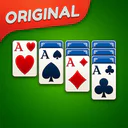
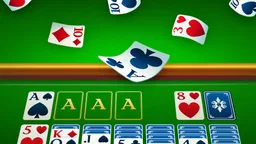
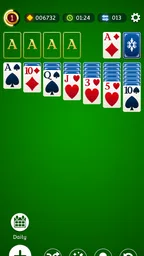
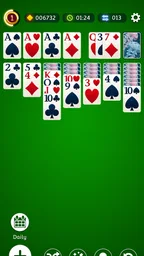


Solitaire.com - Classic Cards review
 Analysis by Appsdrops
The appeal of Solitaire.com - Classic Cards is easy to understand: I can open a familiar card game, make a few moves, and stop whenever I like. The trick is that “a few moves” often turns into another deal. Cards shift into columns, a choice opens up a new possibility, and the small satisfaction of finishing a game makes starting over feel natural. It is a straightforward mobile card game from Tripledot Studios Limited, aimed at people who want a quick, recognizable pastime rather than a complicated new system to learn.
From the first move to the first decision
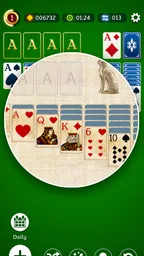
Getting into a game of solitaire takes little effort if you already know the basic idea: build descending sequences in alternating colors, uncover hidden cards, and move cards toward their foundations when possible. That low barrier is one of this game’s strongest qualities. I don’t need to set aside a long stretch of time or remember a story from an earlier session; I can begin with the cards in front of me.
The more interesting part is deciding what to do with an apparently simple layout. A move can expose a face-down card, free a column, or use up a card that might have helped elsewhere. I try to look beyond the obvious legal move and ask what it will make possible next. That habit turns a familiar card pastime into a small exercise in planning, without demanding the concentration or commitment of a more elaborate strategy game.
One practical approach is to prioritize uncovering hidden cards when the choice is close. A newly revealed card gives you more information and may create a useful sequence, while moving a visible card simply because it can move may not improve the board. I also avoid filling an empty column automatically: leaving it open can matter if a suitable king becomes available. These are modest decisions, but they give each deal a little texture.
A familiar format for short breaks
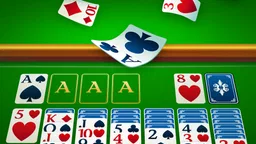
In my experience, the game fits the moments when I want something to do with my hands but don’t want to follow dialogue, manage a team, or learn a large set of rules. It works well for a pause between tasks, a quiet stretch of travel, or a few minutes before putting my phone away. The card-table format is legible at a glance, so I can return after an interruption without needing to reconstruct a complicated state of play.
That convenience also shapes who may enjoy it most. If you like solitaire already, this is an easy way to keep a familiar routine close. If you are new to card games, the core pattern is approachable enough to learn through play. But anyone seeking multiplayer competition, a narrative campaign, or a deep progression system should look elsewhere. The pleasure here comes from solving the deal in front of you, not from a broader world around it.
The steady rhythm of move and feedback
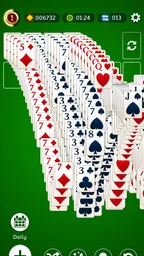
Solitaire’s feedback is quiet but immediate. I move a card, the tableau changes, and I can see whether the choice exposed a useful option or narrowed my routes. When a sequence falls into place, the board looks more organized; when it doesn’t, I have to reconsider which card to release or where to wait. That visual cause and effect is a large part of the game’s appeal: the feedback is understandable without needing scores or instructions to explain every decision.
The rhythm is strongest when a move opens the board rather than merely shifting cards around. I find it useful to pause briefly before drawing or making a move that seems to commit a key card. That small check helps me notice whether I’m preserving a route to a hidden card or spending a useful card too early. Solitaire is still partly governed by the deal, so careful play cannot guarantee a win, but thoughtful sequencing makes the decisions feel less arbitrary.
There is a trade-off in that simplicity. A familiar deal can become repetitive if you want new rules or a changing challenge, and not every game offers a satisfying path to completion. Some rounds feel like a string of productive reveals; others reach a point where the remaining options are limited. I don’t treat an unfinished deal as evidence that I played badly. Sometimes the cards simply don’t provide a route that feels worthwhile to pursue.
What makes a win feel rewarding
Finishing a deal gives a small, clean payoff: the scattered tableau has been resolved, and the foundations are complete. I like that the reward is tied directly to the task rather than requiring me to keep track of a long checklist. Even when I don’t win, uncovering a buried card or freeing a blocked column can make a short session feel useful. For me, that makes the game suitable for brief play without making every round depend on a dramatic finish.
The game is free, so it is easy to try without committing money at the outset. That does not make it the right fit for everyone: people who want a completely uninterrupted or highly customized card-table experience should check how the current app behaves on their device before settling into a routine. I would also avoid treating the idea of “boosting your IQ” as a serious promise. Solitaire can encourage attention and planning, but I see it as a pleasant mental warm-up, not a substitute for structured learning or a measure of intelligence.
Its broad reach is reflected in an average rating of 4.7 from around 328,000 ratings, with more than 50 million installs. Those figures suggest that the simple format has found an audience, though they don’t tell me whether every player will enjoy the same pace or presentation. The game is rated Everyone, which makes its subject matter broadly accessible, and it is listed as a card game rather than a more demanding strategy title.
Resetting the table without losing the appeal
When a deal ends, the next one offers a clean slate. That reset is central to the loop: I get a fresh arrangement, make a few early choices, see whether the board opens up, and decide whether I want to keep going. It avoids the pressure of a long campaign, but it also means that the main reason to return is the pleasure of the card puzzle itself. If that basic activity doesn’t hold your attention, a new deal alone may not be enough to bring you back.
A useful everyday routine is to set a natural stopping point before opening the game—for example, one deal during a coffee break rather than playing until I happen to lose interest. Because solitaire has a clear beginning and end, that boundary is easier to keep than it can be in games built around endless rounds or connected missions. Still, the quick restart makes it tempting to say “one more,” so it helps to decide whether I actually have time for another round before starting it.
Compared with a physical deck, a phone version is more convenient when I’m out and don’t have a surface or cards available. Compared with puzzle games that introduce new mechanics, it is less surprising but easier to pick up. And compared with competitive card apps, it offers a more solitary, low-pressure experience. I’d choose a physical deck for a social game, a richer puzzle for variety, or a competitive card title if I wanted opponents and a sharper sense of stakes.
Who should choose it—and who should pass
I’d recommend this game to someone who already enjoys Klondike-style solitaire, wants a compact way to fill short gaps, or prefers a puzzle whose rules remain comfortably familiar. It is also a reasonable starting point for someone who wants to learn card sequencing at an unhurried pace. The app’s long-running presence is clear from its release on January 19, 2018, and its current version is 4.65.00; it supports devices running OS 7.1 or later.
I would skip it if I needed frequent novelty, meaningful social interaction, or a demanding challenge that keeps changing from session to session. Solitaire depends on repetition, and its most appealing feature—the ability to begin again quickly—is also the reason it can blur one short play into several. Players who dislike chance influencing a puzzle may also find some deals frustrating, even when they make sensible moves.
For me, Solitaire.com - Classic Cards succeeds by keeping its loop clear: act on the cards, read the board’s response, enjoy a completed deal when it arrives, and decide whether a fresh layout sounds appealing. Developed by Tripledot Studios Limited, it doesn’t need a complicated premise to make that routine work. I’d keep it in mind as a convenient, familiar card game for spare moments—not as a deep strategy experience, but as a simple puzzle that can make a short break feel a little more engaging.
What we like
- The familiar rules make it easy to start playing.
- Short rounds fit well into quick breaks.
- Card movement feels straightforward on a touchscreen.
- It offers a relaxing alternative to fast-paced games.
- No card skills beyond basic Solitaire knowledge are needed.
What could be better
- Random card deals can make some rounds unwinnable.
- Repeated play may feel predictable over time.
- Small cards can be difficult to read on compact screens.
- Undo and hint features may reduce the challenge.
- Ads may interrupt play depending on the version.







