






Spades Solitaire - Card Games review
 Analysis by Appsdrops
I like a card game that lets me settle into a short session without turning relaxation into another task. Spades Solitaire - Card Games aims for that familiar, low-pressure appeal: it brings the classic trick-taking game to a phone and makes it easy to pick up when I have a little time to spare. Its appeal is less about novelty than about the steady choices that make each hand interesting.
Getting into a hand without a big learning curve
Spades has a clear rhythm: decide how many tricks you expect to win, then play the hand with that goal in mind. That gives a new player something concrete to focus on from the outset. Rather than matching cards by color or chasing a high score through rapid taps, I have to think about what my hand can realistically deliver and adjust as cards are played.
That small decision before the action begins is what makes the game more thoughtful than a simple card-matching pastime. A hand can look strong but still be awkward if its suits and high cards do not support the number of tricks I expect to take. I find it useful to pause before committing to a target instead of treating the opening choice as a formality.
The game is a card game from Topy Games, and its presentation is built around the recognizable Spades format rather than a broader collection of unrelated activities. That focus suits anyone who already knows the game and wants a direct way to play on a phone. For a newcomer, it also means the best way in is to learn the basic objective first and let the repeated hands teach the finer judgment.
One practical tip is to watch what has already been played, not just the cards still in your hand. Remembering which high cards are gone can change whether a later card is likely to win a trick. This is a useful habit in any Spades game, but it matters especially on a small screen, where it is easy to tap through a hand while thinking only about the current move.
Small decisions give early sessions purpose
The early goal is not to chase a complicated progression system; it is to make better estimates and see how those estimates hold up. Each hand gives me a fresh opportunity to judge the strength of my cards, notice where I was too optimistic, and make a more careful call next time. That gives even a brief session a natural point of focus.
For someone returning to Spades after a long break, I would treat the first few hands as practice rather than a test of skill. The useful question is not simply whether a hand went well, but whether the target made sense when I chose it. If I consistently expect too much from a hand with few reliable winners, the game’s basic structure makes that mistake easy to recognize.
A realistic use case is a quiet pause between errands or a few minutes before bed. I can start with the intention of playing one hand and stop when the moment is over, without needing to follow a story or remember a long sequence of events. That makes the game a better fit for short, self-contained breaks than for players who want a campaign that carries progress across extended sessions.
Progress comes from reading the cards better
The clearest progress signal here is personal: I get more consistent at estimating what my hand can do. There is satisfaction in noticing that a decision which once felt like a guess now has a reason behind it. I pay more attention to suit distribution, likely winners, and the consequences of spending a strong card too early.
That kind of improvement may be less visible than a map full of unlocked stages or a persistent collection to build. If you need the game to regularly announce a new milestone, Spades may feel modest. Its replay value comes more naturally from the changing combinations of cards and the challenge of making a sound plan with whatever hand appears.
I also find it helpful to separate a bad outcome from a bad decision. A reasonable estimate can still be challenged by the cards that follow, while a lucky result does not necessarily mean the opening judgment was strong. Keeping that distinction in mind makes the game feel more like a test of planning and less like a reason to chase a perfect run.
The title has a 4.9 average rating from around 154,000 ratings, which points to broad enthusiasm, though that alone cannot tell me whether its style will suit a particular player. The important question is whether you enjoy the central loop: assess a hand, commit to an expectation, and adapt as the tricks unfold. If that process is appealing, the simple structure has room to stay engaging.
The challenge depends on patience, not spectacle
Spades can be surprisingly demanding once I stop playing on instinct. The challenge is in managing uncertainty: I have only my own hand to work from, and every card played changes the possibilities. A strong opening does not guarantee an easy finish, so planning ahead matters more than simply choosing the highest card available at each moment.
That also sets a limit on the game’s appeal. Players looking for fast action, dramatic visual effects, or a stream of new mechanics may find this too restrained. Its pace is deliberate, and a hand can feel repetitive if I am not interested in tracking suits and reconsidering my assumptions. It is a thinking break, not an adrenaline rush.
Compared with casual solitaire games where the main task is arranging a layout, Spades asks for more attention to other players’ likely hands and to the shared flow of tricks. Compared with a full in-person card table, it is easier to access for a quick solo session, but it cannot reproduce the social reading and conversation that make face-to-face play distinctive. Which alternative is better depends on whether I want quiet practice or company.
For a useful session, I recommend resisting the urge to tap as quickly as possible. Before each important play, I ask what I am trying to protect: a likely winner, a useful suit, or the chance to take a later trick. That brief pause makes the decisions feel more intentional and helps me learn from a hand even when the result disappoints.
What keeps it in rotation—and what may not
The game is free, rated for Everyone, and has more than 10 million installs. Those details make it approachable for a wide audience, but they do not mean every player will enjoy the same pace. I would recommend it to people who like familiar card rules, repeatable hands, and a little quiet decision-making without a large commitment.
On the other hand, I would steer someone toward a multiplayer card table if the main reason they enjoy Spades is reading a partner, bluffing through conversation, or reacting to friends. I would also suggest a more varied casual game for someone who needs frequent new objectives to stay interested. Here, the most dependable reason to return is the game of Spades itself, not a promise of constant surprises.
Retention pressure is therefore fairly gentle in concept: the basic loop invites another hand because the next deal presents a new problem, not because I need to maintain a long chain of activity. That can be a strength when I want a game that fits around my day. It can also mean there is little pull for players who prefer a clearly signposted sequence of unlocks and escalating rewards.
The current version is 1.33.0.20260824, and the game has been available since November 23, 2021. I would not choose it expecting its appeal to come from a recently introduced format; its core value is the enduring card challenge. The version detail is useful if you are checking compatibility, while the minimum requirement of Android 7.0 makes it relevant to people using older Android devices.
Who should play it, and my verdict
Spades Solitaire - Card Games is a sensible choice if you want Spades in a compact, accessible form and enjoy improving through repeated decisions. I especially like it for short breaks where I can focus on one hand, think about the cards, and put the phone away without losing the thread of a larger activity. Topy Games keeps the concept centered on the card game rather than asking it to be something else.
Its weakness is also its defining trade-off: a focused, traditional card loop will not provide the variety or social energy some people expect from mobile games. The experience is best when I approach each hand as a small planning exercise, not when I expect constant unlocks or dramatic changes in pace. If that sounds satisfying, the familiar rules offer a durable reason to return; if it sounds repetitive, a broader card collection or live multiplayer option is likely a better fit.
Overall, I see it as a relaxed way to revisit Spades, with enough judgment in each hand to reward attention. It is not the right pick for every kind of card-game player, but for someone who values a clear objective, manageable sessions, and the quiet satisfaction of making a better call, it earns a place among the more straightforward options to try.
What we like
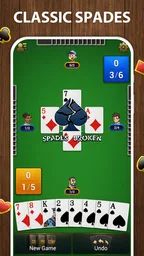
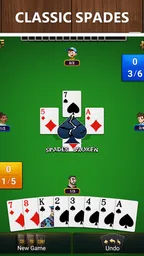
- Clear card layouts make suits and ranks easy to read.
- Undo helps correct an accidental move.
- Hints can help when you are unsure which card to play.
- Short rounds work well for quick play sessions.
- Offline play is useful when an internet connection is unavailable.
What could be better
- Hints may reduce the challenge for experienced players.
- Random deals can make some rounds feel luck-dependent.
- Ads may interrupt play depending on the version.
- Touch controls can lead to misplaced cards on small screens.
- The game may feel repetitive without varied modes.







