

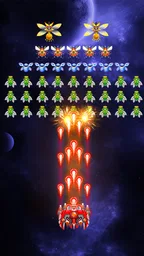
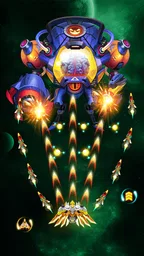


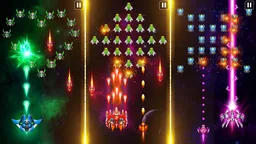


Space shooter - Galaxy attack review
 Analysis by Appsdrops
When I want a quick arcade game that asks for attention without asking me to learn a complicated rulebook, Space shooter - Galaxy attack is an easy one to consider. Its central appeal is straightforward: steer through a space battle and focus on shooting down alien attackers. That familiar setup makes it approachable, but it also means the fun depends on whether you enjoy repeating a simple action loop and getting better through practice.
I see it as a pick-up-and-play arcade game rather than a story-led space adventure. You do not need to set aside a long session to understand the premise, and the space-shooter format is clear from the first glance. The important question is not whether the idea is complicated; it is whether you like the small, immediate challenge of staying alert while enemies fill the screen.
Why the classic shooting loop works
The game’s strongest idea is also its simplest: keep your attention on the battlefield, avoid letting the alien attack overwhelm you, and fire back. In my view, that clarity is useful on a phone. There is little conceptual overhead between opening the game and understanding what kind of play it offers.
That makes Space shooter - Galaxy attack a natural fit for brief breaks. I would reach for it when I have a few spare minutes and want something more active than scrolling, but do not want to commit to a lengthy campaign. The arcade structure gives each play session a direct purpose: react, shoot, and see how well I can handle the encounter.
The trade-off is that a familiar premise can feel repetitive if the basic action is not enough for you. Players who need a strong narrative, a broad range of activities, or a detailed simulation of space combat may find this style too narrow. Its value is in the immediacy of the shooting, not in promising a deep universe to explore.
Learning the rhythm instead of rushing
For this kind of game, the first useful habit is to watch the whole play area rather than fixating on the nearest target. When alien attackers are the focus, reacting only to what is directly in front of you can make a run feel frantic. I find it more sensible to keep a calm eye on where pressure is building and to make deliberate movements instead of constantly darting around.
A second practical tip is to treat an early attempt as a chance to learn the game’s pace, not as a test of skill. Notice how quickly you need to respond and whether your own movements are making it harder to keep targets in view. That small adjustment can make the action feel more controlled, even when the underlying challenge remains simple.
I would also avoid assuming that faster movement is always better. In a shooter, frantic steering can be as distracting as the attackers themselves: it may pull your attention away from aiming and make the screen harder to read. A measured approach is often more useful than trying to chase every target at once.
A good fit for small pockets of time
A realistic use case is a short wait before an appointment. I can open the game, take on a quick burst of arcade action, and put the phone away when I am called. That is a better match than starting a game that expects me to remember a complicated story or settle into a long session.
It can also suit someone who enjoys the classic arcade routine of trying again after a rough attempt. The appeal is not that every session needs to feel different; it is that a simple challenge lets you concentrate on your own reactions. If you like noticing that you are handling the action more confidently, this kind of loop can be satisfying without demanding a major time investment.
On the other hand, I would not choose it for a quiet moment when I want something relaxing or low-stimulation. A shooter built around alien attacks is meant to keep your attention engaged. If you prefer a gentle puzzle, a narrative game, or a more leisurely strategy experience, another arcade or mobile genre will probably suit your mood better.
Where it sits among mobile arcade alternatives
Compared with casual puzzle games, this is a more reflex-led choice: the focus is on responding to a space battle rather than pausing to plan a move. Compared with elaborate action games, its appeal is the directness of the premise. I would choose it when I want shooting action without first learning a large set of systems.
That simplicity has a clear limit. Someone looking for a deep progression path or a substantial story may prefer a larger action game, while a player who wants an endlessly varied set of mini-games may be happier with a broader arcade collection. Here, the central attraction is the space-shooter format itself, so interest in that format matters more than a desire for genre variety.
There is also a useful distinction between a game that is easy to understand and one that everyone will enjoy. The basic idea is accessible, but the repeated focus on shooting and reacting may not hold the attention of players who quickly tire of a single core activity. I would judge it by whether that loop feels enjoyable to repeat, rather than by expecting it to become a different kind of game after a few sessions.
What to know before installing
Space shooter - Galaxy attack is a free arcade game from Unicorn Studio Official, and it is rated for Everyone. It has an average rating of 4.8 from around 1.9 million ratings, alongside roughly 40,000 written reviews, and has passed 100 million installs. Those figures suggest that the straightforward space-shooter idea has broad reach, though popularity alone cannot tell you whether its particular style will suit you.
The game was released on April 5, 2017, and its minimum operating-system requirement is 7.1. I would check that requirement before installing it on an older device. It is free to download, with in-app purchases ranging from $0.99 to $59.99 per item, so it is worth being aware that optional spending is part of the setup. If you prefer to keep mobile gaming strictly free, decide in advance whether you are comfortable seeing purchase options.
One practical way to approach those purchases is to play the free version first and decide whether you enjoy the core loop before spending anything. That is especially sensible here because the game’s main draw is the arcade shooting itself. Paying will only make sense to a particular player if the available purchase options add value they personally want; it should not be treated as necessary just because the game offers them.
Who will enjoy it most
I would recommend it to people who like classic arcade shooting, prefer clear objectives, and want a game that can fit into short breaks. It is also a reasonable choice for someone who wants to try a familiar genre without beginning with a complicated space-action experience. The Everyone age rating makes its intended audience broad, while the uncomplicated premise is easy to explain to a new player.
I would suggest skipping it if you mainly play for character development, a strong plot, long-form exploration, or a large range of distinct activities. It may also be the wrong choice if repeated shooting feels monotonous to you, or if purchase prompts are a deal-breaker. In those cases, a story-focused action game, a puzzle title, or an arcade collection would likely be a better match.
My overall view is that this game knows the sort of experience it wants to provide: accessible, direct space-shooter action. Its best quality is how quickly the central challenge makes sense, and its main limitation is that the same focus may not satisfy players who want more variety or depth. If you enjoy reacting to alien attackers and have a few spare minutes to fill, it is an appealing free arcade option; if you need a broader experience, I would look elsewhere.
What we like
- Simple controls make the game easy to pick up.
- Short stages suit quick gaming sessions.
- Power-ups add variety to combat.
- Boss encounters provide clear progress milestones.
- Offline play is available for gaming without a connection.
What could be better
- Repeated enemy patterns can make later stages feel familiar.
- Difficulty spikes may require repeated attempts.
- Upgrades can take time to earn through regular play.
- Frequent action may feel hectic on smaller screens.
- Optional purchases may speed up progress.







