






Skincare ASMR: Relaxing Games review
 Analysis by Appsdrops
I came to Skincare ASMR: Relaxing Games expecting a small, soothing salon game, and that is the right way to approach it: as a light simulation built around skincare and makeover play, not as a serious beauty tutorial. Its appeal is the simple rhythm of taking an in-game client through a calming treatment and enjoying the sensory payoff. I found it best in short bursts, when I wanted something gentle to focus on without needing to learn a complicated system.
Starting with a treatment, not a tutorial
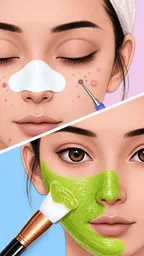
The first appeal is how quickly the premise makes sense. You are stepping into a salon-style makeover experience, where skincare actions form the heart of the play. Rather than asking you to manage a business, plan a schedule, or master a deep progression system, the game puts the treatment itself in the foreground. That makes it approachable if you want to pick it up without studying instructions first.
As a simulation game from Mini Play, it sits in a more relaxing corner of the genre than management-heavy salon games. I would describe the main interaction as a sequence of simple care actions followed by visible reactions. The pleasure is less about making a strategic decision and more about watching a face change as you work. That distinction matters: if you want demanding choices and long-term planning, this is probably too gentle; if you want an easy, tactile routine, the focus is a strength.
The skincare theme also gives the game a more specific feel than a general makeover title. Makeup is part of the broader salon fantasy, but the treatment-and-refresh framing is what sets the mood. I would not use it to learn how real skincare works, since the experience is designed as entertainment rather than practical advice. Think of it as a playful salon scene, not a guide to products or routines.
Why the first action matters
The opening moments establish whether this kind of play suits you. If you enjoy making a small, visible change and moving on to the next step, the setup is easy to settle into. If you prefer games that begin with a clear challenge, a timed objective, or a story hook, the understated start may feel thin. I liked that I did not have to bring much attention or patience to it; the trade-off is that the game does not create much tension to overcome.
One useful way to approach it is to treat each treatment as a little sequence rather than tapping as quickly as possible. I found that paying attention to the order and the on-screen feedback makes the activity feel more satisfying, even when the underlying task is uncomplicated. This is a small but meaningful distinction: the game’s pleasure comes from noticing the process, not racing through it.
The feedback rhythm keeps the loop readable
ASMR-style salon games depend on a steady relationship between action and response. You do something, the scene reacts, and that response tells you the step has landed. In this game, that basic rhythm is the main source of momentum. It gives the player a reason to continue through a treatment without needing a complicated interface or a large set of rules.
That rhythm works best when I am in the mood to focus on small details. It is a natural fit for a quiet break, or for unwinding after a busy stretch when a more demanding game would feel like another task. I also found that the soothing framing does not mean every player will find it relaxing: repetitive actions can become monotonous if you want a lot of variety or a strong sense of challenge. The calm comes from the pace and presentation, not from a guarantee that every session will feel fresh.
A practical tip is to play with sound available if you are specifically seeking the ASMR-style experience. The title and premise signal that sensory feedback matters, so playing while distracted or with the audio muted may reduce some of the intended appeal. On the other hand, if you mainly want a visual, low-effort game, you can still judge whether the treatment loop works for you without treating sound as essential to every moment.
Small rewards, modest stakes
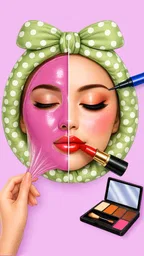
The payoff is the transformation: a treatment progresses, the character’s appearance changes, and the salon scene reaches a more finished state. That kind of reward is immediate and easy to understand. I appreciate this when I want a game that does not ask me to remember a long chain of objectives. The satisfaction is local: complete the current bit of care, enjoy the result, and decide whether I feel like doing another.
The flip side is that players who expect deep collection, complex customization, or a substantial narrative may not find enough here. I would not choose it as my main game for a long evening if I wanted a sense of escalating stakes. It is better thought of as a small, self-contained diversion. The reward is the process and its visible finish, rather than a big strategic unlock or a lasting achievement.
That makes it especially suitable for someone curious about makeover games but put off by titles that layer on management menus or competitive goals. It can also work as a casual shared activity: one person can suggest the next treatment action while another watches the result. The interaction is simple enough to follow, although the game’s main appeal remains personal, low-pressure play rather than multiplayer competition.
When a session ends—and why another can begin
The loop is easy to understand: begin a salon treatment, carry out a series of care actions, watch the visual and sensory feedback, then enjoy the completed makeover. Once that small arc is over, the natural reset is simply the possibility of taking on another treatment. That makes the game convenient for brief sessions, because there is no need to commit to a long campaign before you can get a satisfying stopping point.
For an everyday example, I can imagine opening it while waiting for a meal to finish or taking a short screen break between errands. I would choose it over a puzzle that demands sustained concentration in that moment, because the salon routine is easier to follow casually. I would not choose it while looking for a robust distraction for a long commute, though, if I needed varied objectives to keep my attention for an extended period.
The reset is also where repetition becomes the central trade-off. The same broad appeal—simple treatment steps and visible results—can be comforting when you want consistency, but less compelling if you are hoping every return will introduce a new kind of decision. My advice is to judge it by whether you enjoy repeating a calm routine, not by how much content you expect a simulation game to provide. That expectation will make the difference between a pleasant little ritual and a game that feels too slight.
How it compares with other salon games
Compared with salon games that emphasize running a shop, serving customers quickly, or balancing several demands, this one is more focused on the care-and-makeover moment. That focus gives it a gentler entry point, but it also means it has less of the pressure and planning that make management simulations compelling. Compared with pure casual puzzle games, it offers a more visual, character-centered activity, but it does not necessarily provide the same problem-solving payoff.
If you are choosing between this and a more involved beauty simulator, ask yourself what you want from the word “simulation.” Here, I would expect a stylized salon routine rather than a realistic model of skincare decisions. If you want to experiment with practical beauty techniques or learn about ingredients, a dedicated educational resource is a better choice. If you want an uncomplicated makeover loop with an ASMR mood, this game is closer to the mark.
Who will enjoy it—and who should pass
I would recommend it to players who like gentle mobile games, enjoy makeover transformations, or want short activities that do not punish interruptions. It is also a reasonable first step for someone who has never played a salon simulation and wants to see whether the format appeals to them. The age guidance is Everyone, and the game is free to start, so it is approachable for a broad audience.
I would steer away from it if you need a demanding simulation, a substantial story, detailed real-world skincare guidance, or a constant stream of new strategic problems. Players who quickly tire of repeating familiar actions should be especially cautious. The game’s calm style is not a substitute for variety; it is the reason to play, and also the source of its main limitation.
It has a 4.8 average from around 198,000 ratings, with more than 10 million installs, which suggests that its simple appeal has found a broad audience. Those figures do not change my practical advice: the best test is whether you enjoy the treatment rhythm itself. The game is free, with in-app purchases priced at $1.99 per item, so I would begin without spending and decide first whether the core loop holds your attention.
My verdict on the loop
In its current version, 1.1.9, Skincare ASMR: Relaxing Games makes a clear promise through its play style: take a small salon action, enjoy the response, see the makeover progress, and decide whether to repeat the routine. I like that clarity. The game does not need a complicated premise to work as a brief unwind, and its skincare focus gives the familiar makeover format a softer, more tactile identity.
My recommendation is conditional but straightforward. Try it if a calm salon sequence sounds more appealing than a challenge, and keep your expectations centered on short, satisfying sessions. Skip it if you want depth, realism, or a fresh strategic puzzle every time you open a game. For the right mood, it is an easy little reset; for a player who needs constant novelty, its loop may run out of charm quickly.
What we like
- Simple tap-based interactions are easy to learn.
- Short activities suit quick breaks.
- Soft sound effects add to the relaxing atmosphere.
- The ASMR theme offers a change from action-heavy games.
- Its casual pace does not require fast reflexes.
What could be better
- Some players may find the repetitive tasks dull.
- ASMR sounds may not appeal to everyone.
- The relaxation theme may feel too slow for some.
- Progress can feel limited without varied challenges.
- Touch controls may make precise actions awkward.







