

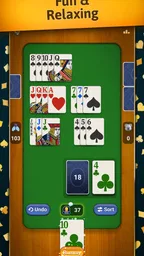
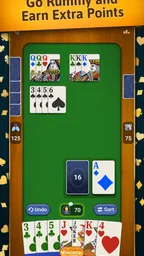
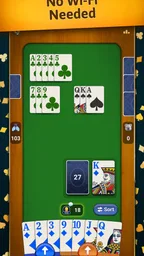




Rummy - Classic Card Game review
 Analysis by Appsdrops
I like a card game best when I can settle into a hand without needing to learn a complicated interface or commit to a long session. Rummy - Classic Card Game is aimed squarely at that familiar kind of play: it brings Rummy to a phone, with Jokers part of the card mix and going out as the central goal. My overall impression is that it suits people who want a straightforward, recognizable card-game routine more than players looking for a deep competitive platform.
Familiar Rummy, with a phone-sized focus
This is a free card game from MobilityWare, a developer whose name will be familiar to many mobile card-game players. Its appeal is easy to understand: the basic Rummy objective is immediately approachable, while each hand still asks you to pay attention to the cards you collect and the opportunities you leave yourself. The game is rated for Everyone, so its subject matter is suitable for a broad audience.
The current version is 1.5.1.1839, and the game requires Android 8.0 or later. It has a 4.7 average from around 38,000 ratings, with about 1.4 thousand written reviews and more than a million installs. Those figures suggest it has reached a sizable audience, though popularity alone cannot tell you whether its particular pace or style will suit you.
I would approach it as a compact way to play a familiar card game, not as a substitute for a table full of friends. The appeal is the low barrier to starting: you can focus on the hand in front of you rather than first mastering a large set of menus or rules. If you already enjoy Rummy, that simplicity is a plus. If you have never played, the core goal is easy to grasp, but the satisfying decisions come from noticing how your hand is developing rather than merely collecting cards at random.
What makes a hand worth your attention
Rummy is simple to describe but not entirely automatic to play well. You are trying to organize cards into useful combinations and get rid of the cards in your hand. Jokers add flexibility, which can make a difficult hand feel recoverable, but they also create a choice: use one to complete a combination now, or hold it in case it becomes more valuable later. That tension is the part I find more engaging than the basic act of drawing and discarding.
A practical habit is to assess your hand after every draw rather than fixating on the plan you had at the start. If the cards are not coming together, holding too many hopeful combinations can leave you stuck with awkward leftovers. I would keep an eye on which cards are genuinely helping and be willing to change direction. That advice is especially useful when a Joker appears: flexibility matters, but spending it too early may close off a better arrangement later.
The game’s brief store description does not settle every rule detail a returning Rummy player might care about. Rummy has many house-rule variations, so I would check the instructions shown in the game before relying on a familiar rule from a family game night. That small step can prevent frustration when a familiar move behaves differently from what you expect.
A good fit for small breaks, not every kind of session
I can picture playing a hand during a quiet lunch break, while waiting for an appointment, or at home when I want something more engaging than scrolling but less demanding than a strategy game. Rummy works well in these gaps because the decisions are easy to return to: look at the cards, consider what could form a combination, and decide what to keep or discard. The game’s basic premise does not require a long tutorial before it becomes understandable.
That same convenience has a limit. A phone version cannot reproduce the conversation, table-reading, and friendly rivalry of playing with people in the same room. If what you want is a social card night, a multiplayer option built around friends or live opponents will be a better fit. If you prefer solitaire-style play with no opponent to account for, a traditional solitaire game may be calmer and more predictable. This one makes most sense if you enjoy Rummy’s hand-management decisions and are happy to play it in a mobile format.
For newcomers, I would treat the first few rounds as practice rather than judge the game by a single unlucky hand. The useful skill is learning to recognize which cards are worth keeping together and when a promising plan is no longer realistic. Experienced players may settle in faster, but they should still check how this version handles its rules before assuming it matches the exact Rummy variant they know.
Progress without turning every hand into a test
The natural sense of progress here comes from making better decisions, not from a complicated long-term system I can confidently describe. A useful personal goal is to notice one choice per hand: did I hold a card because it had a realistic path to a combination, or simply because I was reluctant to discard it? That kind of self-check makes repeat play feel more purposeful without needing to treat every result as a measure of skill.
There can be pressure in any Rummy hand when your cards are not cooperating and you are trying to go out before the opportunity passes. Jokers can ease that pressure, but they do not remove the need to make trade-offs. I would avoid treating a single hand as proof that the game is unfair or that I played badly; card games involve uncertainty, and a sound decision can still lead to an unhelpful result.
One small workflow that helps is to pause before discarding and compare the card against the combinations you already have, not just the combination you hope to build. This makes it easier to spot when you are preserving a speculative plan at the cost of a more useful hand. It is a modest adjustment, but it makes the decision-making feel less reactive, especially for players who tend to keep too many possibilities open.
Spending is clear; the value question is personal
The game is free to download, with optional in-app purchases priced from $4.99 to $29.99 per item. That is the purchase context I would want to know before trying it: you can start without paying, but purchases are available. I would not assume that spending is required to enjoy the core idea, nor would I assume what any individual purchase includes without checking its description in the app.
For a casual player, the sensible approach is to try the free game first and decide whether the basic experience is enjoyable before considering any purchase. If you tend to tap through purchase prompts impulsively, take a moment to read the amount and what is being offered each time. The listed price range alone does not establish whether an item affects play, removes an interruption, or provides some other benefit, so I would make that decision based on the actual in-app details rather than guess.
That distinction matters when judging fairness. A purchase price is confirmed, but it does not by itself show whether paid items change competitive outcomes or whether play is balanced between paying and non-paying users. I would not claim that the game is pay-to-win, and I would not promise the opposite. If competitive equality is your main concern, look at the purchase descriptions and the rules of the particular mode before investing time or money.
Fairness, uncertainty, and what I would check
For a Rummy game, fairness depends on more than the presence of Jokers or the price of optional items. It also depends on the rules, how cards are dealt, whether opponents are human or automated, and whether paid options influence a match. I do not have a verified basis to describe those mechanics here, so I would not present any of them as facts. A careful player can still make a practical check: read the in-game rules, observe how a few hands unfold, and review any purchase details before deciding whether the experience feels right.
This is also where the game may not satisfy every card enthusiast. Players who want transparent competitive matchmaking, a detailed tournament structure, or a strong social layer should compare it with a Rummy app that explicitly centers those features. Likewise, anyone who needs a very specific regional or house-rule version should confirm the rules first. The broad Rummy premise is familiar, but familiarity does not guarantee that every implementation uses the same conventions.
The game has an Everyone age rating, which makes it suitable in content terms for a broad audience, but that does not answer every family-use question. I would still review purchase settings on a device used by children, since optional purchases are part of the app. That is a practical precaution rather than a claim about how the game handles payments.
My verdict: a sensible pick for casual Rummy
I would recommend Rummy - Classic Card Game to someone who wants an accessible Rummy session on a phone and enjoys making small decisions about sets, discards, and Jokers. Its strongest point is the familiar card-game loop: it is easy to understand, yet a hand can still reward patience and a willingness to revise your plan. MobilityWare’s version has earned a 4.7 average from a substantial player base, which is encouraging context, though personal preference matters more than a rating.
I would skip it if I wanted a guaranteed social experience, a clearly documented competitive scene, or a particular rule variant that I had not checked. I would also be cautious about spending until I had tried the free play and read what a purchase actually provides. The available price range is concrete, but the role of purchases in competition is not something I would infer from the price alone.
My trust verdict is measured: the game is easy to consider as a free way to play a familiar card format, and the purchase range is visible enough to inform a cautious first decision. I would judge fairness by the rules and purchase details inside the game rather than by assumptions. If you want an uncomplicated Rummy break and are comfortable checking those details for yourself, it is worth a try; if you need more certainty about competitive systems or house rules before playing, another option may serve you better.
What we like
- Simple rules make it easy for new players to get started.
- Short rounds fit well into quick breaks.
- Offline play is useful when an internet connection is unavailable.
- Familiar rummy rules offer a comfortable card game experience.
- The game provides a casual way to practice planning and memory.
What could be better
- Computer opponents may not challenge experienced players enough.
- Gameplay can feel repetitive after many rounds.
- Random card draws can outweigh careful planning.
- Ads may interrupt the flow of play.
- The single-player experience lacks the variety of live opponents.







