







Ride Master: Car Builder Game review
 Analysis by Appsdrops
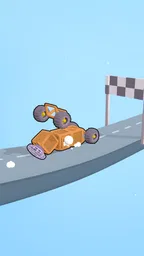
The first thing I like about Ride Master: Car Builder Game is that it gives a simple goal to the familiar act of racing: put together a car that can get through an obstacle course. Rather than asking me to tune a realistic vehicle or master a long set of tracks, it makes building and driving part of the same arcade challenge. I make a choice, see how the car handles the course, and decide whether to try again with a different approach. That quick chain is the reason a short session can turn into another run.
From a build choice to the first obstacle
Ride Master is an arcade game from Freeplay Inc, and its central appeal is the direct link between making a car and testing it. The car is not just a backdrop for a race: the build is part of the problem to solve. The obstacle course gives those decisions a practical purpose, because a design has to do more than look appealing; it needs to carry you through the challenge.
That setup suits players who enjoy experimenting more than following a detailed simulation. I can approach a run with a simple question—what might help this car handle the next course?—instead of worrying about realistic driving technique. It is a useful distinction if you are choosing between this and a conventional racing game. Ride Master puts its emphasis on the build-and-test loop, while a traditional racer is usually the better fit if you want close control over steering, believable car handling, or competition focused on lap times.
The first useful habit is to treat each run as a test rather than expecting one perfect build to solve everything. If a car struggles, I would change one part of the approach at a time where possible. That makes the result easier to read: a new attempt can tell you whether the adjustment helped, rather than leaving you unsure which change made the difference. It is a small but practical way to make retries feel like learning instead of blind repetition.
The premise also makes the game easy to pick up in ordinary gaps in the day. I can imagine opening it while waiting for a ride or taking a short break, making a quick attempt, and putting it away without needing to remember a complicated racing setup. That is where its arcade framing works well: the goal is immediately understandable, and the next action is clear even if I have only a few minutes.
What the course teaches through feedback
The most satisfying part of the loop is the feedback from the course. A car either makes progress or reveals that its setup is not suited to the obstacles in front of it. That visible consequence gives the building step a reason to exist. I am not changing a vehicle just to browse customization; I am trying to make the next attempt go better.
There is a trade-off, though. Players who want a deep workshop, precise engineering tools, or a realistic account of why a vehicle behaves a certain way may find this approach too light. The appeal is quick cause and effect, not a serious vehicle-design course. I would recommend it to someone who enjoys playful trial and error, but not to a player who expects the same depth as a dedicated car simulator.
One way to keep the feedback useful is to notice the point where a run goes wrong, then make a targeted adjustment before restarting. Changing everything at once may produce a better result, but it teaches less about why. The obstacle-course format is at its best when I use a failed attempt as a clue, even if the clue is simply that my current idea is not working. That mindset can make a simple arcade game feel more engaging without pretending it has complex mechanics.
It also makes the game a reasonable choice for casual play with a friend nearby. One person can suggest a build idea, the other can try it, and the result gives you something concrete to react to. I would not treat that as a promise of a particular multiplayer feature; the point is that the basic challenge is easy to watch and discuss. The decisions are visible enough to make a run interesting even to someone who is not holding the device.
Why another run feels worthwhile
The reward here is not only reaching the end of a course. A successful attempt also validates a choice I made while building. That connection gives progress a personal edge: the car gets through because I found a better way to approach the challenge, not simply because I waited for a result. When a run falls short, the next build becomes a natural response rather than an unrelated menu choice.
That rhythm is a good match for an arcade game. Action leads to feedback; feedback suggests an adjustment; a better result makes the effort feel worthwhile. Then the game can reset the question for another attempt. I find that more appealing than a racer where the only reason to repeat a track is to shave time off a lap, especially if I prefer variety in the problem I am solving over precision driving.
Still, the loop depends on enjoying repetition. If you dislike retrying a challenge after a setback, a game built around changing a car and testing it may begin to feel circular. I would also steer players toward a more traditional racing title if they mainly want a long career, detailed licensed cars, or a strong emphasis on head-to-head driving. Ride Master’s identity is the compact puzzle of making a vehicle that can handle an obstacle course, and it is strongest when that is exactly what you want.
For a practical session, I would set a small goal: try a course, identify one problem, and make one considered change before going again. That approach gives the game a satisfying beginning and end even when I am playing briefly. It also avoids the common frustration of tapping through repeated attempts without remembering what I was trying to improve. The game’s simple premise rewards attention to the result more than a long, elaborate plan.
Who will enjoy the pace—and who may not
Ride Master is best suited to casual arcade players who like building something, immediately putting it to use, and learning through visible outcomes. It can also work for younger players and families looking for an approachable game: its content rating is Everyone. That broad rating does not mean every player will enjoy the retry rhythm, but it does make the game easier to consider for a shared device or a relaxed play session.
The game is free to download, with in-app purchases ranging from $0.99 to $14.99 per item. I would go in expecting optional purchases to be part of the experience and decide for yourself whether they are worth it; the listed range is not a reason to assume you need to spend to enjoy the core idea. If you are choosing a game for a child, it is sensible to review purchase settings on the device before handing it over, as with any free game that offers paid items.
Its reach suggests that the format has found a large audience: it has more than 50 million installs, and its average rating is 4.7 from around 396,000 ratings. Those figures are useful context, not a guarantee that its particular style will suit you. I would weigh them against what you enjoy: quick arcade experiments rather than realism, and repeated obstacle-course attempts rather than a broad racing career.
At the time of writing, the current version is 5.7.2, and the game requires Android 7.0 or later. It was released on March 2, 2023. Those details matter if you are checking compatibility before installing, especially on an older Android device. The game is categorized as an arcade title, which is a better guide to its feel than expecting a full simulation simply because cars are involved.
The reset is part of the appeal
A reset can be either the best part of a short arcade game or its main irritation. Here, restarting makes sense when I can connect it to a new idea: change the build, take another run, and see whether the course responds differently. If I cannot identify a reason to try again, the loop loses its pull. That is why I recommend playing with curiosity rather than treating every failed run as wasted progress.
For players who like optimizing, a useful personal rule is to remember the last change and judge the next run against it. You do not need to turn the game into a spreadsheet. Simply keeping one thought in mind—“this attempt is about seeing whether my adjustment helps”—can make repeated play feel more deliberate. It is a small workflow, but it suits a game whose central pleasure comes from connecting a build choice to an on-course result.
On the other hand, if you want a game that offers a new kind of activity every few minutes, or one that does not ask you to repeat a challenge, this may not hold your attention for long. The same loop that makes it easy to dip into can also limit its appeal over a long session. I would play it in bursts rather than expect it to replace a more varied racing game or a deep builder.
My verdict on the build-test-repeat loop
I recommend Ride Master to anyone who wants a straightforward arcade diversion where making a car is directly tied to getting through an obstacle course. Its strongest quality is the clarity of its cycle: choose an approach, test it, read the result, and decide whether another attempt is worth making. That creates a satisfying reason to restart without needing a complicated story or simulation layer.
My reservation is equally clear: the game’s appeal relies on liking that cycle. Players after realistic handling, extensive tuning, or a broad racing structure should look elsewhere. But if you enjoy quick experiments and the small satisfaction of seeing a better idea work, Ride Master is an easy game to understand and an inviting one to revisit. It is at its best when each retry has a purpose, even if that purpose is simply finding out what happens when you build the car differently.
What we like
- Easy controls make the driving challenges accessible to newcomers.
- Vehicle parts can be arranged to try different designs.
- Short levels suit quick play sessions.
- Physics-based obstacles add variety to each course.
- The core gameplay works well for casual play.
What could be better
- Some vehicle designs may struggle on certain obstacles.
- Repeated level layouts can make progression feel familiar.
- Ads may interrupt the flow of play.
- Later stages can require several attempts to complete.
- Unlocking more options may take considerable play time.







