Ragdoll Archers - CrazyGames review
 Analysis by Appsdrops
I’d pick up Ragdoll Archers when I want an arcade game that asks for more than quick tapping. Its appeal is the small but satisfying puzzle inside every shot: judge the angle, account for the arrow’s path, and try to land a hit while the floppy character physics make the result feel unpredictable. A clean shot is rewarding; a miss can be funny rather than frustrating. That balance makes it an easy game to try in a short break, though it won’t suit everyone looking for a deep, long-form experience.
What playing it feels like now
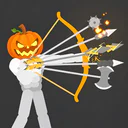
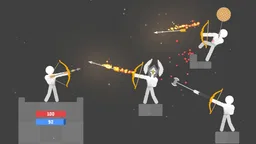
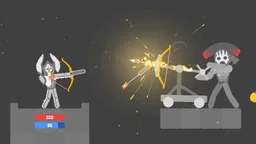
This is an arcade game from CrazyGames.com, built around archery and ragdoll reactions. The basic idea is immediately readable: aim and shoot, then see how the target responds. The realistic-physics focus gives aiming a little more texture than simply pointing at an opponent. You have to think about where an arrow will travel, not just where the target is at that instant.
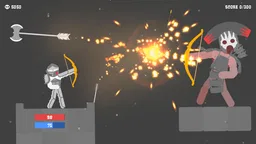
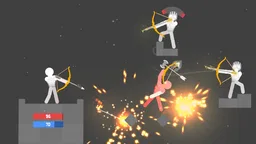
The ragdoll element is central to the fun. Characters don’t react like rigid targets, so a hit can produce an awkward tumble or a change in position that alters what you might try next. That unpredictability keeps repeated shots from feeling entirely identical. It also means outcomes can look messy, which is part of the joke, but players who prefer precise, consistently controlled results may find it less satisfying.
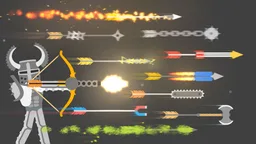
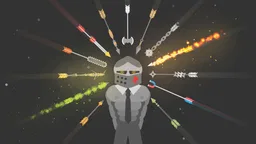
The game’s distinctive arrows add another layer to its shooting premise. Rather than treating every attempt as the same plain projectile, the idea of unusual arrow types invites you to consider how a shot might work, not only where it lands. I’d approach each attempt as a small experiment: adjust the aim, observe the result, and change one thing on the next shot. That is more useful than rushing through repeated guesses.
At its current version, 0.6.4, the game is a compact proposition rather than something I’d assume is a sprawling archery simulator. The version number is useful context, but it doesn’t by itself tell me what has changed or how extensive the experience is. I’d judge it on the play available now: a physics-led arcade loop, quick decisions, and humorous consequences when an arrow sends a ragdoll off balance.
Aiming is the real skill check
The most practical tip I’d give a new player is to separate aiming from timing. First make a deliberate adjustment to the direction of the shot, then watch what that adjustment does. If you alter several things at once, it becomes harder to understand why the arrow missed or why a hit had a different effect. Treating each shot as feedback makes the physics feel learnable instead of arbitrary.
There is also a useful trade-off between a safe attempt and an ambitious one. A straightforward shot may be easier to line up, while a more carefully judged trajectory can be more rewarding when the target or situation calls for it. I wouldn’t expect every shot to be elegant. The ragdoll motion makes recovery from an imperfect result part of the spectacle, and a good player can enjoy that without pretending every outcome is under perfect control.
For a realistic everyday use case, this is the kind of game I’d open while waiting for a coffee or taking a short break between tasks. The premise takes little explaining, and a round of aiming and reacting can fit a small window of free time. If I had a longer evening and wanted character progression, a campaign, or a highly structured challenge, I’d look elsewhere unless I had already confirmed that the current game offers the depth I wanted.
Where it sits among arcade alternatives
Compared with a conventional arcade game built around rapid movement or repeated button presses, Ragdoll Archers puts more emphasis on judging a shot and reading the aftermath. That makes it a better fit for someone who enjoys a brief pause to line up an attempt. Compared with a dedicated archery simulator, however, its ragdoll comedy and arcade framing are the point; I wouldn’t choose it as a substitute for a serious practice tool or a realistic sports game.
It also differs from puzzle games that present a fixed board and invite a single carefully reasoned solution. Here, the physics and character reactions can make a result feel lively rather than neatly solved. If you like experimenting with angles and seeing how a shot changes the scene, that is a strength. If you dislike outcomes that look chaotic or want every attempt to produce a predictable result, a more controlled puzzle or target-shooting game will probably be a better match.
The audience response gives some useful context without settling whether it will suit you personally: it has a 4.5 average from around 18 thousand ratings, and more than a million installs. I read that as evidence that the simple premise has broad appeal, not as proof that every player will enjoy its physics or pacing. The game is free to start, with optional in-app purchases priced from $1.99 to $4.99 per item, so I’d decide whether the core loop holds my interest before considering any purchase.
What the version history can and cannot tell you
The game was released on September 19, 2023, and its current version is 0.6.4. Those are concrete markers of its timeline, but they do not establish which features changed between releases. I wouldn’t claim a particular improvement, new arrow, balance adjustment, or bug fix without evidence for it. For someone installing today, the sensible approach is to assess the current build rather than assume that a version number guarantees a specific evolution.
That distinction matters more to returning players than to newcomers. If you played before, familiar controls and the same broad physics-driven premise may make it easy to settle back in, but a version label alone is not enough to promise that a favourite detail is unchanged or that a past frustration has been fixed. I’d reopen it with a short test session and see how the shots behave on the device in hand before committing to a longer play session.
For a new player, the release date mainly says the game has been available for a while; it is not a reason to expect either a completely new experience or a neglected one. The current version is the meaningful reference point for deciding whether to install. I’d keep expectations focused on what the game visibly does well—quick archery decisions and expressive ragdoll outcomes—rather than imagining a roadmap from its release history.
Who should try it, and who may want another game
I’d recommend it to players who enjoy physics-driven comedy, short arcade sessions, and improving through trial and adjustment. It is especially appealing if you like games where a miss still produces an entertaining result and where the next shot gives you a clear chance to change your approach. The Teen content rating is also worth noting for anyone choosing games for a younger player or checking suitability for a household.
I’d skip it if you want a carefully scripted story, a long progression system, or archery that behaves like a real sport. I’d also be cautious if ragdoll movement tends to annoy you rather than make you laugh: the same looseness that creates memorable impacts can make an outcome feel less controlled. In those cases, a structured target game or a more traditional arcade title may offer a better use of your time.
Device compatibility is another simple practical check. The minimum operating-system requirement is Android 7.0, so I’d compare that with the phone or tablet before installing. That requirement doesn’t tell me how the game will feel on every device, so I’d use a brief first session to see whether aiming feels comfortable and whether the physics are responsive enough for my taste.
What I would keep an eye on
When deciding whether to stick with it, I’d focus on three things: whether aiming starts to feel more intentional after a few attempts, whether the arrow variety gives me meaningful reasons to adjust my approach, and whether the ragdoll outcomes stay amusing rather than repetitive. Those are the parts that determine whether the short loop has staying power for me. If I’m only repeating the same shot without learning anything or enjoying the result, the game has probably served its purpose for that session.
I would also keep an eye on future updates without treating expectations as facts. A later version could change the experience, but the current build is what a new player can judge now. For an existing player, it makes sense to check the installed version when returning and then evaluate the actual play rather than rely on assumptions about what an update might contain.
Overall, Ragdoll Archers is a free arcade game with a clear personality: its pleasure comes from aiming with care and watching imperfect physics turn a shot into a small spectacle. I’d recommend giving it a try if you want an approachable, experiment-friendly diversion, while keeping in mind that the ragdoll unpredictability is both its charm and its main limitation. It runs on Android 7.0 or later, and its Teen rating helps set expectations for the intended audience. For me, it works best as a quick break rather than a replacement for a deeper archery or progression-focused game.
What we like
- Simple controls make aiming and shooting easy to learn.
- Physics-based arrows give each shot a satisfying sense of impact.
- Different arrow types add variety to combat.
- Short matches suit quick gaming sessions.
- Its cartoon ragdoll style keeps the action lighthearted.
What could be better
- Random arrow trajectories can make precise shots difficult.
- Combat can feel repetitive after several matches.
- The physics may occasionally produce unpredictable outcomes.
- Some matches depend heavily on weapon and arrow luck.
- Small on-screen controls may be awkward on certain devices.







