


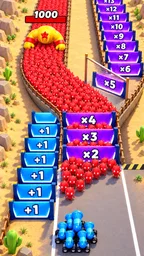



Mob Control review
 Analysis by Appsdrops
I’d recommend Mob Control to someone who wants an arcade game that is easy to pick up but still asks for a little thought on each attempt. The basic appeal is immediate: send a crowd of small units into a battlefield and try to build enough strength to overwhelm what is ahead. In practice, I found the satisfying part isn’t simply making the biggest crowd. It’s deciding how to direct the flow and noticing when a small change in timing or route produces a much better result.
Made by VOODOO, this free arcade game is rated Everyone and has a 4.3 average from around one million ratings. Its reach is substantial, with over 100 million installs, but those figures matter less than the kind of play it offers: short, active rounds rather than a lengthy story or a complicated set of controls. The current version is 3.24.4, and the minimum operating-system requirement is 8.0.
What a first session feels like
The game gives you a clear objective without requiring a long introduction: grow your group, lead it through the action, and take the battlefield. That straightforward premise makes the first minutes approachable even if you don’t usually play arcade strategy games. I wouldn’t approach it as a deep tactical simulator; the pleasure comes from quick decisions, immediate visual feedback, and trying to do better on the next run.
For a newcomer, the important shift is to stop thinking of every unit as an individual. You’re managing a moving crowd. The useful question is where that crowd should go and how to make its path count. A route that looks promising at first can leave you with too little force where it matters, so watching the flow is more valuable than tapping hurriedly just because the screen is busy.
This makes it a good fit for small breaks. I can imagine opening it while waiting for a kettle to boil or sitting through a short pause in the day, playing a round, then putting the phone down. It doesn’t demand that you remember a long plot or reconstruct a complicated plan after a few hours away. If you want a game built around exploration, character development, or extended sessions, though, this is not trying to fill that role.
Getting started without overthinking it
After installing, I’d begin by focusing on what the screen is asking me to do rather than hunting through every available option. The central loop is readable: build up your mob, guide it through the battlefield, and judge whether your approach is working. That gives you enough context to learn through play. A first-time player doesn’t need to master every possibility before making a useful attempt.
My practical advice is to make one deliberate decision at a time. Watch where your crowd is moving, choose the route that seems most useful, and then observe the consequence. If you change several things at once, it’s harder to tell why a run went well or badly. Treating the early attempts as experiments makes the game feel less punishing: each result teaches you something about timing and direction, even when it doesn’t end in a win.
It also helps to play with your attention on the screen. This is not the sort of arcade game I’d recommend starting while walking or trying to follow a conversation. The controls may be approachable, but the action still rewards watching the crowd and responding at the right moment. A quiet minute with the phone in hand is a better first session than trying to squeeze in a distracted half-round.
The first success comes from controlling the flow
When I’m trying to turn an early attempt into a meaningful success, I focus on getting a useful stream of units to the point where they can make a difference. The instinct to send everything forward immediately is understandable, but a crowded screen can hide whether the force is actually reaching the place it needs to. I get more from pausing mentally for a beat, reading the movement, and then committing to a route instead of tapping on impulse.
A helpful learning routine is to compare two attempts. Keep your general approach similar, then alter one choice—such as when you direct the crowd or which path you favor. That makes the result easier to interpret than changing your whole strategy every time. It is a small habit, but it turns quick arcade play into a simple feedback loop: notice, adjust, try again. Small, purposeful corrections are more useful than frantic input.
There’s also a trade-off between speed and control. Moving quickly can feel exciting, yet rushing can make it harder to see whether your group is building momentum or being sent into a poor position. On the other hand, overthinking every moment can drain the energy from a game designed around brisk action. I’d aim for deliberate reactions, not a perfect plan. The best early goal is understanding how your choices affect the crowd, rather than expecting to win every round straight away.
Where newcomers can get confused
The most common point of confusion is mistaking a larger crowd for an automatic victory. Numbers matter to the premise, but direction and timing matter too. If units are flowing somewhere unhelpful, simply pushing more into that same pattern may not fix the problem. When a run disappoints, I’d first ask whether the route or timing was wrong before assuming that the game requires faster tapping.
Another possible frustration is the difference between a round that looks busy and one that feels strategically clear. The action can be visually lively, and that may make it tempting to react to every movement. I find it more useful to identify the main decision in front of me and ignore distractions that don’t change it. This keeps the game readable, particularly for players who are still learning what their actions accomplish.
Because the premise is simple, the challenge is not learning a large collection of commands; it is judging how to use the ones the game puts in front of you. That simplicity is a strength when I want to start quickly, but it can also mean that players looking for elaborate tactical planning may want more depth than the game is intended to provide. If you prefer a traditional strategy game with long turns and detailed unit management, that would probably be a better match.
How it fits beside other arcade games
Compared with a typical reflex arcade game, Mob Control gives me more reason to think about direction and crowd management. It is not just a test of reacting quickly to an obstacle or keeping a character alive. The battlefield framing makes each attempt feel like a compact push toward an objective. Compared with a full strategy game, it is much lighter: I can make a decision, see the result, and move on without committing to a long campaign session.
That middle ground is its clearest strength. Someone who enjoys quick action but wants a little more agency than simple tapping may find the crowd-based approach refreshing. Someone who values precision platforming, a strong narrative, or intricate long-term planning should look elsewhere. My recommendation is strongest for casual players who enjoy learning from short attempts and don’t mind repeating a basic loop as they refine their choices.
It is also worth setting expectations about spending. The game is free to download, with in-app purchases listed from about eighty-four cents to nearly four hundred dollars per item. That broad range is a reason to check purchase details carefully before confirming anything, especially if a child uses the device. The Everyone rating describes the game’s age classification; it doesn’t remove the need for an adult to manage purchases thoughtfully.
Making the next session more rewarding
Once the opening rounds feel familiar, I’d stop treating every attempt as a fresh guess. Pick one thing to improve—your sense of timing, your choice of route, or your ability to read the crowd—and pay attention to that during the next few rounds. This gives the game a modest but satisfying learning curve. You can see your judgment improving without needing a complex guide or a long block of free time.
For an everyday use case, it works best as a short reset between tasks. I’d play when I have enough attention to follow the action but not enough time for a much larger game. If I’m tired or distracted, I might still understand the basic goal, but I’m less likely to make thoughtful decisions and more likely to blame the game for a sloppy attempt. That is a real limitation of its active, hands-on style: it is quick to start, not necessarily rewarding when played absent-mindedly.
Players who enjoy replaying a compact challenge can get value from returning and adjusting their approach. Those who need a new setting, a deep progression system, or a very different objective in every session may find the central loop repetitive. I’d make the choice based on what you want from a mobile game: quick crowd-control action and small strategic choices, rather than variety for its own sake.
My recommendation for a first-time player
I think Mob Control is an approachable pick if you like arcade games that let you act quickly while still rewarding a bit of observation. Start with a calm first round, watch where your mob goes, and make one change at a time. That path from install to understanding is reassuringly direct, and the first satisfying moment comes when you recognize why a particular decision worked—not merely when the screen fills with units.
I’d skip it if you want a story-led adventure, precise character movement, or layered strategy that unfolds over long sessions. I’d also be cautious about in-app purchases if the device is shared with a child. For everyone else, its free entry point and clear premise make it easy to try, while its demand for timing and judgment gives a short session more purpose than mindless tapping. As an arcade option, it is worth a look if that balance sounds appealing.
What we like
- Quick rounds make it easy to play during short breaks.
- Simple controls are easy for new players to learn.
- Unit upgrades give players a clear sense of progression.
- Different gates add variety to each battle.
- The colorful presentation makes action easy to follow.
What could be better
- Frequent ads may interrupt the flow of play.
- Progress can slow without collecting enough upgrade resources.
- Later stages may feel repetitive.
- Some upgrades require substantial time to unlock.
- A stable internet connection may be needed for certain features.







