

Math Solitaire: Brain Puzzle review
 Analysis by Appsdrops
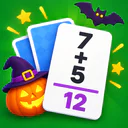
I like card games that give my hands something to do while keeping my mind engaged, and Math Solitaire: Brain Puzzle takes a familiar card-game idea in a distinctly numerical direction. Instead of treating cards only as suits and ranks to arrange, it uses them as pieces in arithmetic and logic challenges. The appeal is immediate: make a move, work through an equation or calculation, and see whether the cards fall into place. It feels more like a quick mental workout than a conventional solitaire session, though that difference is also the main reason it will not suit everyone.
Turning a card move into a calculation
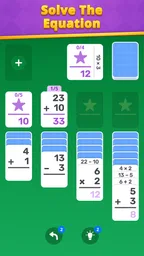
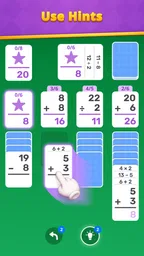
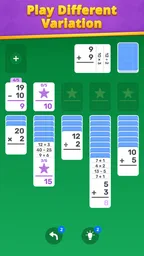
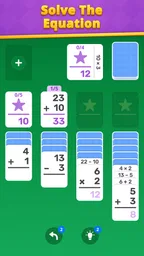
The basic proposition is easy to understand even if a particular puzzle takes thought. You use classic cards and flash cards as the material for solving equations and calculation tasks, so each decision asks you to look beyond the next open space. I find that change of focus gives the game a useful identity: it borrows the orderly, hands-on feel of solitaire while asking for more active arithmetic than a standard card layout does.
That makes the first move feel purposeful. Rather than moving a card simply because the move is available, I’m encouraged to consider how it contributes to a calculation. A good approach is to pause briefly before committing, scan the cards that could work together, and treat the board as a small problem rather than a race. That habit is especially helpful for younger players or anyone using the game to practise mental maths without opening a worksheet.
The game is a free card puzzle from Smart Project GMBH, with a 3.2 average from around five thousand ratings and more than a million installs. It is rated for Everyone, which fits the broadly accessible idea, although the challenge can still depend on a player’s comfort with arithmetic. The rating is a mixed signal rather than a reason to dismiss it: I’d treat it as an invitation to try a short session and judge whether this particular blend of cards and calculations clicks for you.
What the move-by-move rhythm gets right
The most satisfying part of this concept is the link between a choice and its mathematical consequence. In ordinary solitaire, a move often feels good because it clears a space or exposes a card. Here, the pleasure is more mental: I’m looking for a valid relationship between values, then checking whether that choice helps the puzzle progress. That extra layer can make even a small decision feel earned.
It also changes how I’d use the game during the day. A brief break between tasks is a natural fit because the player can focus on one contained puzzle rather than needing a long uninterrupted stretch. I can imagine opening it while waiting for a drink or sitting on a bus, concentrating on a calculation and then putting the phone away. The useful tip is to approach it as a deliberate pause, not background entertainment: the arithmetic is the point, so it works better when you give each move a little attention.
There is a trade-off, though. Players who want solitaire mainly for its relaxing, familiar card flow may find the calculation layer interrupts that comfort. Likewise, someone who dislikes doing sums in their head may experience the same decision-making as effort rather than fun. I wouldn’t recommend it as a mindless alternative to a standard card game; it asks you to stay mentally present.
Small wins, practice, and the kind of reward that matters
The reward here is less about spectacle and more about the moment a calculation makes sense. When a move fits, I get the satisfaction of having reasoned it out instead of merely following an obvious card-placement routine. That can make the game useful for practising number sense: a player can work through arithmetic in a more tactile context, using cards as visible pieces rather than staring at a row of abstract sums.
For parents or caregivers considering it for a child, I’d frame it as a light way to engage with numbers, not as a substitute for structured teaching. The Everyone age rating makes it broadly approachable, but children’s enjoyment will still depend on whether the puzzles feel achievable to them. Playing together can help: ask the child how they reached a move rather than simply supplying the answer. That turns a successful calculation into a conversation about reasoning, while leaving the game itself in charge of the challenge.
Adults can get something from that same loop. If I’ve spent the day on repetitive work, a short puzzle gives me a different kind of focus: identify the useful values, test a possible move, and adjust if the result doesn’t help. It is a small reset for attention rather than a deep strategy experience. People looking for long-form planning, a story, or a competitive card table should look elsewhere; this game’s draw is the compact arithmetic problem.
Why a fresh session can be appealing—and when it isn’t
A puzzle game earns repeat visits when the next attempt offers a reason to rethink rather than merely repeat. In this case, the underlying reason is the combination of card handling and calculation: even with familiar-looking pieces, a player can return wanting another chance to spot a better sequence or solve a new task. That makes the loop easy to understand: choose a move, see how the arithmetic works out, enjoy the progress when it clicks, then start again when you want another short challenge.
My practical advice is to keep sessions modest at first. If you are using it for mental practice, stop when you notice that you are moving cards without considering the numbers. At that point, the game has stopped serving its strongest purpose. A quick break and a fresh attempt are likely to be more satisfying than grinding through moves while distracted. This is a small but meaningful distinction from passive card play, where it can be perfectly fine to let your attention wander.
It is also worth thinking about spending before settling in. The game is free to download, but it offers in-app purchases ranging from $1.99 to $119.99 per item. That wide range means I would check the purchase details carefully in the app store and use device purchase controls if a child will play. The core appeal is the maths-and-cards loop, so I’d first see whether that loop is enjoyable before considering any optional spending.
How it compares with familiar card and maths games
Compared with classic solitaire, this is the better choice when you want your card moves to exercise arithmetic as well as pattern recognition. Traditional solitaire is usually more about sequencing, suit, and managing available spaces; this game shifts attention toward equations and calculations. On the other hand, someone who wants the predictable rules and low mental load of a standard solitaire game may prefer the usual version.
Compared with a dedicated maths practice app, the card framing is its clearest distinction. A conventional drill can be more direct if your goal is to repeat a particular type of sum or follow a structured learning routine. This game is more appealing if you would rather encounter calculations through a puzzle format. I would not assume it offers a complete curriculum: its value is in making arithmetic part of a playable card challenge, not replacing a teacher or a focused study tool.
That distinction gives the game a fairly specific audience. It is a good fit for casual players who enjoy solitaire, people who want a compact arithmetic challenge, and families looking for a shared number-based activity. It is less suitable for players who avoid maths, want an elaborate strategy game, or need clearly structured lessons. Being honest about that boundary matters: the central idea is focused, and enjoyment depends on liking both halves of it.
Version, access, and what to expect before installing
The current version is 1.22.3966, and the stated minimum operating-system requirement is 7.0. If you are checking an older device, that requirement is the practical first thing to compare with your settings before downloading. The game was released on February 9, 2026, and its broad age rating means it is not positioned as content for adults only.
I’d also set expectations around the experience. This is not a conventional solitaire game with a maths theme pasted on top; the calculations are central to why a move matters. That makes the concept more engaging for players who like solving small problems, but it also means the game can feel less relaxing than standard card play. The strongest reason to install it is wanting arithmetic to be part of a quick puzzle session, not simply wanting another deck of cards on a screen.
My verdict on the play loop
Math Solitaire: Brain Puzzle has a clear, appealing hook: turn a card decision into a calculation, get the satisfaction of a solution, and come back for another short mental challenge. I like that it gives familiar card play a more active purpose, and I can see it working particularly well as a brief break or a gentle way to make number practice less worksheet-like. Its middling average rating suggests that the approach will not land equally well for everyone, which makes sense for a game whose central mechanic asks players to enjoy doing sums.
I’d recommend giving it a try if you already like solitaire and want more reasoning in each move, or if you’re looking for an approachable family puzzle. I’d skip it in favour of regular solitaire for a more relaxing card session, or choose a dedicated maths tool for structured practice. The loop is simple but coherent: think, move, check the calculation, enjoy a small success, and decide whether you want another puzzle. When that rhythm matches your mood, the game has a useful niche; when you want cards without arithmetic, it is the wrong kind of solitaire.
What we like
- Offers a fresh twist on solitaire with arithmetic challenges.
- Short rounds make it easy to play during breaks.
- Provides a low-pressure way to practice mental math.
- Simple rules make it approachable for new players.
- Works well for players who enjoy logic and card puzzles.
What could be better
- Some puzzles may feel repetitive after extended play.
- The math focus may not appeal to traditional solitaire fans.
- Difficulty may not suit players seeking a highly challenging game.
- Mental calculations can be tricky on smaller screens.
- Progress may depend on completing puzzles in sequence.







