






Lazy Jump review
 Analysis by Appsdrops
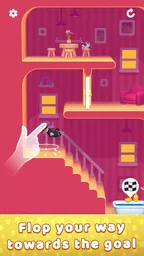
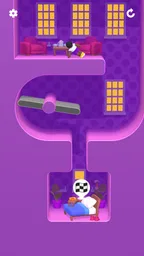
I like arcade games that make sense within seconds, but stay entertaining after the first few attempts. Lazy Jump has a clear hook: you guide a floppy rag doll through levels by flipping and flailing it toward the goal. The appeal is less about precision platforming than about watching awkward movement turn into progress—or a wonderfully silly failure. It is an easy game to pick up when I have a spare moment, though its loose physics will not suit everyone.
Getting a feel for the rag doll
In practice, the central challenge is judging how a rag doll will move when you set it in motion. The character does not have the crisp, predictable feel of a runner or a conventional platform hero. A small input can lead to a clumsy tumble, and that unpredictability is part of the joke as well as the task. I find it more enjoyable when I treat each attempt as a chance to learn the movement, rather than expecting every action to produce a perfectly controlled landing.
The basic loop works well for short sessions. I can start a level, try to get the character moving in the right direction, and see quickly whether my approach is working. That makes the game a natural fit for a break between errands or a few minutes of downtime. It is also the sort of game I would hand to someone who wants a light arcade diversion without a long tutorial or a complicated setup.
The useful habit is to watch what happens after an action, not just to keep reacting. If a launch sends the doll tumbling awkwardly, repeating the same attempt at speed may not help. I do better by pausing for a moment, noticing whether the character is gaining useful momentum or getting caught in an unhelpful motion, and then trying a different timing or direction. That small reset makes the physics feel less random and gives each attempt a purpose.
There is a trade-off here: the loose movement creates funny outcomes, but it can also make success feel less directly tied to exact skill than in a tighter arcade game. Players who enjoy experimenting with momentum are likely to find that charming. If you want every input to translate into a precise, repeatable movement, a classic platformer or a score-focused arcade title may feel fairer.
Small habits that make attempts more useful
I recommend changing one thing at a time when a level is not going well. If I alter both timing and direction on every retry, it is hard to tell what actually improved the result. Keeping one part of an attempt consistent makes the next outcome easier to read. This is not a hidden technique or a special control scheme; it is simply a better way to learn a game built around unpredictable-looking movement.
It also helps to judge an attempt by where the doll ends up, rather than by whether the motion looked graceful. The rag-doll comedy can encourage button-mashing just to see a more spectacular tumble, but that is not always the fastest route through a level. When I am trying to make progress, I focus on a useful landing or a better position, and save casual experimentation for when I am playing purely for laughs.
What to check before settling into a routine
On mobile, I would spend the first session getting comfortable with how the controls respond on my own device. The most reliable approach is to use deliberate inputs and leave a beat to see the result before committing to another attempt. That is especially helpful if you are playing one-handed or while distracted: rushing through repeated actions can make the movement harder to interpret, not easier.
I would also check the game’s available settings before assuming that every part of the experience can be adjusted to personal taste. Keep expectations practical: a settings screen is worth reviewing, but it should not be treated as evidence of options that may not be there. For a game whose appeal depends on floppy movement, the key question is whether the default feel is enjoyable for you, rather than whether you can tune it into a precise physics simulator.
If you play in short bursts, use the start of each session to reorient yourself instead of trying to recover an old rhythm immediately. A couple of careful attempts can remind you how the character responds, after which you can decide whether to play methodically or lean into the slapstick. This is more useful than trying to force a long, uninterrupted session out of a game designed around quick arcade interactions.
Where it fits among arcade alternatives
As an arcade game from SayGames Ltd, Lazy Jump takes a different route from games built around constant forward motion, exact timing windows, or a high-score chase. Its personality comes from the rag doll’s awkward movement and the player’s attempts to direct it. Compared with a standard endless runner, it feels less like memorizing a rhythm of obstacles and more like testing how a loose body will react. Compared with a precise platformer, it is less about clean jumps and more about adapting when a movement goes oddly.
That comparison matters when deciding whether to install it. If you like physics-based comedy and do not mind a little trial and error, it has a clear niche. If your favorite arcade games reward speed, exact input, or a measurable personal-best routine, another option in the category may hold your attention better. Lazy Jump is strongest when the journey itself is amusing, not when you demand that every attempt look controlled.
A realistic use case is a short wait when you do not want to begin a game that requires a long commitment. I would play a level or two, enjoy the occasional ridiculous tumble, and stop when the novelty of the movement starts to fade. It is less suited to a commute where you need to keep your attention on something else, since reacting to the rag doll works best when you can look at the screen and learn from what just happened.
Who will enjoy it—and who may not
I would recommend it to players who like quick, silly challenges and are happy to improve through repeated attempts. It can also work for someone who wants an arcade game that is easy to understand without relying on the usual runner formula. Its audience rating is Everyone 10+, so families can consider it with that age guidance in mind, while still judging whether the slapstick style is a good fit for the person playing.
I would steer away from it if you dislike imprecise motion, repeated retries, or outcomes that look chaotic even when you are trying to play carefully. It may also be a poor match if you want a substantial narrative, a deep skill tree, or a detailed competitive routine; those are not the reasons this game is appealing. Its best use is as a compact, playful distraction rather than a replacement for a more involved game.
The game is free to download, with in-app purchases listed at $2.99 per item. I would treat that as a reason to pay attention to any purchase prompts during play, especially if a child is using the device. The free entry point makes it easy to try the core idea, but the game’s value for you depends more on whether the movement stays funny and engaging than on the number of sessions you can fit into a day.
Practical details and the long-term question
Lazy Jump was released on July 27, 2022, and its current version is 1.10.10. It requires Android 8.0 or later. It has a 4.5 average from around 41,000 ratings, and has passed 10 million installs, which suggests that its simple, comic premise has reached a broad audience. Those figures are useful context, but they do not tell me whether its physics will click with you; a few minutes of play will answer that more clearly.
The main limitation I would keep in mind is that a deliberately floppy character can blur the line between a funny mistake and a frustrating one. When the game is clicking, I am curious to see how a different attempt will turn out. When it is not, repeating the same kind of movement can feel like hoping for a better outcome rather than mastering a clear system. The best response is to slow down, vary one input, and decide whether experimentation is still enjoyable.
For experienced players, the most repeatable pattern is not a secret shortcut but a calm routine: observe the result, identify the part that went wrong, change one thing, and try again. That keeps the game from collapsing into random tapping. It also sets a sensible limit: if several attempts stop teaching you anything and only produce similar tumbles, take a break rather than forcing a long session. The game’s short-form nature is an advantage, and there is no need to turn every level into a test of endurance.
My verdict after finding its rhythm
I see Lazy Jump as a cheerful, deliberately messy arcade game that earns its place through character rather than precision. The rag doll’s unstable movement gives ordinary attempts a comic edge, while a little patience makes the challenge more readable. I would happily recommend it to a friend who wants something light to play in spare moments and enjoys learning through trial and error.
My recommendation comes with a clear caveat: this is not the right pick for someone who wants tight controls, predictable jumps, or a deep progression system. Try it if the idea of guiding a floppy character sounds amusing, and give yourself a few attempts to understand the movement before deciding. If you are still laughing when a plan goes wrong, it is doing its job; if the same unpredictability is getting on your nerves, a more precise arcade game will be a better fit.
For me, the winning approach is to play deliberately, keep sessions short, and enjoy the absurd motion without expecting perfect control. That makes the game easy to recommend as a casual diversion, while keeping its limitations in view.
What we like
- Simple one-touch controls are easy to learn.
- Short levels suit quick play sessions.
- The ragdoll movement gives jumps a playful feel.
- Unlockable characters add a small goal to pursue.
- The basic gameplay is accessible to casual players.
What could be better
- Repeated jumps can make the gameplay feel monotonous.
- Precise landings may take trial and error.
- Ads may interrupt the flow of play.
- Progress can feel slow without frequent rewards.
- The simple mechanics may not satisfy players seeking depth.







