Jumping Car Damage Test Game review
 Analysis by Appsdrops
The appeal of Jumping Car Damage Test Game is easy to understand: drive a car toward a jump, send it flying, and see what happens when it comes back down. I like that direct premise for a short break. There is no need to settle in for a long simulation session before reaching the central action. The fun is in committing to a launch, watching the outcome, and deciding whether to try again with a different approach.
One clear action, then the moment of impact
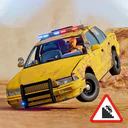
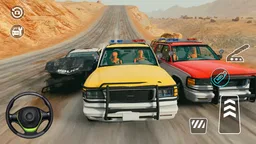
This is a car-jumping simulation game from SpeedZone, built around the spectacle of a vehicle in motion and the crash that follows. Its short store description is “Jumping Car,” but the experience is better understood as a compact stunt-and-damage loop than as a conventional driving game. I would come to it for the jump itself, not for a realistic commute, a broad open road, or a long-form racing challenge.
The first useful question is what kind of play you want. If you enjoy setting up a stunt and seeing how it turns out, the premise gives you a reason to act immediately. If you are looking for detailed car tuning, realistic traffic, or a structured championship, this is probably not the right fit. The appeal is narrower and more immediate: create a dramatic run, observe the result, then decide whether another attempt might be more satisfying.
That clarity is a strength on a phone. I can imagine opening it while waiting for a friend or taking a short pause between tasks, because the central idea does not ask me to remember a complicated objective. It also means the game has to make each attempt feel worthwhile. A jump that looks and feels different from the last one can carry a session; a string of similar outcomes can make the premise wear thin quickly.
What the impact feedback is for
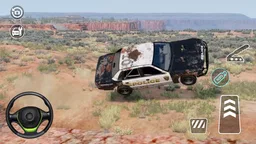
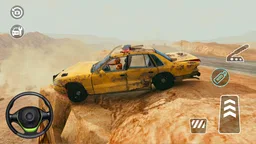
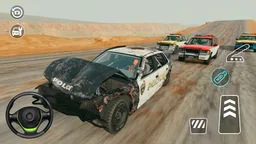
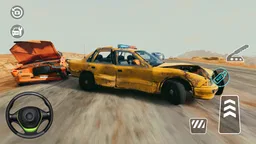
The crash is not just an ending to the drive; it is the payoff the whole action points toward. That changes how I judge the experience. In a normal racing game, a collision is often something to avoid. Here, the attraction is seeing the consequences of a stunt. The useful distinction is whether I want to improve a clean lap or simply enjoy an unpredictable landing. This game belongs much more to the second mood.
For a more satisfying run, I would treat each attempt as a small experiment rather than mindlessly repeating the same launch. Notice how the approach feels, pay attention to the vehicle’s trajectory, and change one part of your timing or steering at a time if the controls allow it. Changing one thing makes the result easier to interpret than altering everything at once. Even in a simple game, that habit can turn a string of crashes into a small personal challenge.
There is a trade-off in this kind of feedback. A big impact can be entertaining even if it does not represent progress, while a less dramatic landing might be more useful if the goal is to control the car. I would decide which matters to me before playing: spectacle or a better attempt. That keeps the game’s basic loop from feeling like a puzzle with an invisible answer when its main pleasure is the moment of surprise.
Why another attempt can feel worthwhile
The reward here is less about a deep simulation career and more about getting another chance to see the action unfold. A memorable jump gives the next try a purpose: perhaps I want to repeat the result, or perhaps I want to change the approach and see whether the car behaves differently. That is a modest form of motivation, but it suits a game designed around one recognizable stunt.
My practical tip is to give a short session a stopping point. Try a handful of runs with a clear intention—one for a dramatic crash, another for a more controlled landing—then take a break if the outcomes start to blur together. This makes the reward more personal than simply tapping through attempts. It also helps reveal whether the game’s core action is enough for you, which matters more than expecting a simulation to provide the depth of a full racing title.
For younger players or families, the content rating is Everyone, so its age classification is broad. That can make it an approachable pick for someone who wants a straightforward car game rather than an intense competitive racer. I would still choose it based on the child’s interest in stunt crashes and repeated trials, not merely because the classification is accessible. A player who wants story missions or varied objectives may find the central activity too focused.
The reset is part of the rhythm
A jump-and-crash game naturally asks the player to reset and try again. That reset can be satisfying when the next attempt is quick to understand: I have seen what happened, I have an idea, and I want to test it. It becomes friction when I feel I am repeating an action without learning anything or when the result does not give me a reason to change my approach. In a short-session game, that distinction is crucial.
I would use the reset as a deliberate checkpoint rather than treating every run as identical. Before starting again, ask what the last attempt showed: was the launch too cautious, did the landing surprise me, or was the entertaining part simply watching the damage? This simple pause makes play feel more intentional. It also gives me a fair way to decide whether I am still enjoying the loop or only chasing a novelty that has already worn off.
Compared with the usual alternatives in the driving-simulation category, this is a more focused choice than a realistic driving app and a less structured one than a racing game with events and progression. That focus is exactly why it may work as a quick distraction, but it is also the main limitation. If I want to practise careful driving, explore a large environment, or steadily build toward a campaign goal, I would pick another kind of game. If I want a compact stunt premise and do not mind repetition, this one makes more sense.
Who should install it—and who should pass
The game is free, and it has reached over 10 million installs. Its average rating is 3.9 from around 19,000 ratings, with 355 written reviews. I take those figures as context rather than a promise that the experience will suit everyone: a simple, specialized loop can be enjoyable for players who like it and unappealing to those who want more variety. It was released on December 11, 2024, and version 1.2.5 supports Android 6.0 and later.
I would recommend giving it a try if you enjoy crash-focused stunts, quick retries, and seeing how a vehicle’s jump ends. It is also a reasonable choice for someone who wants a casual simulation that can be picked up without a long warm-up. I would skip it if the word “simulation” makes you expect detailed vehicle setup, careful road rules, or a large collection of driving tasks. The experience is defined by its stunt loop, not by the breadth of a driving sandbox.
For an everyday scenario, imagine having a few minutes before a ride arrives. A long racing session is awkward to begin and abandon, but a quick stunt attempt gives you a clear action and a natural stopping point. If one run is amusing, try another with a small change; if the next few feel alike, close the game without feeling that you have left a long objective unfinished. That is the context in which I see its design working best.
My verdict on the loop
Jumping Car Damage Test Game has a straightforward rhythm: start a run, watch the jump and impact, take the result as either entertainment or a hint, and reset when curiosity wins. I like that it knows its central attraction rather than pretending to be a complete driving world. The same focus can also limit its staying power, especially for players who need varied goals or meaningful progression to keep returning.
My recommendation is simple: try it when you want a brief, spectacle-first car game, and judge it by whether the next attempt still feels interesting after the novelty of the first crash. If you find yourself experimenting with your approach or enjoying the unpredictable outcomes, it has found its audience. If you want precision driving, a campaign, or a wider range of activities, choose a different simulation instead. As a small loop for a short pause, it has a clear purpose; as a long-term substitute for a full driving game, it is too narrowly focused.
What we like
- Quick rounds make it easy to play in short sessions.
- Simple controls are approachable for new players.
- Vehicle crashes provide clear visual feedback.
- Varied cars can make repeat attempts feel fresh.
- The stunt-focused premise offers casual arcade fun.
What could be better
- Gameplay may feel repetitive after several attempts.
- Crash physics can seem inconsistent at times.
- Progress may depend on repeated play.
- Controls may lack precision during difficult jumps.
- The game may not suit players seeking realistic driving.







