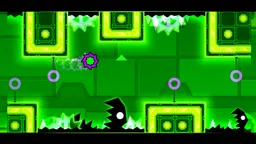
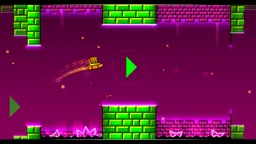
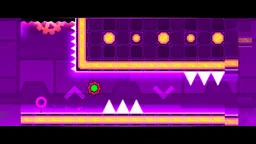
Geometry Dash Meltdown review
 Analysis by Appsdrops
I like Geometry Dash Meltdown most when I want a game that gives me a clear, immediate challenge and doesn’t ask me to settle in for a long session. It turns movement into a test of timing: watch the route, react to what is coming, and try again when a mistake ends the run. That simplicity makes it easy to pick up, but the precision it demands can make even a brief play session surprisingly intense.
A focused arcade challenge built around timing
This is an arcade game from RobTop Games, and its central appeal is easy to understand: the action is direct, while success depends on learning how each stretch unfolds. I don’t need a complicated setup or a long tutorial to begin. The challenge comes from recognizing hazards and responding at the right moment, not from juggling a collection of menus and systems.
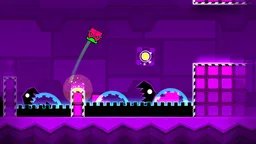
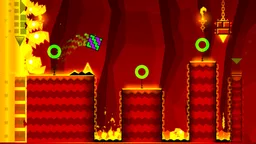
The rhythm-based structure gives the movement a strong sense of pace. Instead of treating a level as a place to wander around, I approach it like a sequence to read and rehearse. Once I know where an obstacle appears, I can focus on making a cleaner input rather than guessing. That makes the game satisfying for people who enjoy practice and precise execution, though it is less welcoming to anyone hoping to explore at a relaxed speed.
Its compact, repeatable format suits the ordinary gaps in a day. I can play while waiting for a bus or take a short break between tasks, then put it down without needing to remember a complicated plot. A useful way to approach a difficult section is to stop trying to rush through the whole level mentally. I focus on the next obstacle, notice what happened on the previous attempt, and make one deliberate adjustment. The game’s challenge feels more manageable when I treat retries as practice rather than as wasted time.
How the current version fits into the series
The game’s current version is 2.2.148, and it first arrived on December 19, 2015. Those details place it as an established entry rather than a newly launched experiment. For someone deciding whether it is worth installing today, the practical point is that the core proposition remains easy to judge: this is a focused rhythm-action platform game, not a broad collection of modes or a story-led adventure.
The version number is useful context, but it is not a promise about what a particular update changed. I wouldn’t assume that a higher version means new levels, a different control model, or a major redesign. If you already know the game, the safest expectation is continuity with the same basic appeal: short bursts of demanding play where timing and familiarity matter. If you are new, you can evaluate it on that basis without expecting a large ongoing progression system.
That distinction matters for returning players. A version label can suggest ongoing development, but the number alone does not tell me whether my favorite parts have changed or whether a feature has been added. I’d treat the current build as the version to try, while keeping expectations focused on the experience itself rather than on an imagined list of updates. That is a more useful way to judge a compact game than reading a version number as a guarantee of new content.
What the rhythm changes about a run
In many arcade platformers, I react mainly to what I see on screen. Here, rhythm gives the action a different feel: timing is not just a matter of reflexes but also of getting familiar with the sequence. When I fail, I can often use the attempt to understand the pace of a section, then carry that understanding into the next try. That learning loop is the game’s real hook, and it can be more rewarding than simply reaching the end once.
A practical tip is to avoid making every retry a full-speed test of willpower. I try to notice whether I missed because I acted too early, too late, or because I had not yet read the upcoming sequence. Those are different problems, and identifying which one occurred gives the next attempt a purpose. This small change in mindset turns repetition into a skill-building routine instead of a string of identical frustrations.
There is a trade-off, though. A rhythm-led sequence can feel strict if I want to improvise or recover after a poor input. The pleasure comes from consistency, not from improvisational freedom. If you prefer platform games where exploration, alternate paths, or broad movement options are the main attraction, this one may feel narrow. Its focus is also its limitation: the game keeps returning your attention to timing and execution.
Who will enjoy it—and who may not
I’d recommend it to players who like a challenge they can improve at through repetition. It works especially well for someone who enjoys memorizing patterns, refining a small movement, and getting a little farther after a few attempts. The game’s simple premise also makes it suitable for quick sessions, provided the player is comfortable with failure being part of the process.
It is not my first pick for a young or casual player who gets upset when a run ends quickly. The age rating is Everyone, but that does not mean the difficulty will suit every mood or temperament. A family member looking for a low-pressure game to share may prefer a gentler arcade title with more room to experiment. Likewise, if you want a lengthy campaign, character development, or a story to follow, this is not built around those expectations.
Compared with the usual alternatives in arcade platforming, this game leans harder on rhythmic timing and repeated attempts than on exploration or varied objectives. That makes it a good choice when I want a clear test of concentration, but a less complete choice if I want every session to feel different. Think of it as a compact skill challenge rather than an all-purpose arcade package. That framing helps set expectations before the first run.
Small decisions that make retries more useful
One thing I find helpful is to separate learning the sequence from trying to perform it perfectly. On an early attempt, I pay attention to where the pressure points are. On the next, I concentrate on one troublesome transition instead of expecting an entire clean run. This is a simple workflow, but it makes the game feel less random: I’m gathering information, then applying it, rather than tapping harder and hoping for a different result.
It also helps to choose the right moment to play. If I have only a minute and feel impatient, the game’s demanding rhythm can make a short break more irritating than refreshing. When I have a few calm minutes and can give the screen my attention, the same repetition feels satisfying. The most useful everyday scenario is therefore not just “play whenever”; it is choosing a brief window when I’m willing to focus and retry rather than expecting instant progress.
Another trade-off is how much attention the action asks for. This is not the kind of game I’d keep half-open while reading messages or listening for a conversation. A missed cue can end a run, so divided attention undermines the point. If you need something that tolerates interruptions, a turn-based puzzle or a slower arcade game is likely a better fit. If you like a small, self-contained challenge that rewards concentration, the focus can be a welcome change.
Popularity, access, and practical expectations
The game has an average rating of 4.6 from around 1.9 million ratings, with roughly 153,000 written reviews and over 100 million installs. Those figures indicate that it has reached a very large audience, but they do not tell me whether every player will enjoy its demanding pace. I would read its broad popularity as a sign that the basic idea is easy to understand, not as evidence that the difficulty is universally comfortable.
It is free, carries an Everyone content rating, and requires Android 7.0 or later. That makes it straightforward to consider if you use a compatible Android device and want to try a no-cost arcade game. The price removes one barrier to sampling it, but it does not change the central question: do you enjoy learning a fixed-feeling sequence through repeated, precise attempts? That matters more than the download decision itself.
If you are wondering whether it suits a first-time player, I think it can, as long as you go in expecting a challenge rather than a gentle introduction to platforming. If you are asking whether it is a good choice for a quick session, yes, provided you have enough attention to focus on the run. And if you are deciding between it and a more varied arcade game, choose this one for timing practice; choose the alternative when exploration, changing objectives, or a calmer pace matters more.
What to expect from future changes
I would be cautious about treating the current version as a hint that a particular feature or content update is coming next. The version number establishes the build available now; it does not tell me what the developer plans to do. For existing players, the sensible approach is to enjoy the game for the challenge it offers today and check the app store if they want to know whether their installed build has changed.
What I would watch for in any future update is whether it improves the experience for players who enjoy the core challenge without changing what makes the game distinctive. For example, clearer communication about a build’s changes would help returning users decide what to revisit. That is an expectation, not a claim about current plans. The game already has a coherent identity, so changes would be most valuable if they supported that focused play rather than adding complexity for its own sake.
Overall, Geometry Dash Meltdown is a strong fit for me when I want a compact, demanding arcade game that rewards attention and persistence. Its rhythm-based runs create a satisfying practice loop, and the free price makes it easy to try. The main caveat is equally clear: repeated failure and precise timing are central to the experience, not occasional annoyances around a more forgiving game. I’d recommend it to a friend who enjoys mastering a challenge one attempt at a time, but I’d point someone seeking variety, exploration, or a relaxed pace toward a different kind of platformer.
What we like
- Short levels make it easy to play in quick sessions.
- Practice mode helps players learn difficult sections.
- Responsive controls make precise jumps feel satisfying.
- The soundtrack stays closely synced with the action.
- Its compact level selection is easy to navigate.
What could be better
- The small number of levels limits replay variety.
- Frequent retries may frustrate newcomers.
- One-touch controls offer little gameplay variety.
- Late obstacles can demand memorized timing.
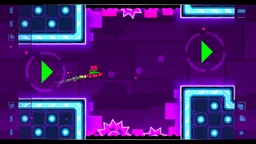
- Visual effects may make hazards harder to spot.







