




Flappy Dunk review
 Analysis by Appsdrops
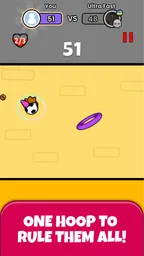
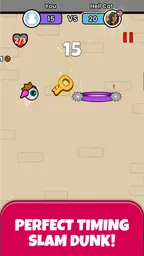
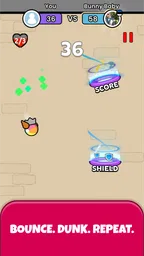
I enjoy arcade games most when they let me start playing before I have time to overthink it, and Flappy Dunk fits that kind of quick break. It turns a familiar basketball goal into a timing challenge: tap to keep the ball moving and try to guide it through the hoop. The idea is easy to grasp, but the narrow margin between a clean shot and a miss gives each attempt a little tension. My main impression is that this is a game for short, focused bursts rather than a deep basketball simulation.
Quick taps, demanding timing
As an arcade game from VOODOO, it puts precision ahead of complicated controls. The one-touch approach makes it simple to pick up, whether I have a spare minute at home or am waiting for something to finish. There is no need to learn a set of moves before a round can make sense. The challenge comes from judging the taps, keeping the ball on course, and responding when a shot is less comfortable than expected.
That simplicity does not mean the game feels automatic. A tap that is slightly too early or too late can change the ball’s path, so success depends on attention rather than button combinations. I like that the control scheme gives a clear reason for a mistake: I can usually connect a missed hoop with my timing and adjust on the next try. The trade-off is that repeated misses can feel frustrating, especially if I wanted something relaxing rather than a small test of concentration.
The game’s 4.5 average from around 229 thousand ratings suggests that many players enjoy this compact challenge. It has also passed 10 million installs, which gives a sense of its broad appeal without making it a complicated recommendation: the core loop is easy to understand, but whether it holds your attention depends on how much you enjoy retrying a precise action.
How fast does a session feel?
Flappy Dunk is built around quick interactions, so the time from deciding to play to making an attempt feels naturally short. That makes it a good fit for a brief pause between tasks. I would not choose it when I want a long, story-driven session or a detailed sports experience; its strength is that I can dip in, focus on a run, and put it down without needing to remember a complicated plan.
A useful way to approach it is to treat each attempt as practice in timing, not as a demand to beat a personal best immediately. If I find myself tapping faster simply because I am impatient, I tend to lose control of the shot. Slowing down enough to read the ball’s movement is a better habit than trying to compensate with frantic inputs. That small change makes the challenge feel more deliberate and less like random luck.
The short format also makes it easy to fit into an ordinary day. For example, while waiting for a kettle to boil, I can play a few attempts and stop when the water is ready. It works well in that kind of gap because there is no expectation that I must settle in for a lengthy match. If I have only a moment, I can still get a complete little burst of play rather than being left midway through a larger activity.
When repeated play gets demanding
The moments that ask for the most attention are not necessarily long sessions; they are stretches where I keep chasing a clean sequence after a near miss. One mistake can encourage another hurried tap, and that is where the one-touch design becomes both its appeal and its main source of friction. I find it more satisfying to pause briefly after a frustrating attempt than to keep tapping immediately and let annoyance take over.
This is also why the game suits people who like learning through repetition. The control stays simple, so each retry gives me a chance to refine the same basic response instead of memorizing a new combination. Players who enjoy chasing a more consistent touch may find that rewarding. On the other hand, anyone who dislikes repeating similar attempts after a mistake may prefer a game with more varied actions or a gentler pace.
For a shared setting, the game is easy to explain: hand the phone over, show the tap, and let someone try. But the same simplicity can make it tempting to keep playing longer than intended, because restarting an attempt requires little commitment. I would set a natural stopping point—such as a short break or a few focused runs—if I am trying not to let a quick distraction stretch into a long one.
Reliability and the feel of play
For this kind of arcade game, reliability matters less as a long list of systems and more as a consistent response to a tap. My practical expectation is straightforward: the controls should feel clear enough that I can learn from a miss. The game’s design gives it a narrow focus, which is helpful when I want to concentrate on timing instead of managing a roster, navigating a complex menu, or following a lengthy tutorial.
I would still avoid judging a single awkward attempt as proof that the game has failed to respond. With a timing-based control, a tap that feels right in the moment may not produce the path I expected, and that can be part of the challenge. If inputs seem difficult to read, I would first try playing with a steadier rhythm and paying closer attention to the ball’s movement. This is a more useful test than tapping rapidly and hoping the game corrects the action.
Recovery is also simple in the everyday sense: a missed shot does not require me to rebuild a complicated setup before trying again. That keeps the cost of experimentation low. It is a good quality for a quick arcade game, though it does not remove the emotional sting of repeated misses. The game is better at making another attempt easy than at making every attempt feel forgiving.
With around 27 thousand written reviews, the game has attracted plenty of player discussion, but I would base my decision on its actual style rather than popularity alone. If I want a responsive-feeling, focused test built around one kind of input, the premise is appealing. If I need a broad set of activities to keep a session fresh, a more varied arcade title is likely a better match.
Device fit, cost, and who should try it
The game is free to download and is rated for Everyone, so it is approachable for a wide range of players. It includes optional in-app purchases, with items priced from $0.99 to $109.99 each. I would keep that range in mind before handing a device to a child or anyone who might make purchases without checking. The basic appeal is the quick basketball-timing challenge, so I would decide whether I enjoy that loop before considering any optional spending.
Version 2.17.0 is listed for devices running at least iOS 8.0. Before installing, I would check the operating-system requirement in the relevant app store and make sure the device has enough room for another game. I would not assume that an older device will feel identical to a newer one; if a phone is already struggling with other apps, closing unused apps before playing is a sensible way to reduce background load. That is general device housekeeping, not a special setting required by this game.
In perceived performance terms, the game’s focused, one-touch format gives it a lighter-feeling role than a large sports game with many modes and systems to manage. Still, I would not promise identical speed or stability on every phone. If the game feels choppy or taps seem hard to judge, restarting it and trying again when the device is less busy are practical first steps. I would also avoid playing while walking or doing something that needs attention: a quick session still asks me to watch the ball closely.
Compared with the usual alternatives in arcade basketball, Flappy Dunk favors a simple timing challenge over simulating a full court, team play, or elaborate shot controls. That makes it easier to pick up than a sports game designed around matches, but less suitable if I want realistic basketball decisions or a longer progression-focused experience. Compared with other tap-based arcade games, its basketball target gives the action a clear visual goal, while the narrow control style can become repetitive if I prefer frequent changes in mechanics.
My verdict on everyday performance
I would recommend Flappy Dunk to someone who wants a compact arcade distraction, likes improving through repeated attempts, and does not mind that a small timing error can spoil a shot. It is especially convenient for short waits and quick breaks, where the simple control has more value than a deep feature set. I would steer away from it if you want a calm game with forgiving inputs, a realistic basketball experience, or enough variety to carry a long session without repetition.
For me, the most important trade-off is clarity versus forgiveness. The single-touch setup makes the game immediately understandable, and it keeps each attempt focused, but it also puts nearly all of the challenge into timing. If that sounds satisfying, the free download is an easy way to see whether the rhythm suits you. If repeated precision challenges usually make you tense rather than entertained, a less demanding arcade game will probably be a better use of your break.
Overall, I see it as a small, purposeful game rather than an all-day basketball destination. It does its best work when I have a few spare minutes, want something I can understand at a glance, and am willing to give a missed shot another try. That focused identity is both its strongest reason to install it and the clearest reason some players should pass.
What we like
- One-touch controls are easy to learn.
- Short rounds suit quick play sessions.
- Dunking gives each run a clear objective.
- Unlockable balls add visual variety.
- The simple format makes it easy to replay.
What could be better
- Timing takes practice to master.
- A single missed shot can end a run.
- Repeated attempts can feel monotonous.
- Ads may interrupt the experience.
- Progress depends heavily on precise taps.







