
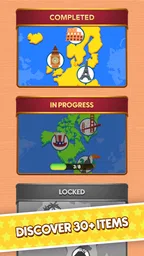
Drop Fit: World Flag Puzzle review
 Analysis by Appsdrops
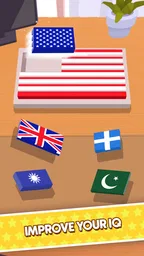
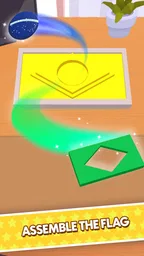
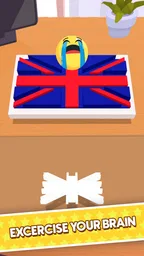
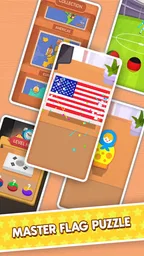
Some puzzle games ask for your full attention; Drop Fit: World Flag Puzzle is better suited to the small gaps in a day when you want something gentle to focus on. Its flag-puzzle premise gives the game a visual, hands-on feel, while its simulation classification is a reminder that this is a relaxed pastime rather than a demanding strategy challenge. I’d consider it when I want a low-pressure game to open briefly, not when I’m looking for a deep campaign or a competitive test.
A relaxed pace, with puzzles at the center
The appeal is in having a clear puzzle to work on without the feeling that every move has to be made quickly. That makes it a natural fit for a short break, a quiet commute, or a few minutes winding down before bed. I like that the basic idea is easy to understand: the flags provide a recognizable visual theme, so the game’s identity is apparent without needing a long explanation.
That same simplicity defines the limits. If you usually enjoy games with intricate rules, long-term planning, or a strong sense of progression, this may feel too light. The flag theme adds personality, but it does not by itself turn a casual puzzle into a broad geography lesson or a serious test of country knowledge. I’d approach it as a soothing puzzle game first.
The key question is whether a calm pace sounds appealing. There is no reason to treat each session like a timed challenge; instead, I’d use the pauses between moves to look at how the pieces fit together. For someone who wants a game that can be put down without losing the thread of a complicated story, that is a practical strength.
What the unhurried format is good for
In a realistic everyday routine, I might open it while waiting for a coffee or during a break between tasks. Those moments are often too short for a narrative game, but long enough to settle into one small visual problem. A useful habit is to decide in advance whether I have time for one puzzle or a longer stretch, then stop when that feels satisfying rather than turning a casual break into another obligation.
For parents choosing something appropriate for a shared device, the Everyone age rating is reassuring as a broad content guide. I would still expect younger players to benefit from an adult nearby if the puzzle itself becomes confusing, especially if they are not familiar with flags. The subject offers a chance to notice colors and symbols together, but I would not rely on the game alone to teach geography.
The game is free to start, with optional in-app purchases priced from $0.99 to $2.99 per item. That can make it easy to try before deciding whether it deserves a place in a regular rotation. I’d keep an eye on purchase prompts if a child is playing, and make sure any buying decision is deliberate rather than part of a quick tap through the game.
How it holds up during longer sessions
A calm puzzle can be more demanding than it first appears when I play for a while. The first few problems may feel like a pleasant warm-up, but repeated visual decisions can become tiring if I keep going after my attention has wandered. With this kind of game, I find it useful to take a short pause when I start making careless moves. A fresh look often helps more than trying to push through on autopilot.
That makes it different from a typical action game, where longer play may depend on fast reactions or sustained intensity. Here, the main trade-off is whether the puzzle remains engaging once the novelty of the flag theme wears off. Players who like quietly working through visual challenges may appreciate that restrained pace; those who need frequent surprises, a story, or changing modes may want a more varied alternative.
I would also avoid judging the game by a single rushed session. A puzzle title is easiest to assess when I’m not distracted, because a small visual task can feel either pleasantly absorbing or oddly fiddly depending on my state of mind. If it feels slow while I’m multitasking, that may be a sign to play when I can give it a little attention—or to choose something more passive, such as a simple matching game.
Reliability and the practical experience
Drop Fit is made by Inwave Co Ltd, and its current version is 1.0.54. It was released on February 6, 2024, and its average rating is 4.9 from around 20,000 ratings, with about 200 written reviews. More than 5 million installs suggest that it has reached a wide audience, though popularity alone cannot tell me whether its particular puzzle style will suit my habits.
For reliability, I’d judge it in practical terms: does it behave well enough for the short sessions it is designed to fill, and does the puzzle remain understandable when I return? I wouldn’t assume that a high rating guarantees a flawless experience on every phone. If a game unexpectedly closes or pauses, I’d first check whether the device has enough free space, whether the operating system is up to date, and whether reopening the game restores the session. Those are sensible steps for mobile games generally, not a promise about how this title handles every interruption.
One useful way to test whether it fits your routine is to try a short session, leave the app, then return later and see whether you can comfortably pick up the puzzle again. This checks the part that matters most for a casual game: whether it works as a brief distraction rather than demanding a long uninterrupted commitment. I would not plan around it as a dependable offline activity unless I had already tested how it behaves in the places where I intend to play.
Device fit and resource expectations
The minimum operating system is Android 7.0, so the stated compatibility begins with an older Android release rather than requiring a recent one. That is useful if you have a phone you do not upgrade often. Still, a minimum OS is not a guarantee that every older device will feel equally responsive; available memory, background apps, and general device condition can all affect how smoothly a game runs.
Because this is a visual puzzle rather than an action-heavy simulation, I would expect its moment-to-moment demands to be modest in concept, but I cannot infer exact battery use, download size, or performance from the game’s category. If your phone is already slow, close apps you do not need and give the game a brief trial before relying on it for a commute. If you are trying to conserve battery, reducing other screen use is a more dependable general measure than assuming any particular game has negligible impact.
On iOS, I would check the app store’s compatibility details for the specific device before installing. The Android minimum system requirement does not establish which Apple devices are supported. For either platform, the sensible approach is to judge the experience on your own phone: notice whether the pieces respond comfortably, whether the display makes the flag designs easy to inspect, and whether the device stays cool enough for your liking during a longer session.
Who should choose it—and who may prefer something else
I’d recommend it to someone who likes simple visual puzzles, wants a gentle alternative to fast games, and appreciates a recognizable world-flags theme. It also makes sense for players who prefer to dip in and out rather than follow a long story. Since it is free to play and rated for Everyone, it is approachable for a broad audience, although optional purchases are worth keeping in mind on a shared device.
I’d skip it if you want a demanding simulation with many systems to manage, a competitive leaderboard-driven experience, or a puzzle game built around elaborate rules. If the goal is to learn flags in a structured way, a dedicated geography quiz would likely be more direct. If you want constant change and fast feedback, a more action-oriented puzzle game may hold your attention better.
Compared with the usual alternatives in the puzzle category, Drop Fit’s distinctive point is its combination of a quiet pace and flag-based visual material. That is a specific mood, not a universal advantage: it can make a break feel calmer, but it may also leave players wanting more variety. I would choose it for a short, focused unwind and choose a quiz, story puzzle, or action game when I want a different kind of engagement.
My verdict after weighing the trade-offs
Overall, I see Drop Fit: World Flag Puzzle as a low-pressure option for people who want a small puzzle to occupy a few spare minutes. Its strongest case is not complexity or spectacle; it is the approachable format and the chance to focus on a visual task without rushing. The large player base and strong average rating make it an easy title to consider, but the right fit still depends on whether this kind of restrained puzzle holds your interest.
My practical advice is to start with a brief session and pay attention to how the pace feels on your own device. If you enjoy studying the puzzle and can stop easily when your break ends, it may become a pleasant part of your routine. If you find yourself wishing for a timer, deeper systems, or a broader learning experience, that is a good sign to move on to a game designed around those needs. For a calm, accessible puzzle with a world-flags theme, it is worth trying.
What we like
- Quick rounds make it easy to play in short breaks.
- Flag puzzles offer a light way to practice visual recognition.
- Simple controls are approachable for casual players.
- Progressive challenges can keep repeated play engaging.
- The world flag theme gives the puzzles a clear focus.
What could be better
- Similar puzzle rounds may begin to feel repetitive.
- Small flag details can be hard to distinguish on compact screens.
- Players seeking fast action may find the pace too relaxed.
- The educational value may be limited without extra context.
- Difficulty may not suit players who prefer more complex puzzles.







