Draw To Smash - Draw Puzzle review
 Analysis by Appsdrops
I like puzzle games that let me try an idea instead of making me hunt through menus, and Draw To Smash has a simple hook: draw a line, then see how the physics play out. It turns a quick sketch into the main way to tackle obstacles, so each puzzle feels like a small experiment. The appeal is easy to understand, but the fun comes from watching a plan either work or fall apart in an unexpectedly satisfying way.
One sketch, one physics puzzle
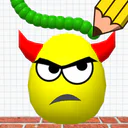
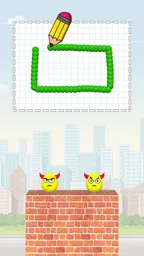
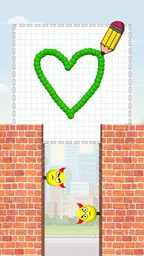
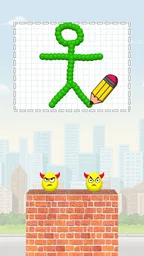
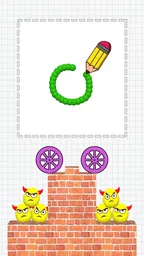
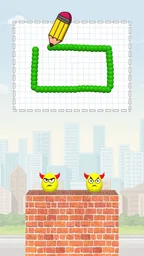
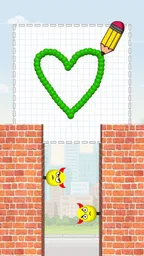
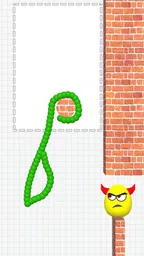
Draw To Smash is a free arcade game from HYPERCELL, built around drawing lines to solve physics puzzles and smash obstacles. That single capability shapes the whole experience. Instead of relying only on precise taps or a long list of controls, I use a drawn shape to influence what happens on screen. The result is an approachable kind of problem-solving: look at the obstacle, imagine how a line might help, and test the idea.
That setup makes the game easy to pick up. Drawing is an action most players understand immediately, and the goal is expressed through visible objects rather than complicated instructions. I can focus on the puzzle in front of me rather than learning an elaborate control scheme. For a casual mobile game, that clarity matters: it makes a short play session feel accessible even when I have only a little time.
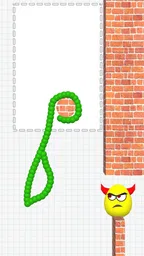
The physics are what give the sketch its personality. A line is not merely a decorative answer; it is part of an attempt to change the situation and get obstacles moving toward a smash. That creates a pleasing gap between what I intend and what actually happens. I may picture a neat solution, but the objects decide whether it holds together. When a plan succeeds, the payoff feels earned; when it does not, I have a reason to rethink the drawing.
Thinking with your finger
In practice, each puzzle invites a small cycle of observation and action. I first look at the arrangement, then decide what kind of line might help. After drawing, I watch the physics response and judge whether the result matches my intention. That rhythm is the heart of the game: a quick mental sketch, an immediate trial, and a chance to adjust my approach. It keeps the focus on the puzzle rather than on lengthy preparation.
The drawing mechanic also gives the player room to express an idea in a direct way. I am not simply selecting from a set of answers; I am making a mark and seeing what it does. Even a rough attempt can be informative, because the outcome shows whether my reasoning about the obstacle was useful. That makes experimentation feel natural. A failed sketch is not automatically wasted effort if it teaches me to look at the setup differently.
The best part is how a simple line turns problem-solving into something you can see unfold. That quality makes the game feel lively without needing a complicated premise. The action is easy to follow, and the cause-and-effect relationship is central: I draw, the scene responds, and I decide what to try next. For players who enjoy visual puzzles, that is a satisfying foundation.
When this game fits best
I think Draw To Smash works especially well in short bursts. Its core interaction is straightforward, so I can settle into a puzzle without a long warm-up. A quick session can be about testing one idea and enjoying the result, while a longer one can become a string of small challenges that keep me thinking. The game’s arcade character suits that flexible pace: it feels easy to return to when I want a light diversion.
It is also a good fit for people who like learning by doing. Some puzzle games ask me to study a board for a long time before making a move; here, drawing is a direct invitation to test a theory. I can use what I see on screen to form a plan, then let the physical response tell me whether it made sense. That hands-on quality may be more appealing than puzzles built around abstract rules or lengthy text instructions.
The game’s broad age rating makes its basic premise approachable for a wide audience. The central action does not depend on specialist knowledge: observe, draw, and watch the obstacles. That does not mean every player will enjoy the same degree of challenge, but the entry point is clear. Families and casual players can understand what they are being asked to do without needing a detailed explanation of the genre.
What the drawing approach asks of you
The same open-ended quality that makes the game appealing can also make a puzzle feel less exact. When I draw a line, I am making a practical guess about how the physics will react, not entering a perfectly controlled command. If the outcome differs from what I pictured, I may need to revise my idea rather than expect the game to behave like a rigid logic test. Players who prefer one clearly signposted solution may find this style less predictable.
There is a tradeoff between simplicity and depth, too. The headline interaction is immediately understandable, which helps the game feel welcoming, but the experience depends heavily on whether I enjoy repeating the draw-and-observe cycle. If I want a game centered on a broad range of controls or a story-led progression, this particular appeal may not be enough on its own. Its strength is its focused puzzle interaction, so expectations are best set around that.
Another practical point is that the fun comes from paying attention to the result. A quick doodle without considering the arrangement may not feel as rewarding as a sketch that responds to what is happening on screen. I get more from the game when I pause briefly to think about the obstacle, make a deliberate attempt, and learn from the outcome. That is a modest demand, but it is part of what makes the puzzles engaging rather than purely automatic.
A popular pick for casual puzzle fans
Draw To Smash has reached over fifty million installs, and its average rating is 4.7 from around 217,000 ratings. Those figures point to a game with a substantial audience, but the reason to try it is simpler: the drawing mechanic gives ordinary puzzle-solving a tactile, playful feel. It is free to play, rated for Everyone, and its current release is version 1.33.0. The game was released on March 14, 2023, and supports Android 7.0 or later.
For searchers looking for a draw puzzle game or a casual physics puzzle, the key question is whether making a sketch sounds more fun than choosing a fixed move. If it does, this game has a clear point of difference. I enjoy that it lets me act on an idea immediately and then learn from the physical result. It is less about mastering a complicated control system and more about seeing whether a simple drawing can change the scene.
The people most likely to get something out of it are players who enjoy trial and error, visual cause and effect, and small challenges that can be approached without a steep learning curve. It can suit a quick break, a relaxed session, or a shared moment where someone suggests a line and another person wants to see what happens. The mechanic is easy to explain, which makes the game approachable even for someone who does not usually seek out arcade puzzles.
Overall, I see Draw To Smash as a focused, friendly option for anyone curious about drawing-based puzzle games. Its central idea is strong because it makes the player’s own sketch part of the solution, while the physics provide the surprise that keeps each attempt lively. It may not suit someone who wants highly predictable answers or a much broader style of play, but for casual puzzle fans who like experimenting, it is an easy game to understand and an enjoyable one to revisit.
What we like
- Simple drawing controls make it easy to start solving puzzles.
- Physics-based outcomes keep solutions fun to experiment with.
- Multiple ways to solve many levels encourage creative thinking.
- Short stages work well for quick play sessions.
- The core gameplay is suitable for a wide range of ages.
What could be better
- Some puzzles may require repeated attempts to find the intended solution.
- Later levels can feel less intuitive than the early stages.
- Ads may interrupt play depending on the version and settings.
- Drawing precision can be tricky on smaller phone screens.
- The puzzle format may feel repetitive during longer sessions.







