




Daily Spider Solitaire Classic review
 Analysis by Appsdrops
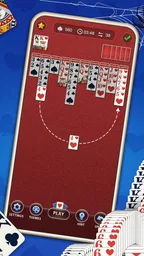
I like solitaire best when I can settle into a hand without needing a connection, a tutorial, or a complicated setup. Daily Spider Solitaire Classic is built around that kind of low-friction play: it is a card game you can take offline, with large cards, helpful hints, and daily challenges. Those details sound simple, but together they make a noticeable difference when I want a quick break or a calmer game that still asks me to think.
Why offline play changes the experience
For me, the most useful capability is being able to play without relying on an internet connection. It makes the game an easy choice for a commute, a waiting room, or a quiet moment somewhere with unreliable reception. I can focus on arranging cards rather than checking whether a connection is available. That does not make every hand easy, but it removes a common interruption from a game that works best when I can think through a sequence.
Spider Solitaire is more involved than a basic one-suit patience game: the point is to build descending sequences and clear completed runs, so a move can affect several later options. That makes a short session feel satisfying when the cards fall into place, while a blocked layout can call for patience. The offline format suits this stop-and-start rhythm particularly well. I can leave a session for later without needing the game to become a social event or a live competition.
The large cards are another practical part of that design. On a phone, a dense tableau can be tiring if the ranks and suits are hard to distinguish. Bigger cards make it easier to scan columns and compare possible moves, especially during a brief session when I do not want to squint or repeatedly reposition the screen. They do not remove the need to inspect the layout, but they make that inspection more comfortable.
Hints are helpful when I have missed an available move or want a nudge after staring at the same arrangement for too long. I see them as a way to keep a game moving, not as a substitute for making decisions. A hint can point my attention toward an option, but the useful question is still whether taking it will improve the board or simply shift the problem elsewhere. That distinction is part of what keeps the game from feeling like automatic card clearing.
What a hint is good for
My practical advice is to pause before accepting a hint and look at what the suggested move might uncover. In Spider, a move that looks productive can also use up a useful space or leave a sequence awkwardly split. Treating a hint as a prompt rather than an instruction helps me learn to read the tableau, and it keeps the game’s central puzzle in my hands. If I am playing casually, I can use it to avoid getting stuck; if I want a more thoughtful round, I can first try to spot the move myself.
The daily challenges give the game a small reason to return to it. Rather than treating every session as an identical fresh deal, I can make a challenge part of a routine: one hand during a coffee break, or a quick game before putting my phone away at night. I would not choose the app solely for a challenge calendar, but it gives an otherwise familiar solitaire format a regular point of entry. The value is modest and personal: it can make a short session feel intentional without asking me to commit to a long play period.
A good fit for short, interrupted breaks
A realistic use case is having a few unplanned minutes between errands. I can open the game, study the columns, and make a handful of moves without needing sound, a network, or another person to be available. If I need to stop, the basic appeal remains the same when I return: the cards are the puzzle, and I can pick up the reasoning at my own pace. That makes this a better fit for quiet solo downtime than for someone seeking a fast, competitive match.
Offline play also changes how I think about where the app belongs on a device. It is an option for a train ride, a flight, or a place where mobile data is inconvenient, as long as the game is already installed. I would still treat it as a casual diversion rather than a substitute for every kind of card game. It offers no reason to expect the interaction of a table full of people; its appeal is that the puzzle is ready when I want to be left alone with it.
Against the usual alternatives, this is the kind of solitaire I would pick when I want more planning than a simple one-suit layout but less commitment than a lengthy strategy game. Compared with a basic solitaire app, Spider asks me to manage sequences across columns and think about the consequences of uncovering or moving cards. Compared with multiplayer card games, it avoids waiting on opponents and keeps the pace in my control. The tradeoff is that the experience depends on enjoying this particular style of card puzzle; anyone who wants conversation, head-to-head play, or a constantly changing set of game modes may prefer a different category.
Where the convenience has limits
Hints can make a difficult position feel less frustrating, but they can also reduce the satisfaction of finding a solution independently if I lean on them every time. I get the most from them when I use one after making a genuine effort, then inspect the board to understand why that move matters. For a player who wants a strict, no-assistance challenge, the presence of hints may be a distraction even if they are optional to use.
The daily-challenge angle is similarly useful only if a routine appeals to me. If I prefer to play whenever the mood strikes and do not care about returning to a daily prompt, it is an extra rather than a reason to install the game. And while the large cards help with readability, the screen still has to show a multi-column puzzle; people who find card layouts visually busy may prefer a less demanding solitaire variant.
There is also a clear limit to what the game is trying to be. It is a focused card game, not a broad collection of activities. I would skip it if I were looking for online opponents, a story, elaborate progression, or a social layer. I would also look elsewhere if I wanted a game that requires rapid reflexes: Spider is about considering options, and that deliberate pace is a feature for some players but a drawback for others.
Who will get the most from it
I think it is strongest for people who already enjoy solitaire and want a comfortable way to play Spider in small pockets of time. The combination of offline access, readable cards, hints, and a daily reason to return suits casual players who like a puzzle but do not want to study a rulebook. It is also a sensible option for someone who wants an independent phone game that does not depend on matchmaking or a live session.
Newer players can use hints to get past moments of uncertainty, while experienced players can ignore them and focus on planning. The useful middle ground is to play unaided first, then call for help only when the board stops making sense. That approach keeps the game approachable without turning every round into a sequence of suggested moves. If you know you dislike card sorting or patient, incremental decisions, though, the basic format is unlikely to change your mind.
Big Cake develops the game, which is free to download and rated for Everyone. Its average rating is 4.9 from around 47,000 ratings, and it has more than a million installs. Those figures suggest that it has found a sizeable audience, but I would still judge it by whether Spider Solitaire itself suits your taste. The game includes in-app purchases priced from $1.99 to $9.99 per item, so it is worth remembering that “free” describes the download, not necessarily every optional purchase.
The game was released on July 25, 2019, and its current version is 17.1.104. It requires Android 7.0 or later. For me, the important point is less the version number than the specific experience it offers: a familiar card puzzle that remains available offline and is easier to inspect thanks to large cards. I would choose it for a quiet break, not for a feature-packed gaming session.
My take after weighing the tradeoffs
Daily Spider Solitaire Classic works best when I want a self-contained puzzle I can play at my own speed. Offline access is the feature that most shapes its everyday usefulness, while the large cards and hints support that relaxed, accessible style. The daily challenges add a gentle routine, but they do not change the fact that the core appeal is arranging cards and thinking ahead.
I would recommend it to a friend who likes Spider Solitaire, wants to play in places without reliable internet, and appreciates a little help when a layout gets stubborn. I would point a friend seeking multiplayer competition or a broader collection toward another option. For the right person, this is a straightforward way to turn a spare few minutes into a small, thoughtful card puzzle; its restraint is both its strength and the reason it will not suit everyone.
What we like
- Familiar rules make it easy to start playing.
- Multiple difficulty levels suit different skill levels.
- Undo options let you reconsider recent moves.
- Daily challenges provide a reason to return.
- Spider Solitaire works well for short play sessions.
What could be better
- Hints can make the game feel less challenging.
- Long matches may require careful planning.
- Random deals can vary in solvability.
- Small cards may be hard to read on compact screens.
- Frequent play can make the puzzles feel repetitive.







