



Crazy Kick! Fun Football game review
 Analysis by Appsdrops
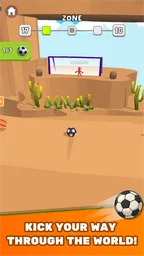
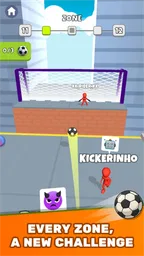
I like arcade games that explain themselves in a few seconds but still leave room to get better, and Crazy Kick! fits that narrow brief. It puts you in control of a soccer ball, with the simple aim of getting past eleven opposing players and scoring. There’s no need to learn a full set of football rules before playing; the appeal is in judging the route, keeping the ball moving, and timing your attempt to get through the defense.
That simplicity is also the main trade-off. This is an arcade soccer game, not a detailed football simulation: I’d open it for quick, focused bursts rather than for team management, realistic match tactics, or a long sports campaign. Made by VOODOO, it has a 4.5 average from around 251,000 ratings and over 100 million installs. Those figures suggest it has found a wide audience, but whether its compact, repeatable challenge suits you depends more on your appetite for short arcade play than on your interest in football itself.
Starting with the ball and finding a reliable rhythm
The most useful way to approach a run is to treat the ball’s movement as the center of the challenge. You are not directing a whole side or choosing a formation; you are trying to make one controlled object advance through a line of players. I’d focus first on reading the space in front of the ball rather than making a rushed move just because a gap appears. A path that looks open for a moment may not be the one that gives you a clean scoring attempt.
That makes the basic loop easy to pick up but not entirely thoughtless. The store summary describes the goal as dribbling, shooting, and scoring against eleven players, and that sequence gives the game its shape: progress through the opposition, then turn the opening into a finish. The fun comes from the small decisions along the way. If I fail, I can usually think about whether I committed too early or chose a poor line, rather than feeling that I need to study a complicated rulebook before trying again.
For a first session, I’d resist trying to play fast immediately. Make a deliberate attempt, notice how the ball responds to your input, and use the next run to change one thing at a time. That simple habit helps separate a bad decision from a general lack of familiarity. It also keeps the game from becoming a string of identical retries where you repeat the same motion and hope for a different result.
A realistic use case is a short break while waiting for a drink or for a friend to arrive. You can get to the point quickly, make a few attempts, and put the phone away without needing to remember a complicated objective later. I find that more suitable for Crazy Kick! than settling in for a long session: its central pleasure is the immediate challenge, not a deep narrative or a season that demands regular attention.
Make each attempt teach you something
When a run ends badly, it helps to give the next one a specific purpose. Try a different approach to the defenders, or pay closer attention to the moment you choose to shoot. Even without inventing a collection of advanced systems, a player can build a repeatable learning loop: observe, make one adjustment, and see whether it improves the attempt. That is a more useful way to spend a few minutes than changing several habits at once and having no idea what mattered.
The game’s narrow focus helps here. Since you are controlling the ball rather than coordinating a full squad, your attention stays on the immediate route and finish. That makes it approachable for someone who finds conventional soccer games too busy, but it also means that players who want passing combinations, lineups, or match planning should look elsewhere. The challenge is about individual control in an arcade setting, not reproducing all the decisions of a real match.
Check the practical details before settling in
Crazy Kick! is free to download, with in-app purchases listed from $0.99 to $69.99 per item. I’d keep that range in mind before handing the phone to a child or tapping through purchase screens casually. The game is rated Everyone, which makes its intended age suitability broad, but an age rating does not remove the need for a parent to consider spending controls on a shared device.
It first appeared on August 30, 2019, and the current version is 2.49.0. The stated minimum operating-system requirement is 8.0, so it is worth checking that your device meets that requirement before expecting to install it. These details matter most when you are deciding whether it will run on an older phone or when you are choosing a simple game for a family device. They don’t change the core appeal: short attempts built around moving the ball through opposition and scoring.
I would also go into it with the right expectations about the word “free.” The download costs nothing, but optional purchases are part of the app’s setup. If you prefer games with no in-app spending at all, that may be a reason to choose a different arcade title. If you are comfortable with a free download that offers purchases, it is still sensible to avoid impulsive taps and decide in advance whether you want to spend anything.
Build faster habits without assuming shortcuts
The quickest improvement is usually not frantic input; it is reducing hesitation while keeping your decisions deliberate. On each run, look for the next useful opening, then commit instead of repeatedly reconsidering the same move. Once you have a feel for the ball, repeat a successful approach long enough to tell whether it is dependable. A habit that works once may be luck; one that holds up across several attempts is more useful.
I’d also separate practice from score-chasing. In a practice-minded run, try to understand how a route develops and when a shot feels well-timed. In a score-minded run, rely on the approach you already trust and avoid experimenting at the last moment. Switching between those intentions can make your play feel less random, even though the game itself remains a straightforward arcade challenge. It is a small change in how you play, but it gives each attempt a clearer purpose.
Another practical tip is to stop after a few attempts if you notice you are repeating the same mistake without paying attention. A short pause can be more productive than tapping through another run on autopilot. Because the game is easy to return to, there is little reason to turn a quick diversion into a frustrating session. That makes it well suited to spare moments, while also making self-imposed limits useful for anyone who tends to keep retrying a challenge long after the fun has faded.
Settings are worth checking for comfort and for avoiding accidental spending, but I would not expect a settings menu to transform the way the game plays. I’d look for the controls or options actually presented on your device, try the available choices, and keep the setup that makes ball movement easiest to read. I won’t recommend a particular hidden toggle or shortcut: the reliable advice is to use only controls and settings you can see, then keep them consistent while learning.
Where the arcade format reaches its limits
Compared with a typical sports simulation, Crazy Kick! asks for much less setup and gives you a more immediate objective. You don’t need to choose a club or think through a full match to get started. Compared with endless runners or other reflex-heavy arcade games, its soccer framing gives each attempt a clearer destination: move through the players and try to score. That combination is its strongest distinction, but it does not make it a replacement for a deeper football game.
The same focused design can become repetitive. If you enjoy gradual mastery of a compact challenge, repeated runs give you a reason to refine your choices. If you need a wide range of modes, richer team tactics, or a sense of long-term progression to stay interested, this may feel thin once the basic loop has become familiar. I’d choose a conventional soccer game for match strategy and team control, or a different arcade game if I wanted a broader rotation of activities rather than one ball-and-defense challenge.
There is also a difference between “easy to start” and “right for everyone.” Someone who wants a calm game with no pressure to react may not enjoy trying to get through a defensive line. Likewise, a player who dislikes replaying a compact challenge after a failed attempt may prefer a game where each session changes more substantially. Crazy Kick! is at its best when you enjoy learning through repetition and can treat a missed chance as information rather than as a reason to keep playing indefinitely.
For younger players, the Everyone rating is reassuring as a content guide, but the purchase range still deserves a grown-up’s attention on a shared device. For adults who simply want to fill a few minutes, the more relevant question is whether the ball-control challenge feels satisfying enough to revisit. I’d recommend trying it with a clear expectation: it is an accessible arcade diversion, not a full football package and not a promise of endless variety.
A good fit for quick play, not a substitute for football depth
My verdict is that Crazy Kick! works best when I treat it as a compact test of control and timing. Its simple premise lowers the barrier to entry, while the need to choose a route and finish the attempt gives each run just enough purpose to invite another. The strongest player habit is modest: make deliberate moves, learn from a failed approach, and repeat what works instead of relying on frantic retries.
I’d recommend it to anyone who likes short arcade games and wants a soccer-flavored challenge that can be understood quickly. I’d skip it if what you really want is realistic match play, tactical depth, or a large variety of activities. The game is free to download, carries an Everyone rating, and has become a familiar choice for many players, but its real value is more personal than those broad signals: it is enjoyable when a small, repeatable challenge is exactly what you want.
In short, I see it as a handy break-time game rather than a must-have sports experience. Give it a few focused attempts, check the available settings and purchase options for your device, and decide whether improving your route and finish keeps you interested. If that loop clicks, Crazy Kick! can make a brief wait feel like a small arcade session; if it doesn’t, a deeper soccer game or a less repetitive arcade option will be a better use of your time.
What we like
- Quick matches make it easy to play in short bursts.
- Simple controls are easy for new players to learn.
- Arcade-style action keeps the gameplay lively.
- Unlockable balls add variety to progression.
- Bright visuals give the game a playful look.
What could be better
- Ads can interrupt the flow between matches.
- Gameplay may feel repetitive after many rounds.
- Progression relies on completing similar challenges.
- The controls can feel imprecise during tight turns.
- The arcade format may not suit fans of realistic football.







