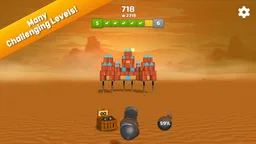
Cannon Balls 3D: Tower Crash review
 Analysis by Appsdrops
I like arcade games that explain themselves quickly, but a simple premise still needs enough variation to keep each attempt from feeling like busywork. Cannon Balls 3D: Tower Crash builds its appeal around lining up shots and knocking down targets. That makes it easy to pick up when I have a spare moment, while the satisfaction comes from judging each shot rather than learning a complicated control scheme.
It is a free arcade game from Famobi Plus, with an Everyone age rating. The game has a 4.8 average from around 13,000 ratings, and more than a million installs. Those figures suggest it has found an audience for quick, accessible play, but they are not a promise that its pace will suit everyone. My main question is whether the goals and challenge make the repeated firing feel rewarding; that is where this kind of game succeeds or starts to wear thin.
Quick goals make the first shots inviting
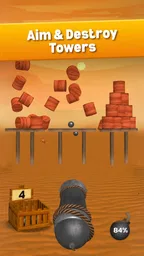
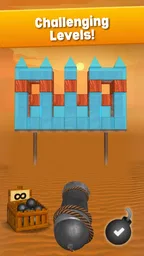
The central attraction is immediately legible: aim a cannon, fire, and try to bring down what is in front of you. There is no need to set aside a long session to understand the basic idea. I can imagine opening it while waiting for a ride or taking a short break, making a few attempts, and putting it away without having to remember a detailed story or complicated sequence of controls.
That low barrier is a real strength, especially for players who want an arcade game rather than a demanding action experience. The target gives every shot a clear purpose, and the physical-looking act of watching a structure collapse gives success a visible payoff. Instead of relying on a score alone to say that I did well, the result is right there on screen: a shot has made a difference, or it has not.
The early appeal also rests on a useful balance between speed and attention. Firing is easy to understand, but aiming still asks me to look at the target and consider where a hit might matter most. A practical way to approach a new setup is to pause for a moment before tapping: identify a weak-looking area, then use the result of the shot to adjust. That small habit makes the game feel more deliberate than simply firing as quickly as possible.
There is a trade-off, though. A straightforward shooting loop is approachable partly because it does not ask the player to learn much before starting. If you want a deep campaign, a broad set of tactical options, or a game built around a long narrative, this is unlikely to be the right fit. Its value is in immediate, focused play, not in replacing a more substantial action or strategy game.
Progress feels clearest when a shot changes the scene
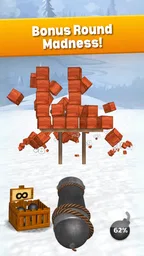
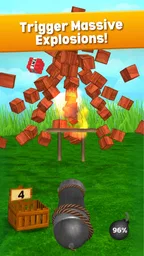
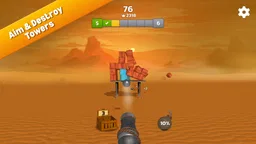
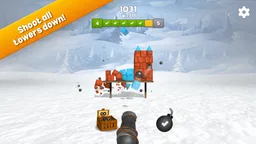
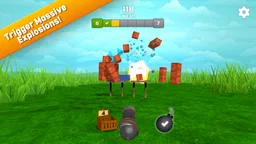
In a destruction-focused arcade game, the most satisfying progress signal is often the effect of a good decision. Watching a structure shift or collapse connects the aim to the outcome, so success feels earned through the shot rather than abstractly awarded. I find that more engaging than a loop where every action produces the same visual response, because it gives me a reason to pay attention to what happened and adapt on the next attempt.
That creates a simple improvement routine: observe the arrangement, choose a target point, fire, and judge whether the result was useful. If a shot does not produce the outcome I wanted, changing the aim is more productive than repeating it blindly. This is a small but concrete way to make short sessions feel like practice. The game’s appeal is not only in knocking things down; it is in trying to make the next shot count better.
Players often want to know whether there is enough progression to make repeated sessions worthwhile. The game’s basic structure offers a clear reason to keep going when a new target or challenge gives the next attempt a different problem to solve. At the same time, I would not treat a simple arcade loop as proof of a large, intricate unlock system. If you need a long list of upgrades or a detailed progression map before a game feels rewarding, check your expectations: the clearest draw here is the shooting-and-destruction cycle itself.
The current version is 20261019, and the game was released on January 21, 2020. I mention that because a player deciding whether to try it may care that this is an established title rather than a newly launched experiment. The version label alone does not tell me what changed in a particular update, so I would judge the experience by whether the current play loop feels enjoyable on my device, not by assuming that a version number guarantees a particular feature.
Challenge works best when I treat each attempt as information
The challenge in a cannon game comes from turning a limited opportunity into a useful impact. A shot that misses the most effective point can leave the target standing, while a better-placed hit can make the whole attempt feel decisive. That relationship gives the play a modest skill curve: beginners can start firing right away, while players who slow down and read the target can make more considered choices.
One useful tactic is to avoid judging a shot only by whether it clears everything at once. A partial collapse can still reveal which parts of the target are vulnerable and help guide the next aim. This matters most when a setup seems stubborn: changing the angle or point of impact is a more thoughtful response than assuming the answer is simply to fire faster. The pleasure is in learning from the visible result, even when the attempt is not perfect.
I would describe the difficulty as a question of patience as much as precision. Players who enjoy quick experimentation may find it satisfying to try, observe, and correct. Anyone who gets frustrated when an imprecise shot wastes time may find the same loop less forgiving, especially if they expect a constant stream of effortless wins. The game is better suited to someone who can enjoy a small problem-solving pause between shots than to someone who wants action with no interruption.
Compared with many arcade alternatives, this has a more tangible cause-and-effect hook than a game focused purely on dodging obstacles or chasing a high score. It asks me to direct force at a target and then watch the result, rather than simply react to incoming hazards. That distinction is appealing when I want a little visual payoff. On the other hand, a score-chasing game may be a better choice if I want a clear competitive benchmark, and a fuller physics puzzler may be preferable if I want more elaborate planning than a quick cannon shot can provide.
Short sessions suit it better than constant, high-pressure play
The game’s relaxed premise makes it a natural option for brief breaks, but the pace still depends on how much satisfaction I get from repeating the core action. I would use it as a small, self-contained diversion: open it, focus on a few targets, and stop when the shooting starts to feel repetitive. That is a healthier fit than expecting it to provide the same variety as a large adventure game or a multiplayer title with changing opponents.
Its store summary emphasizes relaxation alongside firing and destruction, and that combination makes sense as an aspiration: the controls and objective are easy to grasp, while the collapse provides a punchy reward. Yet “relaxing” does not mean every attempt will feel effortless. A player may need to think carefully about aim, and a failed shot can interrupt the breezy mood. I would approach it as low-commitment play, not as guaranteed stress relief.
There is also a practical consideration for people sharing a device or choosing a game for a younger player. Its content rating is Everyone, which makes it broadly accessible in age terms. That does not automatically mean every household will want to allow in-app spending. The game is free to download, with optional in-app purchases ranging from $0.99 to $49.99 per item, so I would check purchase controls before handing a device to a child or anyone likely to tap through prompts without checking.
The purchase range is worth keeping in perspective. I would first decide whether the basic shooting loop is enjoyable without spending; a free game should earn continued attention through play, not through a sense that I must buy something to make it worthwhile. If you are comfortable with optional purchases, keep an eye on what is being offered and set limits that fit your use. If you prefer games with no paid extras at all, this may not be your ideal choice even though the initial download costs nothing.
Who will enjoy the loop, and who should look elsewhere
I would recommend it to someone who likes quick, visual cause and effect and wants a game that can be understood without a tutorial session. It is particularly suited to short waits, a relaxed pause between tasks, or a casual handoff to a friend who wants to try a few shots. The basic objective is easy to explain, and the visible consequences make it accessible even to players who do not usually spend time with more complex arcade games.
I would steer away from it if your enjoyment depends on elaborate unlock trees, a strong narrative, competitive multiplayer, or a steadily expanding set of mechanics. Those are reasonable things to want, but they are not what makes this title distinctive. Likewise, if repeated aiming and firing quickly feels monotonous to you, the game’s central strength becomes its main limitation. It is better to choose a puzzle game with more varied interactions or a score attack game with a sharper leaderboard focus in that case.
For Android compatibility, the minimum operating system is version 9. That is a useful check before downloading: if your device runs an older version, it may not meet the stated requirement. The game is categorized as arcade, and that label fits its short, direct action more than it suggests a deep simulation. I would expect a compact play experience centered on shooting targets, not a broad set of modes that transforms it into a different genre.
My verdict on its staying power
The strongest reason to keep playing is the feedback between aim and collapse. When a shot produces a satisfying change, the next attempt has a purpose: I can use what I just saw to choose a better point of impact. That makes the game more engaging than its simple premise might suggest, especially in short sessions where a clear goal matters more than a sprawling progression system.
Its staying power is also where I would stay cautious. A straightforward loop can be charming, but repetition is hard to avoid when the main pleasure comes from firing at targets. Players who need frequent new mechanics or substantial unlocks may run out of reasons to continue sooner than casual players who are happy to dip in and out. I would not install it expecting a deep long-term commitment; I would try it as a compact arcade diversion and see whether the shot-by-shot feedback keeps me curious.
Overall, Cannon Balls 3D: Tower Crash is an easy recommendation for someone who wants accessible cannon-based destruction, visible results, and a low barrier to entry. Famobi Plus has made a game whose appeal is clearest when I slow down just enough to aim with intention, then enjoy what the shot does. The free starting point lowers the risk of trying it, while optional purchases and a deliberately focused loop are worth considering before making it a regular habit. If that balance sounds right, it is a pleasant choice for spare minutes; if you want deep progression or constant novelty, another arcade game will likely suit you better.
What we like
- Simple controls make aiming and firing easy to learn.
- Destructible towers give each shot a satisfying impact.
- Short levels suit quick play sessions.
- Physics-based collapses add variety to each stage.
- The colorful 3D visuals are easy to follow.
What could be better
- Repeated level layouts can make progress feel predictable.
- Limited aiming control may frustrate players seeking precision.
- Some stages rely heavily on trial and error.
- Frequent ads may interrupt the flow of play.
- The core gameplay can feel repetitive over longer sessions.







