
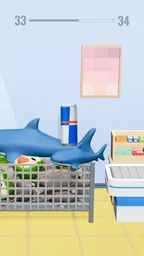
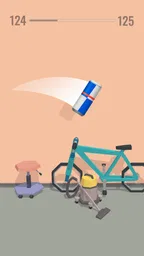
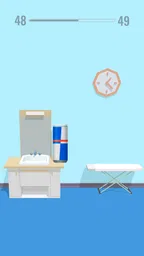
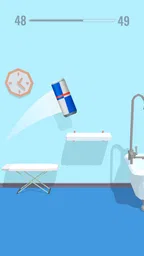
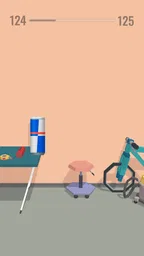
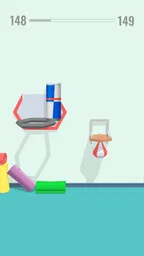
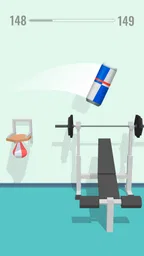
Bottle Jump 3D review
 Analysis by Appsdrops
I like arcade games that let me understand the challenge in seconds, and Bottle Jump 3D is built around exactly that kind of quick decision: make the bottle flip and land it without sending it tumbling off the surface. The idea is easy to grasp, but a clean landing takes more care than the premise suggests. It is a good fit for short breaks, especially if you enjoy repeating a small challenge until your timing feels right.
Getting a feel for each flip
The basic loop is the main attraction. You attempt a flip, watch the bottle’s movement, and try again when it falls. There is no long introduction to learn before playing, so I can pick it up for a minute without needing to remember a complicated sequence of moves. That immediacy also means the game depends heavily on whether the act of retrying feels satisfying to you.
My most useful starting habit is to treat each attempt as feedback rather than a pass-or-fail test. If a bottle lands short or tips over, I try to notice what my input did instead of immediately making a much bigger adjustment. Small, deliberate changes make it easier to find a repeatable rhythm. Randomly varying the strength of every attempt may produce the occasional lucky landing, but it does not help much when I want to understand why one flip worked.
The game’s bottle-flipping premise makes it particularly suited to brief, low-pressure play. I can imagine opening it while waiting for a drink or sitting through a short pause, making a few attempts, then putting the phone away. It is less suited to someone looking for a substantial arcade campaign, a story to follow, or a deep set of skills that keeps expanding over a long session. The appeal is in the immediate physical puzzle of getting the bottle to settle.
Make retries useful, not frantic
When a run goes wrong, I find it helps to pause for a moment and identify the kind of mistake: was the flip too forceful, too weak, or simply poorly timed? That distinction is more useful than tapping or swiping again in a hurry. A short reset in attention can prevent a string of nearly identical misses, particularly when I am playing on the move and not holding the phone steadily.
That is also why I would not judge the game only by how quickly it gets me to a successful landing. A straightforward arcade challenge can be fun precisely because it asks for a little patience. Still, if a player dislikes repetition or expects every attempt to introduce something new, the simple loop may begin to feel thin. The game’s strengths and limitations come from the same source: a narrow action that is easy to revisit, but not designed to be a sprawling experience.
Check the practical details before settling in
Before starting, I would check the game’s sound and control options on the device rather than assume a particular setup is best. I do better with fewer distractions when concentrating on timing, while another player might prefer keeping sound on as part of the arcade feel. I would also choose a comfortable grip and stable place to play; a small, physical action is harder to repeat consistently if I am balancing the phone in one hand while walking.
For a quick session, I would keep the goal modest: a handful of focused tries rather than an open-ended attempt to play until the game feels mastered. That makes it easier to tell whether I am actually improving or just repeating the same motion. If I want to practice, I can use a consistent posture and make one adjustment at a time. This is not a special game mode or hidden shortcut; it is simply a more reliable way to learn a timing-based challenge.
It is worth checking whether interruptions are likely before beginning a longer stretch. Bottle-flipping play is easy to resume in spirit, but a notification or a sudden change of grip can break concentration and make the next input feel inconsistent. I would treat the game as a series of self-contained attempts rather than expect a long, uninterrupted session to be necessary. That approach suits its pick-up-and-play nature and keeps a missed landing from turning into a frustrating marathon.
Build a repeatable rhythm
Once the basic action feels familiar, the most helpful “shortcut” is not a secret move but consistency. I try to keep the same hand position, hold the phone at a similar angle, and avoid changing my input dramatically after a miss. That gives me a fairer comparison between attempts. If I change several things at once, I cannot tell whether the result came from timing, force, or simply a more stable grip.
I also recommend taking a brief pause after a few failed flips. Repeating an input faster is not necessarily the same as getting better at it, and frustration can make a controlled movement turn into a rushed one. A short break is especially useful if I am playing on a crowded commute or in a place where I cannot keep the phone steady. In that situation, putting the game aside is more sensible than blaming myself for inconsistent results.
Compared with many arcade games that rely on a stream of incoming obstacles or a growing set of actions, this one keeps attention on a single physical outcome: a bottle either settles or does not. That makes it easier to understand at a glance, but it also offers less variety than an arcade game built around multiple mechanics. If I want a quick timing test, this focused design is a plus. If I want a changing challenge that keeps asking me to learn new rules, a broader arcade title is likely a better choice.
Where the simple design reaches its limits
The same narrow focus that makes the game approachable can make longer sessions feel repetitive. There is no need to pretend that every flip offers a completely different experience: the central task remains recognizable. I would recommend it to someone who enjoys trying to improve a small skill, not to someone who needs a steady stream of new objectives to stay interested. Whether that repetition feels calming or monotonous is a matter of taste.
It is also not the best choice when I want a game that rewards planning several moves ahead. Bottle Jump 3D is about executing the immediate action, not building a complicated strategy. Players who prefer deep progression, complex controls, or social competition may find more satisfying options elsewhere in the arcade category. For children or adults looking for an easy-to-understand casual game, its uncomplicated premise is more inviting; the content rating is Everyone.
The game is free to download, with in-app purchases ranging from $0.99 to $35.99 per item. I would keep that in mind if I am installing it for a child or simply want to avoid unexpected spending: check the device’s purchase controls before handing over the phone. The existence of optional purchases does not change the basic appeal of the flipping challenge, but it is a practical detail worth considering before play.
Who will enjoy it, and what to expect
CASUAL AZUR GAMES released the game on June 30, 2019, and it remains a widely played arcade title, with over 100 million installs. It has an average rating of 4.4 from around 386,000 ratings, alongside about 7,400 written reviews. Those figures suggest a substantial audience, but they do not guarantee that its repetitive, timing-focused play will suit every player.
The current version is 1.40.0, and the listed minimum operating system is version 8.0. If I am deciding whether it will run on a particular phone, I would check the device’s operating system and the app store’s compatibility details before downloading. That is a more useful check than assuming an older or newer device will behave in exactly the same way.
In practical terms, I would choose it for a short distraction, a simple hand-eye challenge, or a relaxed attempt to improve at one repeated action. I would skip it if I were searching for a long-form game, rich narrative, or lots of changing mechanics. The game works best when I accept its small scope and play in focused bursts instead of expecting it to transform into a deeper arcade experience over time.
My verdict on getting better
I recommend Bottle Jump 3D to anyone who enjoys compact arcade challenges and does not mind retrying the same basic action. The most reliable way to get more out of it is to slow down, keep your setup steady, and change one part of your attempt at a time. Those habits make each miss more informative and each successful landing feel earned, without relying on invented tricks or hidden systems.
For me, its strongest quality is how quickly it turns a spare moment into a small test of control. Its main weakness is equally clear: a focused bottle-flipping loop may not have enough variety for players who want a lasting, constantly changing challenge. If you want an accessible game to dip into between everyday tasks, it is an easy one to try; if you need depth and variety, I would look elsewhere in the arcade category.
What we like
- One-touch controls make the game easy to pick up.
- Short levels suit quick play sessions.
- The flipping mechanic feels satisfying when timed well.
- New bottle designs add a light collection goal.
- The game works well without requiring precise movements.
What could be better
- Gameplay can feel repetitive after many levels.
- Some jumps depend heavily on trial and error.
- Ads may interrupt the flow between attempts.
- The physics can feel inconsistent on tricky landings.
- Progress may offer little challenge for experienced players.







