






Angry Plane Challenge: Evolve review
 Analysis by Appsdrops
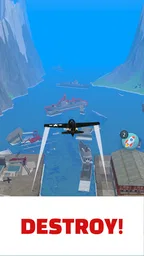
I like arcade games that give me a clear reason to make one more attempt, and Angry Plane Challenge: Evolve has an immediately readable premise: fly a jet, use bombs, and improve your aircraft as you take on sky missions. That combination puts it in the familiar pick-up-and-play territory, but the appeal depends on whether those goals keep each run feeling worthwhile. My impression is that it is best approached as a compact action game for short sessions, rather than as a deep flight simulator or a long-form campaign.
Small goals make the first sessions easy to enter
The first attraction is how quickly the central loop makes sense. You are piloting a jet, dealing with threats from the air, and working toward upgrades. I don’t need a lengthy explanation to understand the basic motivation: get through the mission, use the tools available, and make the aircraft more capable for what comes next. That clarity suits an arcade game, especially when I only have a few minutes and don’t want to relearn a complicated control scheme every time I open it.
The title’s emphasis on a challenge matters more than any promise of realism. I would come to it expecting action and quick decisions, not authentic aviation procedures. The bombing element also gives the flights a purpose beyond simply staying airborne. In a good run, the pleasure comes from balancing movement with the moment to act, rather than treating the jet as a vehicle that only needs to dodge.
That makes the game a natural fit for a short break: I can start with a simple objective in mind and judge a session by whether I made progress, not by whether I have a free evening. It may also suit someone who likes the visible sense of improvement that comes from upgrading a central character or vehicle. If you prefer arcade games where the main goal is a quick burst of action, this premise is easier to approach than a sprawling game that asks for a long commitment before it becomes engaging.
What progress feels like in practice
Upgrading the jet is the clearest long-term incentive in the concept. It gives a failed or imperfect attempt a possible purpose: even if I don’t finish a mission cleanly, I can still think about what improvement might help on the next try. That kind of progress signal can be more motivating than a score alone, because it connects today’s play to a stronger future run.
My practical advice is to treat upgrades as a way to solve a problem, not as a checklist to complete without thought. If a mission feels difficult, I would first notice what is actually stopping me—whether I’m struggling to stay in control, make effective use of bombs, or simply survive long enough to complete the objective—then consider which improvement seems most relevant. This is a useful way to avoid spending resources just because an upgrade is available. It also turns progression into a small decision rather than a passive reward screen.
That approach is especially helpful in games built around repeated attempts. A stronger jet can make progress feel tangible, but improvement does not automatically replace learning the timing and rhythm of a mission. If I rely on upgrades alone, I may miss the more satisfying lesson: recognizing when to move, when to attack, and when a safer route through a situation is better than an aggressive one. The aircraft’s development works best alongside player adaptation.
The challenge is part of the appeal—and the friction
Arcade difficulty is most enjoyable when a setback feels understandable. When I fail, I want to have a useful answer to “what should I try differently?” The fly-and-bomb setup creates room for that kind of adjustment: I can pay closer attention to movement and choose my attacks more carefully rather than repeating the same approach. That is a promising basis for a satisfying challenge, though it also means the game may not suit someone who wants an effortless experience in which every attempt quickly succeeds.
There is a trade-off between challenge and patience. Repeating missions can be rewarding if I can identify a mistake or see that an upgrade has helped; it becomes tiring if a run feels like a replay of the same obstacle with little change in my options. I would recommend taking short breaks rather than pushing through frustration. Returning with a fresh eye can make it easier to spot whether the answer is better timing, more cautious flying, or a change in how I use bombs.
For an everyday example, imagine opening the game while waiting for a ride or during a quiet stretch between tasks. I would play one or two attempts, then stop if I found myself restarting out of irritation rather than curiosity. That keeps the game in its strongest role: a quick arcade diversion with a progression thread, rather than a task that demands attention long after the fun has faded.
How the pacing compares with other arcade games
Compared with score-chasing arcade games, this one has a more explicit improvement hook: the jet itself can be upgraded, so the aim is not only to beat a personal best. Compared with slower flight games, its appeal is the promise of immediate action rather than detailed simulation. Those distinctions help explain who is likely to enjoy it. If you want a straightforward action loop and a vehicle that develops as you play, the combination makes sense. If you chiefly want precision flight, open-ended exploration, or a huge range of strategic choices, a different kind of game is likely a better match.
The usual alternative in the arcade category is a game built around a single repeated score loop. That can be more satisfying for players who care about refining one performance and competing with their own best result. Here, the upgrade idea shifts some attention toward building capability over multiple attempts. The trade-off is that a player looking for pure, instantly readable score competition may find the longer progression less compelling than a game where every run is judged on a straightforward score.
I also think the game’s premise makes it easier to recommend selectively than universally. A friend who enjoys aircraft-themed action and likes to see a vehicle improve would have a clear reason to try it. Someone who dislikes repeating challenges, or who expects every upgrade to dramatically change how the game feels, should be more cautious. Progress can provide direction, but it cannot make every moment equally fresh.
Free to start, with purchases worth keeping in perspective
Angry Plane Challenge: Evolve is free to download, and its age rating is Everyone, which makes it broadly accessible as a casual arcade game. It is made by Freeplay Inc. The game includes in-app purchases priced from $0.99 to $29.99 per item, so I would decide before playing whether I’m happy to keep spending at zero. The most useful test is simple: enjoy the missions and upgrades the way they arrive, and only consider a purchase if it solves a specific frustration rather than reacting to a difficult attempt.
That distinction matters because purchase options can change how a progression game feels. If I can enjoy the process of making gradual improvements, the free entry point is easier to appreciate. If I feel pressured to pay simply to make ordinary play tolerable, that is a sign to step back rather than spend impulsively. I would also keep in mind that buying something does not necessarily make the basic challenge more satisfying; the appeal still rests on whether the flying and bombing loop is enjoyable to me.
Who should give it a try
The game is a sensible choice for players who want an accessible arcade jet game with a clear action premise, short-session potential, and a reason to return through aircraft upgrades. It may work particularly well for someone who likes to alternate between trying a mission and making a modest improvement, rather than spending a long time in one uninterrupted session. The 4.4 average from around 4,500 ratings and more than a million installs suggest it has reached a sizeable audience, though those figures alone cannot tell me whether its rhythm will suit a particular player.
It is less likely to satisfy anyone seeking a realistic flight experience, a story-led adventure, or a large range of carefully explained tactical systems. It may also be a poor choice if repeated attempts are a deal-breaker. I would not download it expecting every session to deliver a major new surprise; I would try it for the pleasure of a direct objective, a chance to improve, and the possibility that a more capable jet makes the next challenge manageable.
My progression verdict
With version 1.11.0 and a minimum operating-system requirement of 7.0, Angry Plane Challenge: Evolve has the basic ingredients I look for in a casual arcade game: an understandable goal, an aircraft to develop, and enough challenge to give improvement a purpose. Its strongest progression idea is also its main test. Upgrades need to make continued play feel worthwhile, while the missions need to stay engaging enough that reaching those upgrades does not become busywork.
I’d recommend trying it if you enjoy quick aircraft action and don’t mind learning through repeated runs. I’d skip it in favor of a score-focused arcade game if you want every attempt to stand entirely on its own, or a simulation if flight realism is the point. For me, the best way to approach it is in short sessions, with a specific improvement goal for each return and a firm limit on spending. That keeps the focus where it belongs: on whether flying, bombing, and gradually building a better jet are fun for you.
What we like
- Quick rounds make it easy to play during short breaks.
- Simple controls are easy to pick up.
- The evolving challenge adds a sense of progression.
- Arcade-style action offers an immediate gameplay loop.
- The game is suitable for players seeking a casual challenge.
What could be better
- Repeated play may feel monotonous over time.
- Difficulty can make progress frustrating for some players.
- The gameplay may offer limited variety between rounds.
- Frequent retries may interrupt the flow of play.
- Players seeking a story may find little narrative depth.







