







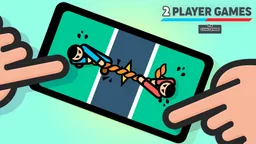
2 Player games : the Challenge review
 Analysis by Appsdrops
I like phone games that turn an idle moment into a bit of friendly rivalry, and 2 Player games : the Challenge is built around exactly that idea. Rather than asking you to connect online or learn a long set of rules, it puts two people at the same device and lets them compete in quick arcade-style contests. That makes it an easy pick when a friend is sitting beside you and you want to play right away.
My overall impression is that this works best as a shared-phone party game, not as a deep solo arcade experience. Its appeal is the convenience of having a ready-made collection of head-to-head play on one screen. That convenience also shapes its limits: if you want a sprawling campaign, a detailed competitive ranking system, or a game designed primarily for one person, this is probably not the one to reach for.
A quick contest that works best face to face
The game comes from JindoBlu and sits in the arcade category, where short rounds and immediate reactions matter more than a lengthy story. Its central idea is refreshingly direct: two players use one device. There is no need to make the other person install the same game before a casual match can happen, which is especially useful when someone asks to play during a break or while waiting for food.
That setup changes the social feel compared with the usual mobile alternatives. Many arcade games are built around solo score-chasing, while online multiplayer often depends on a connection, matchmaking, or both players being ready to join. Here, the phone itself becomes the shared play space. It is a small distinction, but a practical one: the game is at its best when both people are physically together and happy to pass the screen back and forth or play across it.
The trade-off is equally clear. A shared device is not a substitute for online multiplayer, and it will not help much if your friends are elsewhere. Screen size and hand position can also affect how comfortable a match feels, particularly when two people are trying to focus on the same small display. I would treat it as a convenient way to start a local contest, not as a replacement for a console or a dedicated two-player setup.
Why the one-device format matters
The strongest use case is a short, spontaneous session: a couple of rounds while a friend is over, a quick contest with a sibling, or a way to keep children occupied together without handing each of them a separate device. The game’s Everyone age rating makes it broadly suitable for family play, though I would still choose the activity based on the players and the setting rather than assume every match will suit every age.
There is also a useful social advantage to keeping play local. You can see the other person’s reaction, settle a close result immediately, and switch turns without coordinating through chat. That makes it feel less like competing against a distant score and more like a tiny tabletop challenge. If your group enjoys teasing each other over a close win, the format is a natural fit.
For a smoother match, I recommend placing the phone on a stable surface instead of holding it between both players. That reduces awkward hand positioning and makes it easier for each person to concentrate on their side of the screen. It is a simple adjustment, but it helps the shared-screen idea feel intentional rather than cramped. If the device is especially small, taking turns may be more comfortable than reaching across it at once.
What its track record tells me
The game has a 4.6 average from around 739,000 ratings, alongside about 11,000 written reviews, and it has passed 100 million installs. Those figures suggest that the basic local-play concept has reached a very large audience. They are useful context, but they do not guarantee that every player will enjoy the same pace or feel equally comfortable sharing a phone.
It is free to download, with in-app purchases priced at $6.99 per item. I would go in expecting to try the core experience before deciding whether anything paid is worthwhile, rather than treating a purchase as necessary for a casual match. The practical question is whether you and your usual playing partner enjoy the format enough to return to it; a large audience cannot answer that for your particular household or friend group.
What the version history can and cannot tell us
The current version is 7.21.3, and the game was released on May 29, 2019. Those facts show that this is an established title rather than a brand-new experiment. They do not, by themselves, prove what has changed in individual updates, so I would not assume a particular feature, balance adjustment, or content addition simply from the version number.
For someone who already has the game installed, the most sensible way to think about its evolution is practical: keep it current if you want the version currently offered, then judge it by how well it works for your own sessions. A version label is not a promise that the game will feel dramatically different from one update to another. If you are returning after a break, check the menus and settings for anything relevant to how you prefer to play before inviting someone into a match.
For a new player, the release date and current version are less important than the central format. The design is still easy to understand from the outset: this is a two-person arcade game intended for one device. That clarity is a strength for a casual title, because the first question is not how to master a complicated system but whether you have another person nearby who wants to play.
Who will enjoy it, and who may not
I would recommend it to people who regularly share a phone with a partner, friend, or family member and want a quick activity that does not require much preparation. It is also a reasonable option for households looking for an arcade game that can bring two people together on one screen. Its free entry makes trying that format straightforward, while the Everyone rating gives it a broad audience.
I would skip it if your main goal is a serious solo game with long-term progression, if you prefer playing remotely with friends, or if you dislike sharing a small screen. It may also be a poor fit for someone who wants a single, carefully developed arcade challenge rather than a collection oriented around brief head-to-head sessions. In those cases, a focused solo arcade game or an online multiplayer title will likely suit you better.
One useful way to decide is to ask whether you can name a real person you would play with more than once. If you mostly want something to do alone on a commute, the two-player premise may be wasted. If you often have company during short breaks, the same premise becomes the main reason to keep it installed.
Small choices that improve a session
Before starting, agree on how you will handle turns and close results. With a shared device, a little coordination avoids confusion about whose side is whose and keeps the match friendly. For family play, it can help to let younger players choose the activity first, then swap roles or opponents so the session stays social rather than becoming a long run of one-sided wins.
It is also worth treating the game as a short-session option. The format is most useful when you have a few spare minutes, not when you expect a full evening of deep progression. If a round is unexpectedly close, replaying can be fun; if the first match feels awkward because of the device size or controls, moving the phone to a table or taking turns is a better first adjustment than deciding immediately that the whole idea does not work.
One limitation to keep in mind is that the experience depends on the people sharing the device. A competitive friend may enjoy quick rematches, while someone who dislikes being watched or rushed may prefer a solo game. That is not a flaw unique to this title, but it is central to whether this particular design succeeds for you. The best matches are with someone who enjoys light competition and does not mind being close to the screen.
My recommendation
2 Player games : the Challenge succeeds by making a local contest easy to begin. I value that it does not ask two people to coordinate separate devices before they can have a quick match. For a family visit, a break with a friend, or a quiet moment at home, it offers a simple way to turn a phone into a shared arcade distraction.
I would not call it a universal recommendation, because its defining feature is also its boundary: you need another person nearby, and both players need to be comfortable with one device. But if that describes your usual situation, it is an easy free game to try. JindoBlu’s title has an established audience and a clear purpose; whether it earns a place on your phone comes down to how often you want quick, face-to-face competition rather than a solo or online alternative.
What we like
- Quick rounds make it easy to play during short breaks.
- Local multiplayer brings both players together on one device.
- A variety of mini-games helps keep matches fresh.
- Simple controls make it approachable for casual players.
- Friendly competition can make everyday downtime more fun.
What could be better
- Sharing one screen may feel cramped on smaller phones.
- Some mini-games may feel repetitive after extended play.
- The experience depends on having another player nearby.
- Touch controls can be less precise during fast-paced rounds.
- Players may find the challenge uneven across different games.







