


Yacine TV review
 Analysis by Appsdrops
Yacine TV is a free sports app built around following football as it unfolds: I’d turn to it to check a fixture, see how a match is going, or catch up on standings and related news. Its appeal is practical rather than elaborate. Instead of making me dig through a general news feed, it puts the details football fans tend to check together. That makes it useful as a companion during a busy day, though it is not automatically a substitute for a dedicated live-score service or a source of live video.
Football updates in one place
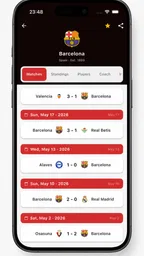
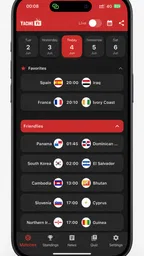
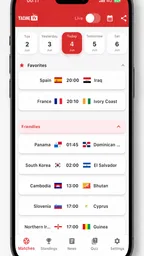
At its best, the app fits the moments when I want context quickly. Before a match, fixtures help me see what is coming up; afterwards, standings give a broader view of what the result means. Scores and news fill in the gaps between those checks, while predictions offer another angle on upcoming games. These pieces make more sense together than they do as isolated features: a score tells me what happened, and the surrounding information helps me decide whether I need to follow the next match or look into a developing story.
The distinction between following football and watching it matters here. The app’s description centers on scores, schedules, tables, news, and predictions—not video streaming. I would choose it to keep track of matches, not assume that it provides a broadcast. If watching the game is the priority, a broadcaster or streaming service with the appropriate rights is the more suitable choice. If I only need to know whether a team has played and how its position looks, a sports-following app can be more convenient than opening a video service.
The clearest strength is the combination of match tracking and wider football context. A score alone can be enough when I am rushing, but the fixture and standings angle is more useful when planning around a match or trying to understand how results affect a team. News can add background, and predictions can invite a little pre-match discussion. I would treat predictions as opinion or entertainment, not as reliable guidance for betting or a promise about the result.
That mix also sets expectations: Yacine TV is a sports app for football followers, not a broad sports reference that should be assumed to cover every competition or sport in depth. If my interest is narrowly football, the focus is welcome. If I want detailed coverage across several sports, or extensive analysis from specialist reporters, a larger sports news platform may suit me better.
How I would use it through a match day
Picture a workday when I cannot watch an afternoon match. I can check the fixture beforehand, return to the score when I have a break, and look at the standings later to see why the result matters. That is a realistic use for a compact football companion: short visits, each answering a specific question. It is less appealing if I expect to sit down for long-form reporting or watch the match directly in the app.
A small but useful habit is to separate the checks by purpose. I would use fixtures to plan, scores for immediate status, and standings for the bigger picture rather than repeatedly refreshing the same screen without knowing what I want to learn. When the result is close or a team’s position is changing, the table is the part that turns a bare score into context. News is better suited to a separate catch-up moment than to frantic checking during play.
Another trade-off is that predictions can influence how a match feels before it starts. They may be fun when comparing expectations with the final result, but I would not let them replace my own judgment or treat them as a dependable forecasting tool. For casual conversation, they can add something to follow; for decisions involving money, they are not a sound basis on their own.
What the release tells existing users
The current release is version 4.0.4, and the app was released on July 25, 2026. Those facts tell me which version and release date are associated with the product, but they do not by themselves explain what changed between releases. I would not infer new screens, improved speed, extra leagues, or redesigned navigation from a version number alone. For someone already using it, the practical course is to check the installed version in the app store and read any update notes shown there before deciding what an update means for their routine.
That restraint matters because a higher version number is not a changelog. It can indicate that the product has progressed through releases, but it does not prove that a particular feature has been added or that a past inconvenience has been fixed. Existing users should judge an update by what they can actually see: whether their usual fixture and score checks still work as expected, whether the information they follow is present, and whether the interface remains comfortable on their device.
The app is developed by Yacine TV LLC. Its audience appears substantial, with more than a million installs, and its average rating is 4.2 from around 6,500 ratings. I see that as a useful signal that many people have tried it, not a guarantee that it will suit every fan or that every part of the experience is equally strong. A smaller pool of written reviews—around 23—also means I would focus more on testing the features I personally need than on assuming that a few comments represent every use case.
It is free and rated for Everyone, which lowers the barrier to trying it. The minimum operating-system requirement is version 7.0, so I would check my device’s software before relying on it as a match-day tool. A free app still has to earn a place on my phone through usefulness: if I already get the same scores and tables from a service I trust, adding another app may create clutter rather than save time.
Where it fits beside other sports apps
Compared with a general sports news app, Yacine TV’s football-oriented mix is the attraction: fixtures, results, standings, news, and predictions are all relevant to following matches. Compared with a dedicated live-score app, however, the deciding question is whether its particular combination and presentation are more convenient for me. If I mainly want rapid score alerts or detailed match statistics, I should compare those specific needs rather than assume that a wider mix necessarily means deeper live coverage.
It also differs from a club’s own app. A club app can be the better choice for official team communications and club-specific material, while a football companion is more natural when I want to keep an eye on several teams or matches. These are different jobs, so I would not expect one app to replace the other completely. For a fan who follows one club closely, the club’s channel may remain the main source; for someone scanning the broader fixture calendar, Yacine TV may be more convenient.
There is a similar divide between a quick-check tool and a full editorial destination. A fan who wants long interviews, tactical breakdowns, or comprehensive coverage of a particular competition may prefer specialist journalism. Someone who wants a quick route from the day’s fixtures to a score and then to the table may value the lighter workflow more. The right choice depends less on how many items an app advertises and more on whether it answers the questions I ask most often.
Practical limits and who should look elsewhere
The biggest limitation is the risk of expecting more than the app’s stated role. A list of football information does not automatically mean every match is covered to the same depth, that updates arrive in a particular time frame, or that a live broadcast is included. I would verify that the competitions I follow appear in the app before depending on it for a full season. If missing a score would genuinely matter to me, I would keep a second trusted source available until I know the coverage works for my teams.
For the same reason, I would not use predictions as a substitute for informed analysis. A prediction can be a conversation starter, but a match has too many variables for a simple forecast to settle what will happen. Fans who dislike prediction features can simply focus on fixtures, scores, standings, and news; fans who want advanced statistics should look for a service that explicitly specializes in that kind of detail.
It may also be the wrong fit for someone who wants a polished, single-club experience, live commentary, extensive historical data, or a place to watch football. Those are reasonable needs, but they are different from checking the basics around a match. I would choose a broadcaster for viewing, a club app for team-specific communication, or a specialist data service for deeper analysis rather than asking this app to do every job.
What I would watch as it develops
For existing users, the most useful thing to watch is not the version number by itself but whether each new release improves the specific routine they rely on. If I use the app mainly before kick-off, I would pay attention to how easily I can find upcoming fixtures. If I check standings after a result, I would make sure the tables remain clear and relevant to the competitions I follow. Those are concrete tests, unlike assuming that an update must have changed something important.
New users can make a fair assessment with a simple trial: choose a team or competition they care about, check a fixture, follow its score, and revisit the standings afterwards. That reveals whether the app’s information is easy to locate and useful in practice. I would also compare it with the score source already on my phone, not because one must replace the other, but because the better option is the one that answers my usual question with less effort.
I would be interested in future changes that make this football-following workflow clearer, but that is an expectation, not a claim about what the current release contains. For now, the grounded case for the app is its focus on match information and surrounding context, offered free and within a familiar sports-app format. Its value depends on whether the competitions and level of detail I care about are covered in a way that works for me.
My recommendation
I would recommend Yacine TV to a football fan who wants a convenient place to check fixtures, scores, standings, news, and predictions without treating the app as a video service or specialist analytics platform. It is especially sensible for people who dip in and out during the day and want a little context alongside the result. The free price makes a trial straightforward, and the Everyone rating means it is intended for a broad audience.
I would skip it—or use it only as a secondary companion—if I need live match viewing, deep statistical analysis, guaranteed coverage of a specific competition, or highly detailed reporting. My overall view is positive but measured: the app has a clear football-following purpose, and that purpose can be genuinely handy when it matches my habits. I would install it, test it against the teams I actually follow, and keep it only if those quick checks feel easier than my usual alternatives.
What we like
- Offers live sports channels for fans who want to follow matches on mobile.
- Its channel lineup may include Arabic-language entertainment and news.
- The simple interface can make browsing channels straightforward.
- Streaming access can be convenient when a television is unavailable.
- Some versions provide multiple stream options for certain channels.
What could be better
- Availability and stability can vary between versions of the app.
- Some streams may require a strong internet connection.
- The app may not be available through official app stores in every region.
- Channel links can stop working without notice.
- Content licensing and broadcast rights may be unclear.





