
Lyft review
 Analysis by Appsdrops
Getting from a front door to a destination sounds simple, but the awkward part is often the gap between deciding to leave and actually moving. Lyft is built around closing that gap: request a ride, get matched with a nearby driver, and set off. I like that clear focus. Rather than asking me to plan a complicated journey, the app centers the experience on finding a ride when I need one.
From the need for a ride to a request
Lyft is a free ride-hailing app in the maps and navigation space, developed by Lyft, Inc. Its central promise is straightforward: get matched with a nearby driver and be on your way in minutes. That makes the app easiest to understand in a real-world situation—when I have somewhere to go and want a direct way to arrange a ride.
The first step is deciding whether a car ride fits the trip. For a journey where walking or driving myself is inconvenient, a ride-hailing service can take some of the coordination off my hands. Lyft gives that choice a dedicated place on my phone, so the task begins with opening the app rather than figuring out an entirely separate arrangement.
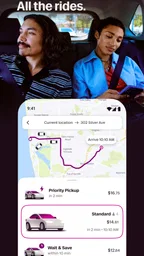
From there, the experience is organized around requesting a ride and being connected with a driver nearby. That basic sequence matters: the app is not just a map to look at, but a way to turn a travel need into a pickup. The store summary captures the idea neatly, and the practical appeal is just as easy to grasp. I make the request, wait for the match, and move toward the ride.
A simple sequence with a clear purpose
For me, the strongest part of Lyft’s design is the directness of its core job. I do not have to learn a complex system before understanding why I would use it. The intended flow is easy to explain: open the app, arrange a ride, connect with a nearby driver, and continue to the destination. That clarity is useful when I am in a hurry or would rather spend less time coordinating transport.
The app’s scale also makes it a familiar option for many people. It has more than 50 million installs, an average rating of 4.8, and around 715,000 ratings. Those figures do not tell me exactly how any individual ride will go, but they do show that Lyft has become a widely used choice rather than a niche tool. The app has been available since August 28, 2012, and its current version is 2026.40.3.1791962843.
Lyft is rated for Everyone, which makes its audience broad. Its purpose is still specific: it helps people arrange a ride, not manage every part of travel. I see that focus as a benefit when the need is simple. If I want a nearby driver, the app’s central function is immediately relevant, and I can judge the experience by whether that request turns into a smooth trip.
The handoff from app to driver
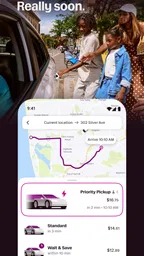
The key transition is the handoff between the digital request and the person who will provide the ride. Before the match, I am interacting with an app; after it, the trip depends on coordination between me and a driver. That shift is where a ride-hailing service has to feel practical. A polished request screen would not be enough on its own if the user could not move from the request to the pickup with confidence.
Lyft’s promise of a nearby-driver match gives the process a clear endpoint for the initial request: a driver is found, and I can get on my way. I appreciate how understandable that is. The app’s value does not rest on an elaborate description of travel technology; it rests on helping the ride happen. When the handoff feels orderly, the phone becomes a useful bridge between the decision to leave and the actual journey.
That handoff also means the experience is not entirely contained inside the screen. A ride involves reaching the pickup point, recognizing the right moment to meet, and continuing the journey with another person behind the wheel. Those ordinary details are part of the real workflow, even when the app is the tool that brings the two sides together. I find it helpful to think of Lyft as coordinating the start of a trip rather than replacing every judgment a passenger makes along the way.
Once the ride is underway, the outcome is refreshingly tangible: I am traveling instead of still arranging transportation. That is the measure I care about most. A successful app session is not simply one that opens quickly or looks neat; it is one that helps convert a request into a completed ride. Lyft’s central purpose is easy to evaluate against that everyday result.
Where the flow can feel less seamless
The same real-world handoff that makes ride-hailing useful can also create friction. A request has to become a match, and a match has to become a pickup. The app can connect the passenger with a nearby driver, but the trip still depends on the people involved and on getting the meeting point right. That means the overall experience is not just a matter of tapping a button; it includes the practical transition from screen to street.
Timing is another part of the workflow to keep in mind. Lyft’s short description says a user can be on the way in minutes, but travel needs vary. When I am planning a day, I would treat the app as a convenient way to request a ride rather than assume every situation will unfold identically. That is not a criticism of the core idea; it is simply how any service involving a nearby driver and a real pickup works in practice.
There is also a natural limit to what a ride-hailing app solves. Lyft is useful when I want to arrange a ride, but it does not make the destination, the pickup, or the wider trip decision disappear. I still need to know where I am going and be ready for the handoff. For a traveler who expects one app to handle every aspect of navigation, the focused role may feel narrower than a full travel planner. For someone who mainly needs a ride, that focus is exactly the point.
Everyday usefulness and overall impression
In day-to-day use, I would describe Lyft as a focused transport companion. Its main job is clear, and the path from requesting a ride to meeting a driver is easy to understand. That makes it suitable for people who want a convenient way to arrange a trip without turning the planning process into a project. The most convincing benefit is not a long list of extras; it is the straightforward connection between a travel need and a nearby driver.
The app has earned around 151,000 written reviews, alongside its large rating count, and its long presence in the market helps explain why it is a recognizable name in ride-hailing. Those signals are useful context, though my practical judgment remains centered on the workflow: does the app help me move from wanting a ride to actually taking one? Its design and promise are built around that question.
I would recommend Lyft to anyone who wants a simple way to request a driver for a journey. It is free to download, focused on a familiar need, and easy to understand at a glance. The experience is strongest when the request, match, and pickup flow naturally into one another. The main friction comes from the real-world coordination that sits between those stages, not from a complicated purpose or a confusing concept.
Overall, Lyft is a practical ride-hailing service that puts the essential task first. It takes the moment when I need to go somewhere and gives me a direct route to arranging a ride, with a nearby-driver match as the bridge. If that is the kind of help I am looking for, the app makes a solid, accessible choice. Its value is simple: less effort spent arranging the trip, and a clearer path from the initial request to being on my way.
What we like
- Upfront fare estimates help you compare ride costs before booking.
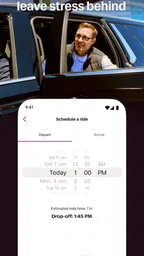
- Scheduled pickups make it easier to plan rides in advance.
- In-app trip sharing lets trusted contacts follow your route.
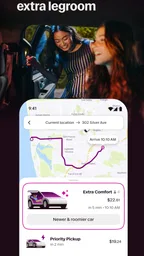
- Multiple ride options suit different budgets and group sizes.
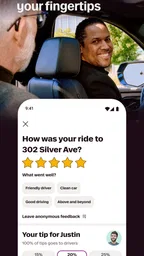
- Driver ratings help you make informed choices after each trip.
What could be better
- Prices can rise during busy periods or in areas with high demand.
- Ride availability varies by location and time of day.
- Cancellations may lead to fees in some situations.
- Pickup delays can occur when drivers are scarce.
- The app requires location access for core ride-booking features.





