
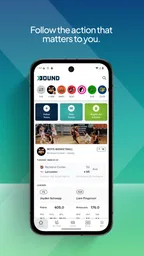
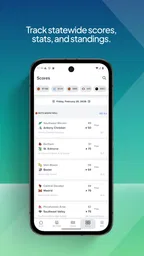



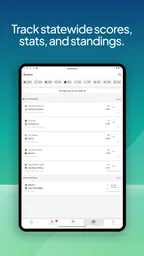
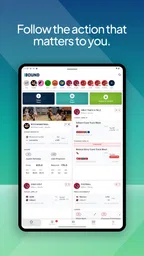

Bound review
 Analysis by Appsdrops
Choosing a youth sports app is less about finding the fullest feature list and more about finding a routine your family will actually keep using. I’d consider Bound when the main challenge is keeping youth activities organized and easy to follow, rather than tracking one team’s performance in detail. It is a free sports app from Bound - Youth Sports & Activities, and its focus on young people’s sports and activities makes it a more natural fit for families than a general-purpose calendar alone.
Decide what you need it to organize
Before relying on any app for a child’s activities, I’d first ask what currently causes the most friction. Is information scattered across messages? Do you need a shared place to keep up with activities? Or are you looking for detailed team tools, such as a coach’s system for communicating with players? Those are different needs, and a youth-activity-focused app is not automatically the best answer to all of them.
Bound makes the most sense when your priority is the broader picture of a young person’s sports and activities. That can be useful for a parent juggling a child’s commitments, or for someone trying to stay oriented around youth sports without treating the experience like a professional team-management job. Its sports focus gives it a clearer purpose than a generic calendar, while its broad youth-activities framing suggests a wider lens than a tool built around just one sport.
I’d also consider who needs to use it. A parent who manages the family schedule may value a dedicated place to check activity-related information; a young athlete may want something more direct; and a coach may need capabilities specific to running a team. Bound’s audience is most compelling when the family or youth-activity context is central. If the adult organizing things is already happy with a shared calendar and simple messages, switching may not solve a meaningful problem.
Where a youth-focused approach helps
The practical advantage of using an app aimed at youth sports is the context. Sports and activities are not simply entries on a calendar: they are commitments involving young people, family routines, and the people helping them take part. A purpose-built destination can feel easier to return to than a general organizer, especially when the information you want is specifically about youth activities.
That focus can help with a common everyday scenario: you are working out the week and want to think about a child’s sports commitments alongside other activities, rather than searching through unrelated calendar events. I’d use Bound as a place to orient myself around that youth-sports context, then keep any details that need to be shared with the whole household in whatever system everyone already checks. That division of labor is useful: it avoids expecting one app to replace every family tool.
One less obvious trade-off is that a focused app can make the subject easier to find while also giving you another place to check. If a coach communicates in one channel and the family tracks appointments in another, Bound may add value as a youth-activity resource but will not automatically eliminate that fragmentation. My advice is to decide in advance what you want it to be responsible for. A clear role—such as your starting point for youth-sports information—is more realistic than treating it as the single source of truth for every schedule and conversation.
The app is rated for Everyone 10+, which is relevant for families considering whether it suits a young user. I would still make the decision based on who will use it and how the family handles sports information, rather than assuming an age rating tells you whether a particular child should manage an account or take responsibility for plans. For many households, the parent may remain the person who checks and coordinates, even when the activity itself belongs to the child.
What the audience response and upkeep suggest
Bound has an average rating of 4.2 from around 1,900 ratings, with 329 written reviews, and has passed 100,000 installs. I read that as a useful sign that it has found an audience, not as proof that it will match every family’s routine. The number of written reviews is also a reminder that a rating alone cannot answer the questions that matter most to you, such as whether its approach fits your particular mix of sports, activities, and communication habits.
The app was released on August 20, 2019, and its current version is 2.1.20. That history makes it a more established option than a brand-new release, but I would still judge it by how well it works for your household now. If you try it, check whether the information and workflows you personally need are easy to find before moving your existing routine over. A long-standing app can be useful, but familiarity and fit are not the same thing.
It is free, so trying it does not require an upfront purchase. That lowers the barrier to exploring whether a youth-oriented sports app feels more useful than your current setup. Still, “free” does not mean there is no cost at all: the real cost can be the time spent learning another interface and getting other family members to use it. I’d treat the first few weeks as a low-commitment test, not a reason to migrate every sports conversation immediately.
When another kind of app is the better fit
If your main need is detailed coordination for a single team, a dedicated team-management app may be the better category to explore. Those tools are typically chosen for coaching workflows and team communication, whereas Bound’s stated focus is youth sports and activities more broadly. I would not choose between them on the assumption that one must replace the other: a family could prefer a youth-focused resource while a coach uses a separate system for team-specific work.
A shared calendar is often the stronger alternative when the problem is simply remembering dates and making sure several household members can see them. It is familiar, flexible, and already part of many people’s routines. The trade-off is that a general calendar does not offer the same youth-sports framing. If you only need reminders, adding a dedicated app may create duplication; if you want a more focused place to engage with youth activities, Bound has a clearer reason to exist.
Parents looking for intensive performance tracking or sport-specific coaching tools should also compare alternatives designed around those jobs. Bound’s broad youth-activity identity is not a reason to assume it provides advanced statistics, training plans, or every team feature. I would choose a specialist tool when the decision depends on those capabilities, and choose Bound when the broader youth-sports and activities context is what you want to follow.
There is another situation where I would skip it: if your child’s activities are already handled smoothly through a school, club, or family system and you rarely need extra context, another app may add little. Likewise, if the young person is not involved in sports or related activities, the app’s focus is unlikely to justify a place in your regular routine. The best app is not the one with the most specific audience; it is the one that removes a real point of friction.
Try it without making a mess of your routine
To test Bound sensibly, I would begin with one child or one set of activities rather than moving the whole family over at once. Pay attention to a few practical questions: can you locate the youth-sports information you came for, does it make your existing routine clearer, and do the people who need to act on that information know where to look? Those checks tell you more than a quick first impression of the interface.
Keep your current calendar or communication channel in place while you evaluate it. This is especially useful if different adults handle transportation, scheduling, and coach messages. For example, one parent might use Bound to stay oriented around youth activities while the family calendar remains the shared place for appointment times. That may sound less tidy than replacing everything, but it avoids losing important details during a trial.
If the app becomes useful, decide what information belongs there and what still belongs elsewhere. This small boundary-setting step is an overlooked way to prevent notification fatigue and duplicate entries. If you find yourself checking multiple places for the same answer, the app may be adding work rather than reducing it. If it gives you a clearer youth-sports starting point without disrupting the tools everyone already uses, that is a meaningful win.
Bound requires iOS 11 or later. Before installing it, I’d check that the device you plan to use meets that requirement. This is a straightforward compatibility check, but it matters in a family where a parent and child may use different phones or tablets. A useful app is only useful to the person who can access it on the device they actually rely on.
My recommendation for families weighing the options
I recommend giving Bound a try if youth sports and activities are a regular part of your family life and you want a more focused place to engage with that world. Its free price makes experimentation easy, and its youth-centered purpose is more relevant than a generic organizer when that is the context you want. I would start small, keep existing systems alongside it, and continue only if it saves time or makes information easier to follow.
I would not recommend making it your only sports tool without first checking that it suits the exact job you have in mind. Coaches who need team-specific workflows, families who only need a calendar, and athletes seeking specialist training or performance tools may be better served by another category of app. That is not a flaw in a youth-activity focus; it is a reason to match the app to the task instead of expecting one product to do everything.
Overall, Bound is worth considering as a youth-sports companion, particularly for families who want something more focused than a general calendar but do not need a dedicated system for every team detail. I’d see it as a practical addition, not an automatic replacement for the tools your household already trusts. If it helps you keep youth activities in view with less searching and confusion, it has earned its place; if it creates another stop in an already busy routine, sticking with your current setup is the better choice.
What we like
- The interface is easy to navigate.
- The core experience is simple to pick up.
- It offers a focused experience without unnecessary clutter.
- Its compact design suits quick sessions.
- The presentation feels polished and cohesive.
What could be better
- The experience may feel repetitive over time.
- There may be limited variety for some users.
- Progress can feel slow without frequent play.
- The app may not appeal to users seeking a deep experience.
- Some features may require an internet connection.





