

Applebee's review
 Analysis by Appsdrops
I think the Applebee’s app makes the most sense when you already have a reason to order from Applebee’s. It gives me a direct way to browse the restaurant’s food and place an order, rather than making me work through a general delivery app. That focus is useful when I know what I want; it is less compelling if I am still deciding where to eat. As a free Food & Drink app from Applebee’s, it is a practical convenience, not a new reason by itself to make the restaurant part of my routine.
What feels useful in the first week
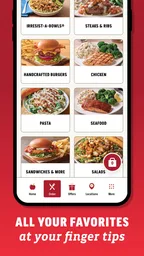
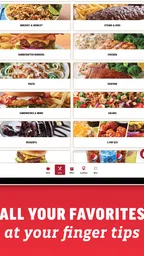
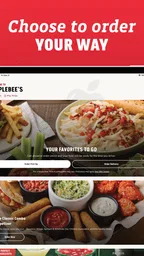
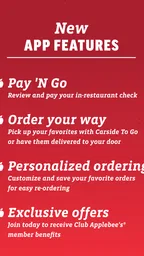
The initial appeal is straightforward: I can look through Applebee’s choices and build an order in one place. The app’s emphasis on customization matters because restaurant orders often involve small preferences that are easy to lose when placed in a hurry. I find it useful to slow down enough to review selections before submitting, especially when ordering for more than one person. A dedicated restaurant app also keeps the task centered on this menu instead of presenting competing restaurants alongside it.
That focus cuts both ways. If Applebee’s is already the plan, I would rather browse its menu directly than search around a broad food-ordering service. If I am comparing several nearby restaurants, the general service is usually a better starting point. This app is for choosing and ordering from Applebee’s, not for discovering the whole local dining scene.
A realistic use case is a busy evening when nobody wants to cook and the group has settled on Applebee’s. I can review the menu, make choices at my own pace, and check the assembled order before moving on. That small buffer is valuable: it gives me a chance to catch a missed item or an unwanted selection before the order is sent. I would still take care to confirm the details rather than assuming that a quick tap has captured everyone’s preferences correctly.
The strongest everyday benefit is control over the ordering process, not a promise of a particular speed or outcome. Ordering directly can reduce the back-and-forth of collecting everyone’s choices in a conversation, but it does not remove the need to check what is in the basket. For a shared meal, I’d gather the group’s requests first and then enter them in one deliberate pass. That is less error-prone than handing the phone around while people change their minds.
Useful for a known destination, less so for browsing
Compared with the usual alternatives, the app occupies a narrow but clear place. A delivery marketplace is handy when I want to compare restaurants or see a broader set of options. Applebee’s own app is more appropriate when the restaurant has already won that comparison and I want to order from it directly. I would choose based on the decision I am trying to make, rather than expecting one app to be best at both discovery and ordering.
The app has an average rating of 4.1 from around 41,000 ratings, with roughly 13,000 written reviews. I read that as evidence that many people find it useful, while remembering that ratings combine different devices, expectations, and ordering situations. They do not tell me whether a specific order will suit my needs. The more relevant test is whether a direct Applebee’s ordering route fits the way I actually eat.
It has more than a million installs, is free to download, and is rated for Everyone. Those details make it easy to try without treating it as a major commitment. The app was released in 2015, and version 4.5.35 is the current version. For me, the important question is not how long it has been around, but whether it stays dependable and convenient enough to keep using when the novelty of having a restaurant app wears off.
Does it keep earning a place month to month?
Repeated value depends on how often Applebee’s is part of my real routine. If I order there regularly, having the restaurant’s menu and ordering flow close at hand can save small amounts of effort each time. If I visit only occasionally, the benefit is more modest: I can install it when I have a specific order to make, then decide later whether it deserves permanent space. I would not keep it solely because it is available; I would keep it if the direct route repeatedly proves easier than my alternatives.
That distinction is useful for families and groups. A household that returns to the same restaurant may appreciate a familiar place to assemble orders, especially when different people want different things. Someone who rotates between many restaurants may get more value from a general ordering app that handles several choices in one place. Neither approach is universally better. The right one depends on whether convenience comes from concentrating on one restaurant or keeping many options together.
One practical habit can make repeat orders smoother without relying on any special feature: keep a simple note of the usual choices and any changes people request. Before submitting, compare the current basket against that note. This is particularly helpful when ordering for a group, where the person using the phone may not be the person who will eat each item. The app can organize the transaction, but a clear checklist prevents the familiar mix-up of forgetting a side or applying a preference to the wrong person.
I would also treat each order as a fresh decision rather than assuming that a previous routine still applies. Menus and personal preferences can change, and a familiar pattern can make it easy to overlook details. Reviewing the choices each time takes a little attention, but it is a sensible trade-off when accuracy matters. Direct ordering is most helpful when it supports a careful check, not when it encourages me to rush through the process.
Small upkeep, with ordinary checks still required
The maintenance burden appears low in the everyday sense: this is a focused restaurant app, not a tool that needs elaborate setup to be useful. I would keep it updated through the app store and make sure the device meets its minimum operating-system requirement of version 10. If it stops behaving as expected, I would first check that the app and device software are current, then try again before deciding that the ordering route itself is unsuitable.
There is also a useful distinction between maintaining the app and maintaining an ordering habit. The app can make the steps more organized, but it cannot decide whether ordering from Applebee’s is still the best choice for tonight. I would compare the menu and the group’s needs with other options instead of opening the app automatically out of habit. That keeps convenience from turning into a default that no longer suits the occasion.
For a meal with a tight schedule, I would plan ahead rather than assume that using an app guarantees a particular pickup or delivery timing. The value here is having a place to make the order, not a reason to skip practical checks about the meal’s timing and arrangements. When timing is critical, I would make sure the chosen ordering method suits that specific situation before relying on it.
Where the routine can become tiring
The main source of fatigue is the app’s limited scope. If I am not in the mood for Applebee’s, a dedicated app cannot solve that problem; I have to leave it and compare other places. Keeping several restaurant apps for occasional use can also clutter a phone, so I would not install this one just because it might be useful someday. A general ordering service may be a better fit for people who value broad choice more than a direct restaurant experience.
Another trade-off is attention. Customization is useful only when I take the time to verify it. On a rushed order, the extra chance to select preferences is not a substitute for reading the final choices carefully. I would avoid placing a complicated group order while distracted, and I would ask each person to state their request clearly before I start. That workflow is less spontaneous, but it reduces the chance that convenience becomes a source of frustration.
The app also cannot make the restaurant’s food a fit for every occasion. If someone in the group wants a different kind of meal, or if the group is still debating where to go, I would choose a broader alternative rather than trying to force the decision through a single-brand app. It is best when the restaurant has already been chosen and the remaining task is to place the order.
My long-term verdict
I would recommend Applebee’s to people who order from the restaurant often enough to value a dedicated ordering route. It is a sensible, free app for keeping the menu and the ordering task together, and its customization-focused approach can be helpful when a meal includes several people’s preferences. I would especially consider it for a household that already returns to Applebee’s and wants a more orderly way to place those orders.
I would skip it, or install it only when needed, if I mostly choose among many restaurants or rarely eat at Applebee’s. In those cases, a general food-ordering app is likely to earn more regular use because it supports comparison across places. My lasting-space test is simple: after a few occasions, does opening this app genuinely make an Applebee’s order easier than the alternative? If yes, keep it. If not, there is little reason to maintain a dedicated app for a restaurant that is only an occasional choice.
Overall, I see it as a focused convenience rather than an essential dining companion. Its value comes from matching a real habit: knowing you want Applebee’s and wanting a direct way to put the order together. The app is most useful when I use it deliberately, check the details, and let the occasion—not the mere presence of the app—decide where I eat.
What we like
- Browse the menu and check prices before visiting.
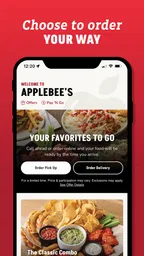
- Order pickup through the app at participating locations.
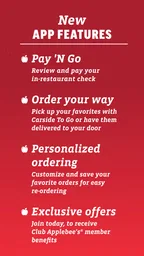
- Save favorite items for quicker repeat orders.
- Find nearby restaurants using location search.
- Access deals and rewards through the loyalty program.
What could be better
- Features may vary by restaurant location.
- Pickup availability depends on local restaurant hours.
- Some menu prices may differ from in-store prices.
- Rewards and offers can have restrictions.
- Location access may be needed for nearby restaurant results.





