




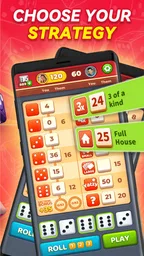



Yatzy GO! Classic Dice Game review
 Analysis by Appsdrops
I find dice games easiest to recommend when the rules are familiar but the screen doesn’t get in the way. Yatzy GO! brings that classic roll-and-score format to a phone, so you can pick it up for a brief break without learning a complicated game. My overall impression is that it suits people who want a relaxed board-game-style diversion, though its fit depends on how comfortably you can read and interact with the game on your particular device.
Reading the board and finding your way around
As a board game, Yatzy is built around a straightforward loop: roll dice, decide what to keep pursuing, and record a score. That familiarity is helpful if you already know the game, and the basic goal is approachable for someone who doesn’t. You can spend your attention on choices rather than learning a large set of controls or rules.
Still, dice and score sheets ask a screen to present several small pieces of information at once. Before settling in for a long session, I’d check whether the dice, score choices, and current round are comfortable to read on your phone. A layout that feels clear at first glance can become tiring if you have to squint or repeatedly inspect the screen to tell options apart.
My practical advice is to treat the first round as a readability check, not just a warm-up. Notice whether you can quickly distinguish the available scoring choices and follow what has already happened. If you’re constantly stopping to decipher the board, the familiar rules won’t make the experience feel effortless.
The game is made by Game In Life and sits in the board-game category, a natural fit for its dice-and-score-sheet structure. It is free to install, with optional in-app purchases priced from $0.99 to $99.99 per item. That wide range makes it sensible to look carefully at any purchase prompt rather than assuming every optional item is a small add-on.
Why the familiar format helps—and where it doesn’t
Compared with a digital board game that introduces a fictional world, a long campaign, or many special rules, this is an easier game to understand at a glance. The trade-off is that a score-focused dice game depends heavily on legible numbers and clear choices. If those elements are hard for you to see, the simple premise alone won’t solve the problem.
I also wouldn’t assume that a familiar game automatically makes the interface self-explanatory. New players may need a moment to connect a roll with the scoring decision it enables. Taking time to read each choice carefully is more useful than rushing through the first turn just because the underlying game seems familiar.
Hands, attention, and sensory comfort
Dice games are usually less demanding than action games because they don’t require continuous movement or rapid reactions. That can make this a comfortable option when you want to play at your own pace. You can think through a decision between rolls instead of responding to a constantly changing screen.
There is still a motor demand: you need to make deliberate selections on a touchscreen. If precise tapping is difficult, small or closely grouped controls can be frustrating, especially when you’re tired or using the phone one-handed. I’d try a short session with your usual grip and posture before relying on the game for longer play.
A useful way to reduce avoidable strain is to play somewhere you can steady the phone, rather than holding it at an awkward angle while tapping. If you’re sharing a table with someone, laying the device flat can also make it easier for both people to see the same turn. These are simple adjustments, but they can matter more than the game’s low-pressure pace.
For sensory comfort, the central experience is the visual presentation of dice and scores. If bright screens or busy animations bother you, it’s worth checking how the game feels in your normal environment before committing to a long session. I wouldn’t count on a particular visual or sound setting unless you can see it available in the game; instead, use your device’s own display and volume controls where they help.
The game’s broad audience is reflected in its Everyone content rating. That makes the subject matter suitable for a wide range of ages, but it doesn’t guarantee that every screen will be equally comfortable for every person. A younger player may understand the game quickly, while someone with low vision or reduced dexterity may need a larger display and a steadier way to interact.
Small decisions that make play easier
One non-obvious benefit of a turn-based dice format is that it gives you time to pause before choosing a score. Use that pause to inspect the options instead of tapping by habit. It is a practical strategy both for new players learning how the scoring works and for anyone who finds quick visual decisions tiring.
Another helpful approach is to avoid playing in poor lighting or while walking. A stationary setting makes it easier to read the score area and reduces the chance of an accidental tap. If you’re playing during a short break, sit down first and give yourself a moment to orient to the current round rather than trying to play while multitasking.
There is a trade-off between convenience and social visibility. A phone makes it easy to carry a dice game anywhere, but a small personal screen is less comfortable for a group gathered around a table than a physical score sheet or a larger shared display. For a quiet solo break, portability wins; for a lively group game, a traditional set may be more inclusive.
Where it fits into an ordinary day
I can see this working well during a lunch break or while waiting for an appointment, when you have enough time to focus on a few turns but don’t want to begin a long story-driven game. The rules don’t demand that you remember a complicated plot, so it’s easier to return to the basic decision-making after a distraction. Just keep in mind that a phone game still needs your attention when it’s your turn.
It can also be a low-pressure way to introduce someone to dice-based scoring. Rather than explaining a whole strategy game, you can take turns talking through why a particular score might be worth choosing. That conversation is useful for a beginner, although the phone’s screen may make it awkward if several people need to read it at once.
Against other board-game apps, Yatzy GO! is best understood as a focused choice rather than an all-purpose collection. If you want a classic dice challenge that gets to its central activity quickly, this style is appealing. If you’re looking for a rich narrative, deep tactical variety, or a game designed around broad group interaction, a different board game will likely serve you better.
The game has a 4.9 average from around 29,000 ratings, and it has been installed over a million times. Those figures suggest that many players have found its familiar format appealing, but they don’t tell me whether the interface will suit your eyesight, hands, or preferences. I’d judge it by a short personal trial rather than by popularity alone.
What to weigh before installing
The game is free, which makes trying it an easy decision if you’re curious about this kind of dice game. Optional purchases are available, so I’d be attentive to purchase screens, especially if a child will use the phone. You can enjoy the basic appeal of a familiar board-game format without treating optional spending as part of the decision to try it.
It was released on February 29, 2024, and the current version is 3.6.6.2. It requires Android 7.0 or later, so check your device’s system version before expecting it to run. That is a practical point for anyone planning to install it on an older phone or tablet.
One limitation I would keep in mind is that a phone interface can make a simple game feel less accessible than its rules. If the score area is too small for comfortable reading, or tapping causes repeated mistakes, patience may not fix the underlying mismatch. In that case, a physical dice set, a larger screen, or another board game with more spacious controls is the better choice.
My inclusive verdict
Yatzy GO! is a sensible pick for players who want a familiar, low-pressure dice game on a phone and are comfortable reading and tapping a touchscreen. Its strongest point is the ease of understanding the basic kind of activity it offers: take a turn, consider the scoring choice, and keep the game moving. The turn-based pace gives you room to think, which is useful for beginners and for casual play between other tasks.
I would recommend trying it in the conditions where you actually plan to play. Check the score area in your usual lighting, see whether the controls work with your normal grip, and notice whether you can follow a round without straining. Those checks will tell you more about personal accessibility than the game’s broad age rating or strong average rating can.
It is not my first choice for someone who needs large, clearly separated controls, wants a screen that can be comfortably shared by a group, or prefers a more varied board-game experience. For those players, a larger display or a physical game may be the more welcoming option. But if you want a portable dice-and-score-sheet diversion and the screen feels comfortable to you, this is an easy game to consider.
Overall, I see it as a straightforward way to bring a classic style of board play to a spare moment, with the usual touchscreen trade-offs. Give it a brief try before settling in, pay attention to readability and tapping comfort, and be deliberate about optional purchases. If those basics work for you, it can make an ordinary wait or quiet break feel a little more engaging.
What we like
- Quick rounds make it easy to play in short breaks
- Familiar rules are approachable for new players
- Dice animations add a lively touch to each turn
- Solo play is available when friends are not around
- Multiple game modes offer variety beyond standard Yatzy
What could be better
- Dice rolls rely on luck as well as strategy
- Some game modes may take time to learn
- Online matches depend on a stable connection
- Ads can interrupt the flow of play
- Progress may feel slow without frequent play







