



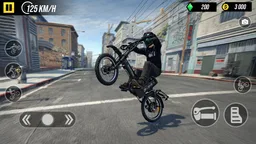

Wheelie Life: Moto Stunt review
 Analysis by Appsdrops
The first thing I enjoy about Wheelie Life: Moto Stunt is how quickly its central idea makes sense: keep a motorcycle balanced on its rear wheel while threading through city traffic. That simplicity is the hook, but it also sets a clear expectation. This is a focused stunt-riding game, not a broad racing experience built around a long list of modes or activities.
Why the first rides feel rewarding
As a free racing game from iJ Sound, Wheelie Life puts the pleasure of controlling a wheelie ahead of conventional finish-line competition. The challenge is less about memorizing a course and more about judging how long to hold a stunt, when to correct your balance, and how much risk to take near traffic. A small mistake can end a promising run, which makes a clean stretch feel earned.
The setup suits short sessions. I can pick it up when I have a few minutes, focus on one ride, and leave without needing to follow a complicated story or manage a long campaign. That makes it an easy game to try while waiting for something or taking a quick break. The appeal is immediate because the goal is visible in play: stay upright, keep moving, and make the stunt last.
The first week is likely to be the strongest novelty period. Learning the rhythm of the bike gives each attempt a clear purpose, and traffic turns otherwise simple riding into a test of timing. If you enjoy games where improvement comes from steadier control rather than unlocking a sprawling collection of content, that focused loop can be satisfying.
Learning control instead of chasing speed
My practical advice is to treat early rides as balance practice, not as attempts to produce a perfect run. Make small corrections and pay attention to how the motorcycle responds before trying to push a wheelie for longer. When traffic is close, prioritize staying composed over making an ambitious move. That approach may feel cautious, but it helps separate a control mistake from a risky decision.
There is also a useful mental distinction between a good run and a lucky one. A ride that lasts because you repeatedly recover from unstable moments may not be as repeatable as one where you keep a consistent rhythm. If you want to improve, focus on reproducing a manageable stretch of clean riding before stretching your limits. The game’s simple premise makes that kind of self-set practice natural.
It is worth knowing what sort of racing game this is before installing it. People looking for realistic circuit racing, varied vehicle handling, or a progression-heavy career may find the stunt focus narrow. By comparison, traditional racers usually make lap times, overtaking, or track knowledge the main test. Here, the appeal is the tension of holding a wheelie in a traffic-filled setting.
What gives it value beyond the first session
For me, the recurring value depends on whether the act of refining control stays enjoyable. The game does not need a large checklist to make a short ride worthwhile, but it does ask the player to create personal goals: hold a steadier line, recover from a wobble, or get through a busier stretch without losing control. Those aims can support a habit for someone who likes visible, hands-on improvement.
A realistic use case is a quick evening break after work. Rather than committing to a long race or a multiplayer match, you can play a few attempts and stop when attention runs low. That brevity is a strength if your gaming time comes in fragments. It is less persuasive if you want every session to reveal a new environment, mechanic, or objective; repeated attempts at the same core stunt may start to feel similar.
It helps to vary the purpose of a session instead of trying to top your best performance every time. One day, concentrate on keeping the bike stable; another time, see how calmly you can handle traffic. This is not a hidden mode or special feature, just a way to get more out of the focused design. It also makes it easier to notice whether the controls are becoming familiar or whether the same errors keep interrupting your runs.
The game is free, which lowers the barrier to trying that routine. Its average rating is 4.7 from around 6.3 thousand ratings, and it has passed 5 million installs. Those figures suggest that the concept has found an audience, but they do not tell me whether its narrow loop will suit a particular player. I would treat them as a reason to take a look, not as proof that it will hold everyone’s attention.
When the focused design can wear thin
The same concentration that makes the game easy to start can become its main limitation. Once the basic goal is familiar, players who need frequent changes of pace may want more variety than a wheelie-centered challenge naturally offers. If you find yourself restarting without feeling curious about the next attempt, that is a good sign the novelty has done its work for you.
Traffic adds pressure, but it can also make a run feel unforgiving when you are still learning to balance the motorcycle. I recommend resisting the urge to treat every near miss as a cue to make a larger correction. Calm, modest adjustments give you a better chance to understand what is happening. If the game feels more frustrating than engaging, shorter sessions are a sensible response rather than forcing a long practice stretch.
Another trade-off is that this is not the right pick for every kind of racing fan. If you mainly want to compete against other people, chase structured championships, or explore a wide range of racing disciplines, a more expansive racer is likely to serve you better. Wheelie Life makes more sense as a compact stunt challenge you can revisit when you specifically want that balance-and-traffic tension.
Keeping it installed without turning it into a chore
I would judge its staying power by how often I genuinely want another ride, not by how long I can keep repeating attempts. A short session should feel like a satisfying test of control. If playing starts to feel like grinding toward an external target you invented only to justify continuing, taking a break is probably better than demanding endless novelty from a deliberately focused game.
For a more sustainable routine, use a simple stopping point: play until you have made one noticeably cleaner run, or until you catch yourself repeating the same mistake without changing your approach. That keeps practice purposeful and helps prevent a quick game from becoming a frustrating loop. It is also a practical way to decide whether the challenge is still rewarding after the initial excitement fades.
On the maintenance side, there is little to manage in day-to-day play beyond keeping the game available and checking that it runs comfortably on your device. The current version is 4.1, and the minimum operating system is version 8.0. I would check compatibility before installing on an older device; if the experience feels awkward or performance interferes with careful control, it may not be a good fit for that device even if the basic idea appeals.
Who I would recommend it to
I would suggest it to someone who likes short, skill-based challenges and enjoys learning through repeated attempts. It is especially suitable if you want a casual game whose central objective is clear within seconds, and you are happy to measure progress in steadier riding rather than a long list of unlocks. Its Everyone age rating also makes it broadly accessible, though the best fit still depends on whether the player enjoys a stunt-focused challenge.
I would steer away from it if you want a deep racing career, constant changes in objectives, or a simulation centered on realistic track competition. It may also be a poor choice if repetition quickly drains your interest. Those preferences are not flaws in the game; they simply point toward alternatives that offer more structured races or broader variety.
After a few weeks, I would keep it installed only if the balancing challenge still gives me a reason to return. Its strongest long-term quality is that it asks for a specific kind of attention: controlled, patient riding through traffic. Its weakness is the matching narrowness of that idea. With a 4.7 average and a free download, Wheelie Life is easy to try, but lasting value comes down to whether you enjoy refining the same core skill after the first rush has passed.
What we like
- Responsive controls make wheelie adjustments easy to learn.
- Short runs make the game convenient for quick play sessions.
- Stunt-focused riding gives each attempt a clear goal.
- Bike handling rewards timing and careful throttle control.
- The simple presentation keeps attention on the riding challenge.
What could be better
- Balancing for long wheelies can feel demanding for new players.
- Repeated attempts may become monotonous over time.
- Small control mistakes can quickly end a run.
- Progress may feel limited for players seeking a story.
- The stunt focus offers little variety in gameplay objectives.







