


Hill Climb Racing review
 Analysis by Appsdrops
Hill Climb Racing is at its best when I stop treating it like a conventional race and start thinking of every slope as a balance puzzle. A run can look simple—accelerate, climb, try not to flip—but the fun comes from judging how much speed a hill needs and when a jump is about to turn into a crash. That small, readable challenge is why I’d recommend this free racing game for quick sessions, even though its repeated terrain and upgrade grind won’t suit everyone.
Why the simple driving has staying power
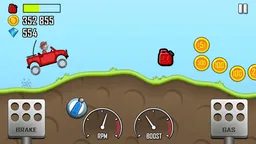
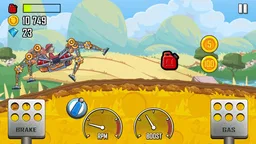
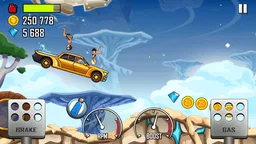
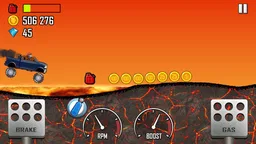
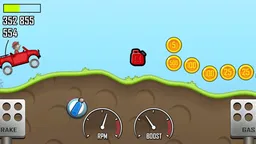
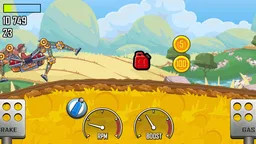
Developed by Fingersoft, Hill Climb Racing strips away the crowded tracks and precise steering that define many racing games. You focus on controlling forward motion and keeping your vehicle upright as the ground rises, dips, and breaks into jumps. The controls are easy to understand, but the vehicle’s momentum gives each input consequences: too much throttle can send you nose-first into a landing, while holding back too long can leave you short of the next climb.
That tension makes failure useful rather than mysterious. When a run ends, I can usually identify the mistake: I accelerated too hard over a crest, landed at a poor angle, or spent too much time in the air. The game encourages small adjustments on the next attempt instead of demanding a long tutorial. It is especially satisfying when a section that used to stop me becomes manageable simply because I learned to release the accelerator at the right moment.
It is also a different kind of racing from a lap-based game. There is no need to memorize a circuit or compete for the cleanest racing line. The immediate goal is to keep going over uneven ground, and that makes the game easy to pick up while waiting for a bus or taking a short break. A run can feel complete even when it ends in a crash, because the attempt itself teaches you something about the terrain and your vehicle.
The controls are deliberately spare, but that does not make every vehicle feel interchangeable. Changes in how a vehicle responds can alter how cautiously I approach hills and landings. The most helpful habit is to use brief, deliberate bursts rather than treating acceleration as an on-off switch: a short lift before a crest can keep the front end from pitching too far, and easing back after a jump can make the landing less punishing. Those are small choices, but they turn a chaotic-looking run into something I can influence.
Progress feels best when it follows a specific need
Vehicles can be upgraded, but I find the system more enjoyable when I treat upgrades as a response to a problem instead of an automatic reward to spend immediately. If a familiar climb repeatedly defeats me, improving the vehicle can make sense; if I am mostly crashing because I rush landings, more power may only make the same mistake happen faster. That distinction gives the progression a useful strategic edge: sometimes the right improvement is a better driving habit, not a stronger machine.
A practical way to play is to pick one goal for a session. I might concentrate on getting farther through a troublesome stretch, or focus on keeping the vehicle stable after jumps. This keeps each attempt purposeful and makes it easier to tell whether an upgrade or a change in technique helped. It also limits the frustration of repeatedly spending resources without understanding what the purchase is meant to fix.
The long-term loop is less compelling if you need constant novelty. The central pleasure remains the same: handling slopes, managing momentum, and trying again after a spill. For me, that repetition is relaxing in short bursts, but it can start to feel like a grind during a long sitting. Players who want a stream of new objectives, elaborate race formats, or a strong story may find that the core loop does not change enough to hold their attention.
Where it sits among racing games
Compared with a typical circuit racer, Hill Climb Racing trades precise cornering and head-to-head competition for individual control and survival over rough ground. Compared with a more simulation-minded driving game, it asks for far less setup and technical knowledge. That makes it a useful choice when I want a racing-flavored challenge without committing to a full race, but it is not a substitute for a game built around realistic handling or competitive track times.
The trade-off is that the landscape can become familiar. Once you understand the basic rhythm of accelerating up a rise and correcting for a landing, a new attempt may feel like another version of a lesson you already know. I would not choose it when I want detailed track design or a tense contest against other drivers. I would choose it when I want to test my own timing, make a little progress, and put the game down without needing to finish a lengthy event.
Who should make room for it
I think it suits casual players, younger players, and anyone who enjoys a clear retry loop. Its content rating is Everyone, so it is broadly approachable for families, while the challenge still gives experienced players something to refine. A child can understand the basic controls quickly; an adult can still find satisfaction in learning when to brake their own enthusiasm and let a vehicle settle over a rough landing.
Picture a short wait before an appointment. You open the game, attempt a climb, notice that the vehicle keeps tipping at the same crest, and try again with a lighter touch. That is the kind of everyday use where it works well: the game can be enjoyed in small pieces, and a failed run does not require a lengthy restart through a complicated event. If you are looking for a deep campaign to occupy an evening, however, this same pick-up-and-repeat design may feel thin.
There is no purchase price to start playing, but in-app purchases range from a few cents to $134.99 per item, and the game includes random-item purchases. I would keep that in mind if a child will be playing, and I would avoid buying upgrades impulsively just because a run went badly. First work out whether the obstacle is a vehicle limitation or a timing error; that simple check helps keep spending separate from frustration.
For a new player, I recommend resisting the urge to hold the accelerator constantly. Watch how the vehicle’s angle changes as it approaches the top of a hill, then use a brief release to keep the front from rising too sharply. After a jump, aim to land in control rather than chasing maximum airtime. These habits are more valuable than trying to rush through each section, and they make the game’s physics feel less arbitrary.
A proven pick, with a familiar ceiling
The game’s reach is hard to overlook: it has more than a billion installs, an average rating of 4.3 from around 11 million ratings, and about 364,000 written reviews. Those figures point to a game with broad appeal, but they do not remove its main limitation. Its core activity is intentionally compact, so players who tire quickly of repeating a similar driving challenge may not get much from that popularity.
Hill Climb Racing was released on September 22, 2012, and version 1.73.3 is listed for devices running Android 7.0 or later. The age rating is Everyone. Those details make it easier to judge whether it fits a device and household, while the free entry point means a curious player can try the basic experience without paying upfront.
My verdict is that Hill Climb Racing remains a smart recommendation for anyone who likes short, physics-driven challenges and does not mind learning through repeated attempts. Its best moments come from control rather than spectacle: a measured climb, a stable landing, and the feeling that I improved because I paid attention. Skip it if you need realistic racing, deep variety, or a campaign that keeps introducing new kinds of play. If simple controls and a satisfying retry loop are what you want, it is an easy game to sample and a surprisingly good one to revisit.
What we like
- Simple controls make it easy to start playing.
- Short stages suit quick gaming sessions.
- Many vehicles offer different driving styles.
- Vehicle upgrades add a sense of progression.
- Offline play makes it useful without internet access.
What could be better
- Physics can feel unpredictable on rough terrain.
- Upgrades may require considerable grinding.
- Fuel limits can interrupt longer runs.
- Ads may appear between gameplay sessions.
- Some vehicles and stages take time to unlock.







