







Stunt Car Extreme review
 Analysis by Appsdrops
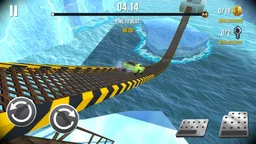
I can see Stunt Car Extreme working best as a game that gets passed around after dinner: one person tries a jump, another insists they can land it better, and a short break stretches into a friendly challenge. Its appeal is easy to understand even if you are not a racing-game regular. You guide stunt cars through demanding tracks, where the fun comes from judging a ramp, controlling the flight, and recovering when a landing goes wrong. I like that this gives a shared device a simple, low-explanation activity rather than asking everyone to learn a complicated racing simulation.
That casual appeal does not mean every household member will enjoy it equally. The game rewards patience and repeated attempts, and a dramatic crash can be funny once but frustrating when a difficult section keeps interrupting progress. I would think of it as a bite-sized arcade racer for people who enjoy improving a run, not as a calm driving game or a realistic motorsport experience.
Passing the phone around without turning it into a long session
On a shared phone or tablet, the clearest way to enjoy the game is to agree on a simple turn-taking rhythm before starting. One player takes a run, then hands over; the next person can try the same challenge or choose a different one. That keeps the focus on the driving rather than on who has been holding the device longest. Because stunt driving is immediately visible, spectators can follow what is happening without needing a tutorial before every turn.
A useful household rule is to separate “one more attempt” from “one more level.” When a jump is almost successful, it is tempting to keep retrying until the landing is perfect. That determination is part of the game’s appeal, but it can make a supposedly short session drag on. I would set a small turn limit or pass the device after a clear milestone, such as completing a run, rather than letting every near miss restart the clock.
The game’s central pleasure is not simply reaching the finish. It is learning how a particular jump behaves and adjusting your approach: a little more speed may help clear a gap, while a less aggressive approach may make the landing manageable. That creates a good spectator conversation. Instead of only saying “you missed,” a player can point out whether the car seemed too fast, too slow, or poorly lined up. For a shared session, that turns retries into a useful little experiment.
There is a trade-off, though. Players who prefer a race with obvious head-to-head competition may find the stunt format less satisfying. The strongest shared-use moments come from comparing attempts and cheering each other on, not from assuming the game will provide a formal local multiplayer match. If your group wants everyone racing simultaneously on one screen, a dedicated party or split-screen racer is a better fit.
Start with the way your group likes to play
For a mixed group, I would let the least experienced player take the first turn. That gives everyone a sense of the controls and the track’s rhythm before the more confident players start offering advice. Keep suggestions specific: “try a gentler approach” is more useful than a stream of instructions while someone is already steering. Stunt games are easier to enjoy when the person holding the device can make their own decisions.
If younger and older players are taking turns, avoid treating every result as a contest. A new player may need several attempts to understand the timing, while someone familiar with racing games may adapt quickly. Comparing personal improvement—getting farther, making a cleaner landing, or recovering from a mistake—usually makes a more welcoming shared challenge than ranking everyone by a single successful run.
Setting expectations before the first run
Stunt Car Extreme is a free racing game from Hyperkani. It was released on April 13, 2021, and its current version is 1.139. The game is rated Everyone, which makes it a plausible choice for a broad household audience, but an age label is only one part of deciding whether it suits a particular child. I would still watch a first session and consider whether the repeated crashes, challenge, and temptation to retry feel fun or stressful for that player.
It is also worth setting expectations about spending before handing over a device. The game is free to start, with optional in-app purchases priced from $0.99 to $104.57 per item. That range is broad enough that I would make a household rule clear in advance: a child should ask before any purchase, and the device’s usual purchase protections should be handled by the adult responsible for it. That is sensible shared-device practice, not a claim that the game itself provides family controls.
On a device used by several people, account and progress boundaries deserve attention too. I would not assume that a shared installation automatically gives each person a separate profile or independent progress. If keeping individual runs distinct matters, check how the game behaves on your device before the household starts treating it as a personal record book. The practical point is simple: decide whether the device is being used for communal play or whether progress belongs to one player, then avoid promising separate histories until you have confirmed the arrangement.
That boundary matters most when several people take turns in one session. A player may be happy to experiment and lose progress, while another may care about preserving a particular run or achievement. Agreeing that the device is for casual attempts prevents an argument later. If your household needs carefully separated child accounts, tightly managed access, or a game that explicitly organizes play around individual family profiles, this is not the choice I would make without checking those requirements first.
Small habits that make retries less frustrating
One practical tip is to change only one thing between attempts. If a jump fails, immediately changing speed, steering, and timing together makes it hard to tell what helped. Keep the next run comparable and adjust one decision, such as the approach or the point at which you correct the car. This turns trial and error into learning rather than random repetition, especially for players who are new to stunt racers.
Another useful habit is to hand off after a frustrating failure rather than after a successful landing. A fresh player can approach the same obstacle without carrying the previous player’s irritation, and the group can compare different instincts. It is a small change, but it helps prevent one difficult section from becoming a household argument. If someone is no longer enjoying the retries, switching to a different activity is a better call than insisting they persist.
For brief waits—such as a few minutes before leaving or while another person finishes a task—the game can work as a quick arcade diversion. I would avoid opening it when the group needs a strict stopping point unless everyone agrees to one. The desire to retry a near miss is exactly what makes the stunt format compelling, and also what makes it less predictable as a timed activity than a game with naturally short, fixed rounds.
How it fits among racing games, and who should choose something else
Compared with conventional circuit racers, this game puts more emphasis on unusual jumps and precise recovery than on following a smooth racing line around a track. Compared with driving simulators, it is a much more playful proposition: the satisfaction is in managing a stunt challenge, not in reproducing the feel of real-world driving. That distinction is useful when choosing for a household. Someone who likes spectacular leaps and learning from failed landings may find more to enjoy here than in a standard lap racer; someone seeking realistic handling or a strong sense of live competition should look elsewhere.
The game has a substantial audience, with over 100 million installs and a 4.7 average from around 167,000 ratings. Those figures help explain why it is easy to encounter, but they do not tell me whether a particular family will like its style. Its simple premise is accessible, while its retry-driven challenge can feel demanding. I would treat popularity as a reason to consider it, not as a guarantee that it will suit every player.
It is available for free, which makes it easy to try without paying upfront. The trade-off is that optional purchases are part of the experience, so a household should decide how it handles spending rather than leaving that question until a prompt appears. If your priority is a fully predictable, purchase-free activity for children, choose a game whose payment approach you already understand and feel comfortable with.
Device compatibility is another practical check before installing: the game requires Android 8.0 or later. That makes the operating-system requirement worth checking on an older shared phone or tablet before planning a group session. The current version is 1.139, but I would still make sure the device itself has enough room and runs games comfortably; a compatible operating system alone does not guarantee a pleasant experience on every older device.
Age, trust, and a realistic household verdict
The Everyone rating is reassuring as a broad age indicator, and the game’s stunt-racing premise is easy to explain to a child. Still, I would use the first session to see how the child reacts to repeated failure and whether they can stop when asked. A game can be suitable in content and still be a poor match for someone who becomes upset by retries or struggles with spending prompts. For younger players, I would keep an adult nearby at the start and make the purchase rule explicit.
Hyperkani’s game has drawn around 2,800 written reviews, alongside its larger pool of ratings, and it has clearly reached many players. What matters more to me at home is whether the group likes the same kind of challenge. If your family enjoys taking turns, discussing a better approach, and laughing at imperfect landings, this is a strong candidate for a shared casual session. If your household needs separate profiles, hands-off child spending management, simultaneous local competition, or a realistic racing experience, another game will serve those needs better.
My household verdict is positive with a few clear boundaries. I would install it for a shared device when the goal is short, lively stunt challenges that people can understand by watching, and I would agree on turn length and purchase rules first. Its best quality is how quickly a failed jump can become a reason to try a smarter one; its main friction is that this same retry loop can stretch a session and test patience. For a family or group that enjoys playful competition without demanding formal multiplayer, Stunt Car Extreme is an easy game to recommend—provided everyone knows what kind of racing, and what kind of spending, to expect.
What we like
- Multiple game modes offer variety beyond the main stunt courses.
- Car upgrades give players a reason to keep earning rewards.
- Tracks reward careful throttle control and well-timed braking.
- Optional challenges add replay value for experienced players.
- The arcade-style controls are easy to learn.
What could be better
- Some later tracks can feel punishing without upgraded cars.
- Frequent crashes may make progress feel slow for newcomers.
- In-game purchases can speed up access to upgrades.
- The camera may make judging landings difficult on some jumps.
- Repeated attempts can make certain courses feel repetitive.







