


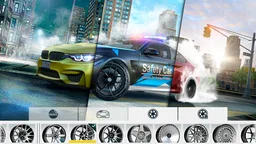

Extreme Car Driving Simulator review
 Analysis by Appsdrops
I like Extreme Car Driving Simulator most when I treat it as a place to mess around behind the wheel, not as a serious racing career. It gives the familiar pleasure of finding a car, taking it onto open roads and seeing what happens when I push the driving beyond ordinary traffic. That loose, exploratory approach is its defining strength: I can enjoy a brief session without needing to learn a deep competitive system first. It is less satisfying if I want tightly structured races, a demanding simulation, or a clear sequence of goals to work through.
Why open-ended driving is the main attraction
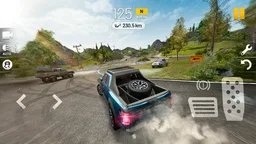
This is a free racing game from AxesInMotion Racing, and its focus is on driving rather than on a conventional race schedule. The open-world format changes the mood. Instead of treating every run as a contest against a timer or a field of rivals, I can use the environment as a space to practice, explore and try different approaches to controlling a car. That makes it easy to pick up when I have only a little time.
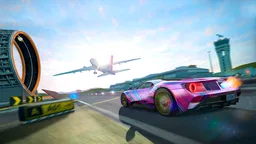
The appeal is especially clear for players who enjoy the small experiments that racing games often leave between events: testing how a car responds when I accelerate out of a turn, trying a different line, or simply driving around without a result screen being the whole point. The game’s emphasis on updated graphics is part of its presentation, but the practical reason I would return is the freedom to create my own short session.
There is a useful distinction between freedom and depth here. The open setting gives me room to choose what to do, but that does not automatically make the experience a full driving simulator in the strict sense. Players who expect painstakingly realistic vehicle behavior, detailed tuning, or a long competitive campaign should be cautious. I would describe it as an accessible driving playground with racing-game instincts, rather than a substitute for a specialist simulation.
A good fit for short, self-directed sessions
In an everyday situation, I might open it while waiting for a ride or taking a break, choose a car and spend a few minutes driving without committing to a long event. That is where its low-pressure structure works well. There is no need to reserve a full evening for a session, and the open-world idea lets me decide whether I want to explore casually or focus on handling for a while.
That flexibility also makes it approachable for someone who is curious about mobile driving games but does not want to begin with a demanding racing ladder. The game is rated for Everyone, which suits its broad, casual positioning. I would still recommend that parents check the device and store settings they normally use, but the game’s stated age rating makes it easier to consider for a family device than a title aimed at mature audiences.
What the scale and update history tell me
Its audience is substantial: the game has passed 500 million installs, with an average rating of 4.3 from around 4.8 million ratings and roughly 121,000 written reviews. Those figures suggest a widely tried mobile title, though popularity is not proof that it will suit every kind of racer. I read them as evidence that the basic pick-up-and-drive appeal reaches a broad audience, not as a guarantee of simulator-level detail.
The game originally arrived on July 15, 2014, and its current version is 7.22.1. That long-running presence matters in a practical way: this is an established mobile game rather than a brand-new experiment. Still, I would judge it by whether its present driving loop fits me, not by how long it has been available. A mature title can be easy to return to, but it can also feel less focused than games built around one sharply defined competitive mode.
How it compares with other mobile racers
Compared with the usual race-first alternatives, this game’s strongest difference is that I do not have to make every session about beating opponents. Many racing games push me toward events, progression or head-to-head competition; here, the open driving premise makes self-directed play the point. If I want a quick place to experiment with driving, that is a meaningful advantage.
The trade-off is that players seeking a clear championship structure may find the freedom less motivating. A race-focused alternative is a better choice if I want a defined route through events and a strong sense of competitive progression. A more serious simulator is better if precise vehicle behavior and technical depth matter more than easy access. I would not choose this game expecting it to satisfy both of those audiences equally.
One practical tip is to decide what a successful session means before I start. If I expect a structured challenge, open-ended driving can feel aimless; if I set a small personal goal, such as practicing a particular kind of turn or exploring a stretch of the environment, the same freedom becomes an asset. That is a small change in approach, but it makes the game’s format feel intentional rather than unfinished.
The friction: freedom does not replace structure
The main limitation, in my view, is also the source of the game’s charm. An open driving space can be relaxing, but it may not give me enough direction when I want the game to tell me what to do next. Players who rely on event lists, rivalries or a steady sequence of objectives may lose interest once the novelty of simply driving wears off.
I would also keep the purchase model in mind. The game is free to download, but it includes optional in-app purchases ranging from $0.99 to $999.99 per item. That wide range is worth noticing before handing a device to a child or making purchases casually. I recommend checking purchase controls on the device and treating paid items as optional rather than assuming that every attractive upgrade is necessary to enjoy the basic driving experience.
For a free game, the entry point is appealing, but free does not mean every part of the experience is automatically cost-free. I would install it first, spend time with the driving loop, and only consider spending if I have a specific reason. That approach avoids paying in response to a passing impulse and helps me decide whether the game’s open-world style is something I will actually revisit.
Who I would recommend it to
I would recommend Extreme Car Driving Simulator to casual players who want a mobile car game they can dip into without preparing for a long race, and to anyone who enjoys making their own fun with driving rather than following a strict event path. It is also a reasonable choice for someone who wants to see whether open-world car driving appeals to them before moving on to more specialized racing games.
I would steer away from it if my priority were realistic simulation, highly structured competition or a strong campaign that keeps setting new objectives. Those players are not wrong to want more direction; they are simply looking for a different kind of racing game. The same applies if I know I am easily tempted by in-app purchases: I would set spending limits before installing, especially on a shared or child-used device.
My verdict after weighing the trade-offs
What I value here is the uncomplicated freedom to drive on my own terms. It is approachable, easy to fit into spare moments and distinct from mobile racers that make every session a contest. Its weakness is equally clear: players who need a strong progression path or simulation depth may find the open-ended design thin. That is not a reason to dismiss it, but it is a reason to match expectations to the game.
Because it is free, I think it is worth trying if a relaxed driving sandbox sounds appealing. I would keep purchases optional, go in with a small personal goal, and judge it by whether the act of driving is enjoyable on its own. For that audience, this is a welcoming way to spend a short break; for a serious racer looking for structured events and demanding realism, I would choose a more focused alternative.
What we like
- Open-world streets make it easy to explore at your own pace.
- Several camera angles help you judge turns and drifting.
- Driving assists can make the controls easier for beginners.
- Damage effects add visual feedback after collisions.
- Free-roam play offers a break from structured racing.
What could be better
- The driving physics can feel inconsistent at high speeds.
- Traffic and city environments may become repetitive.
- Ads can interrupt play in the free version.
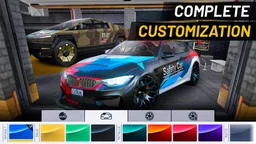
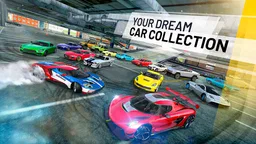
- Some cars and upgrades require in-app purchases.
- Touch controls may feel imprecise during tight maneuvers.







