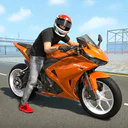
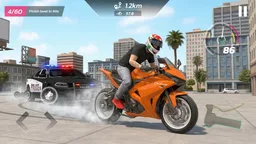
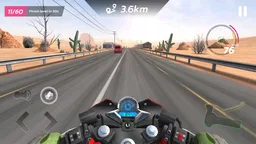
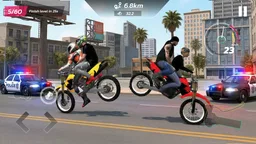
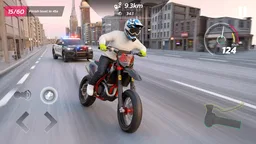
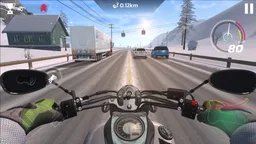
Traffic Moto Rider City review
 Analysis by Appsdrops
Traffic Moto Rider City is a straightforward pick for anyone who wants a quick burst of traffic-dodging rather than a long racing campaign. I like the basic appeal: get onto a busy road, read the gaps, and see how long you can keep moving without a collision. It is easy to understand, but that simplicity also sets expectations. This is an endless-road arcade racer, not a deep driving simulator or a story-led game.
What the current version is best at
Safari MMS developed this free racing game, whose current version is 1.2.2. It is rated for Everyone, and it has an average rating of 4.5 from around 9,200 ratings, alongside more than five million installs. Those figures suggest a sizable audience, though they do not tell me whether its particular style will suit you. The useful question is whether you enjoy quick reactions and repeated attempts more than structured races and a clear finish line.
The central challenge is familiar but satisfying when you are in the mood for it: keep your attention on the road, spot a safe opening, and react before traffic or an obstacle closes it. The city-highway setting gives that loop a clear theme. Instead of asking you to manage a garage, tune a vehicle, or learn a complicated control scheme, the game puts the emphasis on moment-to-moment decisions.
That makes it convenient for short sessions. I would reach for it while waiting for a ride or taking a brief break, when I want something active but do not have time to follow a long event. The trade-off is that endless play needs to stay engaging through the quality of each run. If you prefer a race with a defined course, opponents, and a finish, this format may feel less rewarding.
How to approach a run
My practical advice is to treat each attempt as a reading exercise, not a test of how aggressively you can weave. Look ahead for a usable route, then commit to a move only when the opening is clear. In traffic games, chasing every tempting gap can turn a manageable run into a sequence of rushed corrections. A calmer line often gives you more time to react to the next obstacle.
It also helps to separate a good decision from a lucky outcome. If a run ends after you make a sensible move and another hazard appears, that does not necessarily mean the move was wrong. On the next attempt, focus on one habit—such as scanning farther ahead—rather than changing everything at once. This makes repeated play feel more purposeful, even without a campaign structure to guide you.
For a casual player, the most useful test is whether the basic loop stays enjoyable after the novelty wears off. If you like learning to react more smoothly, the repeated runs can offer a small personal challenge. If you need new objectives, varied race formats, or a strong sense of progression to stay interested, you may find the core idea runs out of room sooner.
What the version and release timing tell us
The game was released on June 26, 2026, and version 1.2.2 is the current release. Those are useful points of reference, but they do not establish a particular update history or reveal which changes arrived in earlier versions. I would not assume that a numbered version means a specific new mode, control option, or performance improvement. The safer way to judge it is by the game available now, rather than by guessing what may have changed over time.
For someone already playing, a version number can help identify whether the installed build is current when checking the app store. It is also a reason to reassess the experience after updating: see whether the controls still feel comfortable and whether the game remains stable on your device. I would avoid treating the release date as a promise of frequent future additions; it only tells you when this release first appeared.
For a new player, the current version matters more as a snapshot than as a forecast. If the short-run traffic challenge is what you want, you can decide on that basis. If you are waiting for evidence of a larger feature set or a long-term content plan, there is no solid reason to expect either just from the version label.
How it compares with other racing games
Compared with circuit racers, this is a lighter commitment: there is no need to learn a track layout or plan a full race before you can enjoy a quick attempt. Compared with realistic driving games, the appeal is less about careful simulation and more about responding to hazards at speed. That makes it easier to dip into, but it will not satisfy someone looking for detailed vehicle handling or a convincing road-world simulation.
Endless runners offer another useful comparison. They often ask players to react to a stream of obstacles, and this game applies that kind of focus to a racing setting. The road traffic is central to the decision-making, so your attention is on available space and timing rather than on a finish-line strategy. If you enjoy that repeated, reflex-focused format, it is a reasonable alternative to a more elaborate racing game when you have only a few minutes.
There is also a clear trade-off against racers built around progression. A structured game can give you a reason to return through events, objectives, or a defined sequence of challenges. Here, the draw is the run itself. I would choose this when I want uncomplicated action, and choose a campaign racer when I want a sense of completion or a more varied set of goals.
Who should try it—and who may not enjoy it
I would recommend giving it a try if you like fast reactions, traffic-based challenges, and games that are easy to start without a long warm-up. It is especially suited to people who enjoy replaying a simple setup to improve their timing. The Everyone age rating makes its intended audience broad, though parents should still make their own decision about whether this style of racing is right for their child.
I would skip it if you mainly want multiplayer competition, realistic road behavior, a large collection of race types, or a campaign with a strong sense of progression. Those are not reasons to call the game poor; they are simply different expectations from an endless arcade racer. Likewise, if repeated attempts frustrate you more than they motivate you, a slower racing game with forgiving practice or clearer objectives may be a better fit.
One practical way to decide is to try a brief session when you are not distracted. If you enjoy judging gaps and adjusting your timing, the core loop is doing its job. If you find yourself wishing that every run had a different mission or a definite endpoint, that reaction is useful evidence that another racing style will suit you better.
Cost, compatibility, and a sensible first session
The game is free to download, with in-app purchases priced from $0.99 to $19.99 per item. I would treat those purchases as optional until you know whether you enjoy the basic driving loop; there is no good reason to spend simply because an item is available. If you are setting it up for a younger player, it is sensible to review purchase settings on the device first, especially because optional spending can be easy to overlook during casual play.
Its minimum operating-system requirement is version 7.0. Before installing, check that your device meets that requirement and has enough available space for the app and any future updates. A compatible operating system is a baseline rather than a guarantee that every older device will feel equally smooth, so the first session is a good time to see whether input and performance feel comfortable on your own phone or tablet.
For a fair first impression, play somewhere you can give the road your attention, then decide whether you want to repeat a run. A traffic racer depends on readable hazards and responsive control; trying it while hurried or distracted can make the experience seem worse than it is. If the controls feel awkward, do not assume you will adapt instantly—give yourself a few attempts, then judge whether the timing becomes natural.
What I would watch next
For existing players, the useful things to watch are practical: whether future versions improve the feel of play, keep the game working well on supported devices, or add enough variety to make repeat sessions more interesting. Those are sensible questions for any ongoing mobile game, but they are expectations, not confirmed features. I would judge any update by what is actually available after installing it.
For new players, I would watch my own reaction rather than wait for a promised expansion. Do I want another attempt because I can see how to make a better decision, or am I only replaying because the game has no stopping point? That distinction quickly reveals whether an endless racer fits your taste. The game’s large install base and strong average rating can be reassuring context, but personal fit matters more than popularity.
Overall, Traffic Moto Rider City makes sense as a free, accessible option for short sessions built around dodging traffic and staying alert. I appreciate that its premise is easy to grasp, while its limits are equally clear: players looking for deep simulation, varied events, or a substantial progression path should look elsewhere. If you want a focused arcade challenge and are comfortable with optional purchases, it is worth trying; just let the actual feel of a few runs decide whether it earns a place on your phone.
What we like
- Responsive steering makes it easy to weave through city traffic.
- First-person riding adds a convincing sense of speed.
- Short rides suit quick gaming sessions.
- Unlockable bikes give players goals to work toward.
- Traffic patterns reward careful timing and lane changes.
What could be better
- Frequent crashes can make progress feel frustrating.
- Bike upgrades may require considerable time or currency.
- The city scenery can feel repetitive during longer sessions.
- Ads may interrupt play depending on the version.
- Touch controls can feel imprecise at high speeds.







