
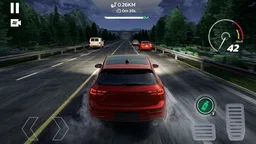
Traffic Car Racer: Driving 3D review
 Analysis by Appsdrops
There’s an immediate appeal to a racing game built around one clear challenge: mastering the highway. Traffic Car Racer: Driving 3D sets that idea against realistic 3D driving physics, putting the feel of the road at the center of its pitch. I like that focus. Rather than promising an elaborate racing world, it points toward the familiar tension of driving through traffic and asks you to make the road itself the test.
As a free racing game from Meta Play Studio, Traffic Car Racer: Driving 3D is easy to consider if you enjoy driving games with a straightforward premise. Its presentation suggests speed and concentration, while its emphasis on traffic makes the setting feel like an active part of the challenge. The appeal is less about a complicated setup and more about the mood of being behind the wheel, reading the road, and trying to stay in control.
A highway-focused first impression
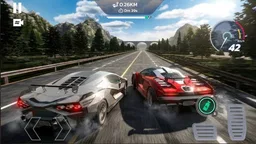
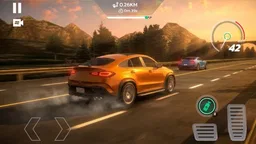
The highway is the natural star here. It gives the game a clear visual and mechanical identity: a long stretch of road, surrounding traffic, and the feeling that every driving decision matters. That’s a strong foundation for a casual racer, because the setting communicates the basic idea quickly. You don’t need a long explanation to understand why attention and timing should matter.
The game’s short store description, “Traffic Car Racer,” is plain, but it fits that direct approach. The fuller pitch adds the promise of extreme traffic and 3D driving physics, shaping expectations around an energetic road experience. I find that combination more useful than a vague claim about being the ultimate racer: it tells you to expect traffic pressure and a focus on how driving feels.
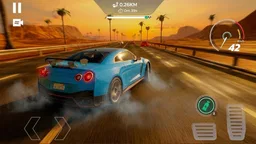
Its 3D presentation also suits the subject. A highway is most engaging when the road and nearby vehicles feel like a space you are moving through, rather than a decorative background. The realistic-physics emphasis points toward a grounded style of driving, even as the word “extreme” gives the overall mood a more heightened, arcade-like edge. That contrast can be appealing: the world aims to feel recognizable, while the challenge promises intensity.
Road scenery as visual language
In a traffic racer, the surroundings have a practical job as well as an atmospheric one. The road establishes direction, traffic gives the eye something to monitor, and the sense of forward motion helps create urgency. Traffic Car Racer’s highway premise makes those elements the core of its visual language. It’s a setting that can make a simple drive feel active without needing a sprawling map or a story-heavy frame.
The strongest part of this concept is its clarity. A highway is instantly readable, and that means the game can keep the player’s attention on driving rather than asking them to learn an unfamiliar world first. For me, that’s a good match for a mobile racing game: the setting can be understood at a glance, while the challenge comes from staying composed as the road unfolds.
The title’s “Driving 3D” wording also puts perspective and road presence front and center. It signals that the game wants to be experienced as a drive through a space, not merely as a score or a collection of menus. That’s a sensible choice for a traffic-focused racer, since a feeling of depth can make the highway setting more immediate and help sell the sensation of movement.
Speed needs a readable rhythm
Highway racing depends on a balance between urgency and clarity. If the pace feels too relaxed, traffic loses its tension; if it feels chaotic without giving the player time to respond, the experience can become tiring. Traffic Car Racer’s promise of extreme traffic gives it an energetic identity, while the realistic-physics angle suggests that control remains important. Those two ideas work best when they reinforce each other: the road should feel demanding, but the driving should still feel understandable.
That balance is also what gives the setting its mood. A highway can feel open and liberating one moment, then demanding the next as attention shifts to the traffic ahead. The game’s concept is built around that change in pressure. It invites the player to enjoy forward motion while staying alert, which is a more compelling foundation than speed alone.
Sound and the sense of motion
Sound is a natural part of the highway-racing mood, even when the central appeal is visual movement and vehicle control. In a game like this, audio can help make speed feel present and give the drive a sense of continuity. The best fit for the premise is a soundscape that supports concentration: enough energy to make the road feel alive, but not so much that it distracts from watching traffic.
That relationship between audio and attention matters because the highway is already doing a lot of work. The road provides the visual flow, traffic supplies the pressure, and driving physics promise a tactile layer beneath both. A restrained, purposeful sound direction would help those pieces feel like one experience rather than competing effects. The overall concept is well suited to a focused, forward-moving rhythm.
Pacing is similarly tied to the idea of a continuous drive. A traffic racer draws much of its appeal from the repeated cycle of scanning, reacting, and settling back into the road’s flow. That can create a satisfying rhythm when the player feels engaged without being overwhelmed. Traffic Car Racer’s premise naturally leans toward this kind of concentration, making the highway more than a backdrop: it becomes the pulse of the experience.
Where the mechanics meet the mood
“Realistic 3D driving physics” is one of the game’s clearest promises, and it gives the traffic-focused premise a useful anchor. Physics affect how a drive feels, not just how it looks. In a racing game, a sense of weight and response can make steering decisions feel meaningful, while the surrounding traffic gives those decisions a reason to matter. That is a good pairing for a game whose central image is a car moving through a busy highway.
The phrase “extreme traffic” points in a different direction, toward heightened pressure and a more dramatic challenge. Together, these ideas suggest a game trying to combine a recognizable driving feel with an intense road scenario. I like that as a design identity because neither side has to cancel out the other. A racer can feel grounded in how a car behaves while still placing the player in a heightened, fast-moving setting.
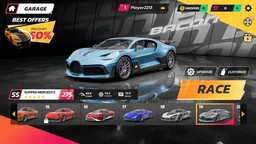
For players choosing a highway traffic racing game, the key question is whether that combination sounds enjoyable. If you want a focused driving premise, the game has an easy-to-understand hook. If you’re hoping for a broad collection of elaborate modes or a detailed narrative, that isn’t what its central pitch emphasizes. Its identity is more immediate: take to the highway, face traffic, and let the driving experience carry the mood.
The game is rated Everyone, which makes its general audience broad. That fits the simplicity of the concept: a recognizable car-and-highway setup can appeal to many kinds of players, including people who want a racing game they can grasp without a complicated introduction. The challenge still depends on concentration, but the premise itself is approachable.
A quick look at its place on mobile
Traffic Car Racer is available as a free game, with optional in-app purchases priced from $0.99 to $19.99 per item. That gives players a straightforward way to try the highway-racing concept before deciding whether they want to spend anything. I appreciate that kind of low-friction starting point for a game whose appeal can be judged quickly: the central question is whether the driving mood and traffic challenge suit your taste.
The game has a 4.5 average from around 2,400 ratings, and it has passed one million installs. Those figures suggest that the highway-racing idea has found an audience, though the more useful test for an individual player is still whether the focus on traffic and driving physics sounds right. It is published by Meta Play Studio, and the current version is 1.1.3.
It was released on July 3, 2026, and requires Android 7.0 or later. These practical details make it easier to decide whether the game fits your device and expectations. They don’t change the core appeal, which remains its direct highway setting and the promise of an intense drive shaped by traffic and 3D physics.
Who may enjoy the drive
I’d point this toward players who like racing games with a clear, familiar setting and a driving-first identity. The highway premise is easy to understand, and its emphasis on traffic gives each stretch of road a built-in source of tension. If you enjoy games where attention and timing are part of the fun, that concept has an obvious appeal.
It may also suit someone who wants a game that gets to its theme quickly. There’s no need to be invested in a fictional universe before the road makes sense. The visual idea is immediate, the central challenge is easy to describe, and the physics-focused pitch gives the driving itself a role beyond simply moving forward. That combination makes the game approachable without making its mood generic.
On the other hand, players who want racing to be about a large collection of distinct experiences may find the highway focus narrower than they prefer. That isn’t necessarily a weakness; a focused premise can be a strength when it has a coherent mood. Here, the attraction is the relationship between open-road movement, traffic pressure, and the promise of realistic handling.
The atmosphere verdict
Traffic Car Racer: Driving 3D has a cohesive central idea: make the highway feel like both a place to move freely and a space that demands constant attention. Its 3D driving physics support the grounded side of that idea, while the extreme-traffic framing adds energy. The result, as a concept, is easy to picture and easy to approach—a racing game built around the feeling of negotiating a busy road.
I’m most drawn to the way the setting and mechanics appear to support the same mood. The highway provides direction, traffic creates pressure, and driving physics are positioned as the link between the player and the road. That is a sturdy foundation for a mobile racer, especially for anyone who prefers a focused challenge over a more elaborate presentation.
Overall, this is a promising choice for players looking for a 3D traffic car racing game with an accessible premise and a clear highway identity. Its free entry makes it easy to give the experience a try, while its central appeal rests on a simple question: do you enjoy staying alert as the road and traffic demand your attention? If that sounds like your kind of drive, Traffic Car Racer: Driving 3D has a coherent, energetic mood to explore.
What we like
- Simple controls make it easy to start driving.
- Several camera angles help suit different driving preferences.
- Traffic creates a steady challenge for earning points.
- Short runs work well for quick play sessions.,3D environments give the driving a sense of depth.
What could be better
- Ads may interrupt the flow between races.
- Traffic patterns can feel repetitive over time.
- Precise steering may take practice on smaller screens.
- Visual detail may look dated on newer devices.
- Progress can feel slow without frequent upgrades.







