


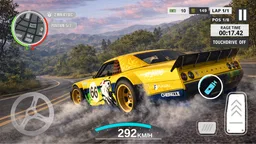
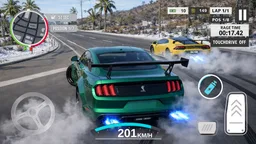
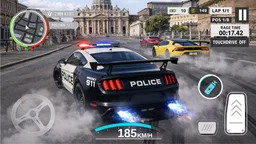
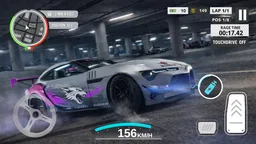

Real Drift 3D: Car Racing review
 Analysis by Appsdrops
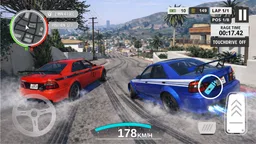
Real Drift 3D: Car Racing is a racing game for anyone who would rather learn to slide through a bend than simply chase top speed. I’d approach it as a quick, hands-on driving challenge: the appeal is getting a feel for the car, correcting a drift, and trying to make the next corner cleaner. That focus makes it easy to understand what the game wants from you, though players looking for a deep simulation or a broad racing career may want something else.
What the driving experience is built around
Developed by Bacon Ltd, this racing game puts drifting at the center of its identity. The basic goal is approachable even if you have never played a drift-focused game: take a turn, let the car move sideways, and try to stay in control. The challenge is not just entering a bend quickly. It is judging how much slide you can manage without letting the car’s line fall apart.
That gives each attempt a useful little learning loop. You try a corner, notice whether you turned in too early or carried too much speed, then make a small adjustment on the next run. I find that kind of practice more satisfying than a game that only rewards pressing the accelerator and hoping for the best. A successful drift feels earned because it depends on timing and restraint as much as speed.
The store presents the game as Real Drift 3D, and its full title, Real Drift 3D: Car Racing, makes the focus clear without promising a complicated motorsport package. Think of it as a focused option for short sessions rather than a replacement for a large racing game built around extensive vehicle setup, long events, or detailed career progression.
Its reach suggests that plenty of players have been willing to give the idea a try: it has over ten million installs, with a 4.4 average from around eleven thousand ratings. Those figures are useful context, not a promise that every player will enjoy the handling. Drift games are especially sensitive to personal taste; someone who likes gradual control and repeated practice may settle in, while a player who wants immediate, effortless speed could find the learning curve less inviting.
Who is likely to enjoy it
I would recommend it first to people who want a racing game that gives them one clear skill to work on. It can suit a short break when you have a few minutes to focus on a bend, or a longer spell when you want to repeat attempts and improve your control. The drifting premise also makes it a natural choice for players who find ordinary point-to-point racing a little too straightforward.
It is less suited to someone who expects realistic driving instruction or a detailed simulation of car setup. A mobile drift game can make the basic idea entertaining, but that is different from teaching real-world vehicle handling. I would also look elsewhere if your main priority is a long list of race formats or a story-led career. The appeal here is the act of controlling a slide, not a promise of a broad racing catalogue.
Getting started without overthinking it
For a first session, I’d keep the goal small: learn how the car responds before trying to make a corner look perfect. Start by paying attention to the relationship between steering and acceleration. If you make several large corrections at once, it becomes difficult to tell which change helped or hurt. A calmer approach—one adjustment, then a quick check of the result—makes the handling easier to read.
That advice matters because drifting can feel counterintuitive at first. A car that is already sliding may not respond the way a beginner expects from a conventional turn. Rather than treating every wobble as a failure, use it as feedback. If the car swings wider than intended, ease into the next turn more carefully. If it refuses to hold a slide, try changing your timing instead of simply forcing more input.
I would also avoid judging the game from a single messy attempt. The first useful success is not necessarily a long, dramatic drift. It is a corner where you can see what caused the car to slide and make a deliberate correction before the bend ends. That kind of small win gives you a repeatable starting point and is more reassuring than trying to copy expert-looking runs before you understand the controls.
How to make the first clean corner count
Choose one corner as your practice target and treat it like a tiny experiment. On the first pass, focus on entering at a manageable pace. On the next, change only when you begin turning. If the slide starts too late, adjust the timing; if it begins too sharply, use a gentler approach. This simple method helps separate a steering problem from a speed problem instead of turning every attempt into guesswork.
A second useful habit is to judge the whole arc, not just the moment the car breaks traction. It is tempting to focus on the dramatic start of a drift, but control through the middle and exit is what makes the move feel deliberate. If the car slides convincingly and then runs out of room, the entry was not the whole story. Learning to leave yourself room to finish the turn is a better milestone than chasing a flashy opening.
For an everyday use case, imagine opening the game while waiting for a friend or taking a short break between tasks. Rather than launching into an ambitious run, give yourself a single objective: make one bend smoother than it was before. That makes a brief session feel worthwhile even if you do not master the driving immediately. It also gives you a sensible stopping point before repetition turns into frustration.
Common first-session confusion
The most common misunderstanding with a drift-focused game is assuming that faster always means better. Speed can make a turn feel exciting, but it also leaves less time to recover from an overcorrection. I’d first aim for a controlled slide, even if it looks modest, and only then experiment with carrying more pace. A stable run teaches you more than a dramatic spin that gives no clear clue about what went wrong.
Another point to keep in mind is that a drift is not the same as losing control. A sideways car can still be following a planned line. When you first see the vehicle move away from the direction it is pointing, it may feel like a mistake; the practical question is whether you can guide it through the bend and bring it back into a useful position. Thinking in terms of direction and recovery makes the learning process less confusing.
If an attempt feels inconsistent, resist changing every input at once. Keep the corner and general approach similar, then alter one part of your timing. That may sound basic, but it is a particularly effective way to understand a game built around controlled slides. It also helps you decide whether the challenge is enjoyable for you: if experimenting with small adjustments feels rewarding, the core loop is doing its job; if it feels like busywork, a more straightforward arcade racer may be a better fit.
What to expect from the wider package
The game is free to download, while optional in-app purchases range from $0.99 to $25.99 per item. I’d treat those purchases as a choice rather than a prerequisite for deciding whether the central driving idea suits you. Start by learning the handling and see whether repeated corner practice holds your attention before spending anything. That is the most sensible way to approach a free game with optional paid items.
It is rated Everyone, so its stated age classification is broad. Its current version is 1.1.4, and the listed minimum operating-system requirement is version 8.0. Those details help with deciding whether to try it on a device, but the more important practical question is whether you enjoy a game that asks you to develop control through repetition.
Compared with a conventional mobile racer, this game has a narrower point of interest. A typical racing alternative may put more emphasis on finishing positions, varied competition, or moving through a sequence of events. Here, the distinctive pleasure is shaping a slide around a corner. That focus is a strength when you want a clear skill to practise, but a limitation if you need variety to stay engaged. I would choose a broader racer for a more rounded racing routine, and this one when I specifically wanted to work on drifting.
Taking the next step
Once you can get through a corner without feeling surprised by every movement, build consistency before chasing bigger slides. Try to repeat the same general approach and see whether you can make the car’s path feel more intentional. Then experiment with a slightly different entry or correction. The point is not to follow a rigid formula; it is to recognize which changes make your own run easier to control.
That gradual approach is also a good way to decide whether to keep playing. If you enjoy noticing a small improvement from one attempt to the next, Real Drift 3D offers a clear reason to return. If you would rather unlock variety, tune a detailed collection of cars, or race through a substantial progression, you may find the focused premise too limited. Neither response is a failure—the right choice depends on whether the act of drifting is enough to hold your interest.
Overall, I’d suggest giving it a fair first session with patience and one manageable goal. Don’t measure success by how dramatic the slide looks; measure it by whether you can understand and influence what happens through the corner. That makes the learning curve feel less intimidating and gives you a concrete way to tell whether the game suits you. For a free mobile racing game centered on drift practice, that focused challenge is its strongest reason to try it.
What we like
- Quick races make it easy to play in short sessions.
- Drifting challenges reward precise steering and timing.
- Several camera angles help tailor the driving view.
- Car upgrades offer a sense of progression.
- Touch controls are accessible for casual players.
What could be better
- Drift handling may take time to master.
- Progress can feel slow without repeated races.
- Some cars and upgrades may require substantial in-game currency.
- Touch steering can feel less precise than tilt controls.
- Visual detail may look dated on newer devices.







